Photo: Wikipedia
Demographics of Clay County
Affluence Level in Clay County
A middle-class area roughly in line with national averages across income, home values, education, and employment.
People of Clay County
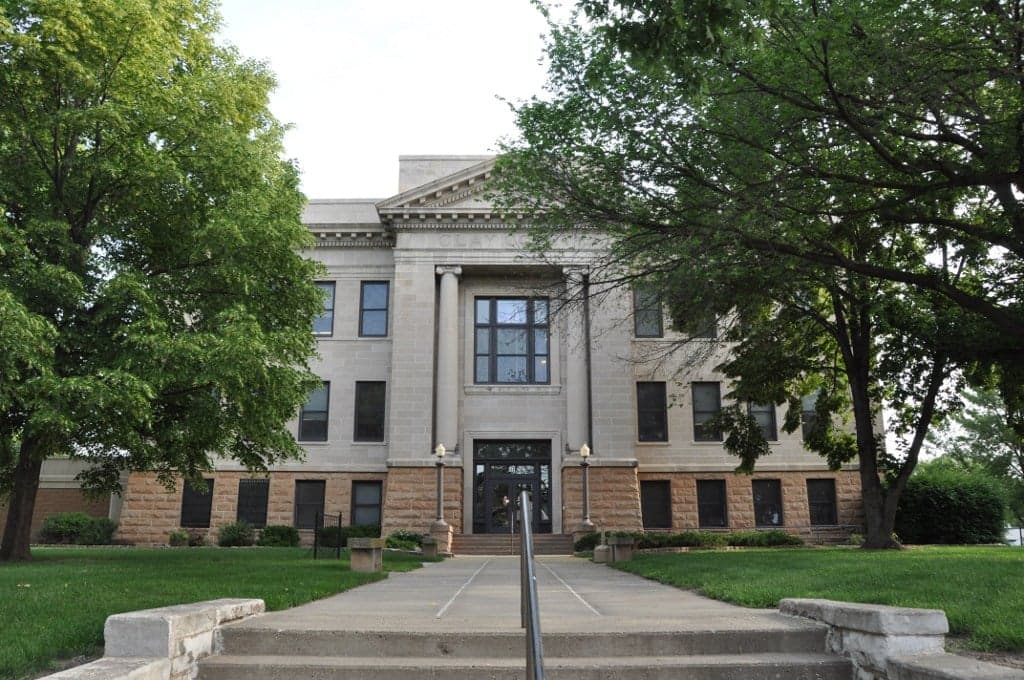
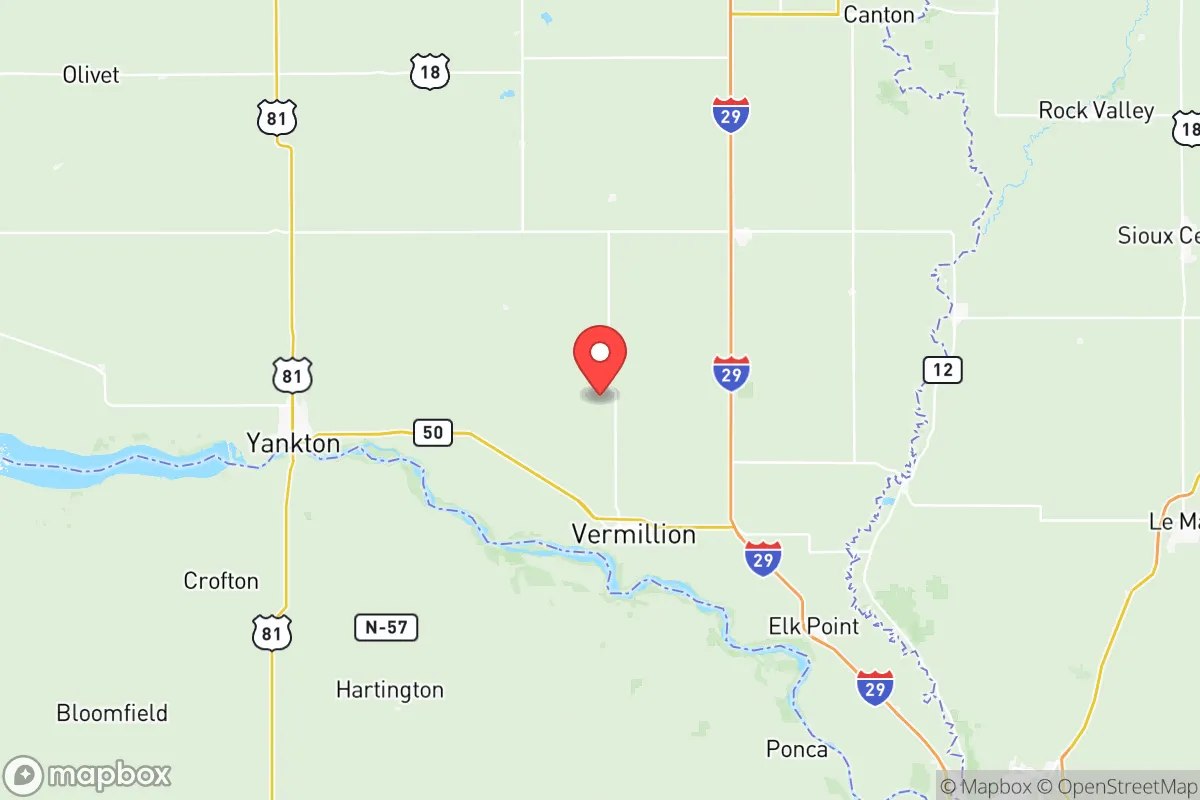
Clay County, South Dakota, is a small, predominantly white, college-educated community of roughly 15,100 residents, anchored by the city of Vermillion and the University of South Dakota. The county’s character is defined by a blend of historic agricultural roots and a modern, university-driven economy, giving it a distinctly more liberal and transient population than much of the surrounding rural region. With a foreign-born population of just 3.9% and a white share of 86.4%, Clay County remains less diverse than the national average, though its college town status brings a noticeable, if small, presence of East/Southeast Asian and Indian subcontinent residents. The population is stable but aging slowly, with growth concentrated in Vermillion and the nearby unincorporated community of Meckling.
Settlement & growth (pre-1960)
Before American settlement, the area now known as Clay County was part of the traditional territory of the Yankton Sioux (Nakota) people, who used the Missouri River bottomlands for seasonal hunting and farming. The first European-American presence came with the Lewis and Clark expedition in 1804, but permanent settlement did not begin until after the 1851 Treaty of Fort Laramie, which opened the region to Euro-American homesteaders. The county was officially organized in 1862, named after Kentucky statesman Henry Clay, and the first wave of settlers were primarily Yankees from New England and the Upper Midwest, drawn by the promise of fertile Missouri River bottomland for wheat and corn farming.
The key settlement was Vermillion, founded in 1859 as a river port and trading post. It quickly became the county seat and the commercial hub, attracting a second wave of German and Scandinavian immigrants in the 1870s and 1880s. These groups—particularly Germans from Russia and Norwegians—established farms in the townships around Vermillion, Burbank, and Westreville. The arrival of the railroad in the 1880s spurred the growth of smaller towns like Wakonda and Irene (the latter partly in Clay County), which served as grain-shipping points for the surrounding agricultural hinterland. The Homestead Act of 1862 and the subsequent Dakota Boom of the 1880s were the primary pull factors, with land offered at minimal cost to those who would farm it for five years.
The early 20th century saw little new immigration to Clay County. The Dust Bowl and Great Depression of the 1930s hit the region hard, causing a net out-migration of farm families to California and the Pacific Northwest. However, the establishment of the University of South Dakota in Vermillion in 1862 (originally the Dakota Territorial University) began to reshape the county’s economy and demographics. By the 1950s, the university had become the county’s largest employer, attracting faculty and staff from across the Midwest and a small number of international students. The post-World War II era also saw the construction of the Gavins Point Dam (completed 1957) on the Missouri River, which created Lewis and Clark Lake and brought a modest tourism and recreation economy to the county’s western edge, particularly near the unincorporated community of Spink.
Modern era (post-1965)
The 1965 Hart-Cellar Act had a limited direct impact on Clay County compared to urban areas, but it did begin a slow diversification of the university’s student body and faculty. The most notable demographic shift since the 1970s has been the growth of the university’s international student program. East/Southeast Asian students—primarily from China, South Korea, and Vietnam—began arriving in small numbers in the 1980s, and today they constitute the largest non-white group in the county, at 1.9% of the population. Indian subcontinent students (from India, Pakistan, and Bangladesh) followed in the 1990s and 2000s, now making up 1.1% of the population. These groups are almost entirely concentrated in Vermillion, living in off-campus housing near the university or in faculty neighborhoods.
Domestic migration has been more significant than international immigration in shaping modern Clay County. The county has experienced a steady, if slow, outflow of young adults after graduation, balanced by an inflow of retirees and second-home buyers drawn to the Lewis and Clark Lake area. The Hispanic population, at 3.2%, is a relatively recent addition, growing from near-zero in 1990. This growth is driven by Mexican and Central American laborers working in agriculture (particularly in the hog and corn operations around Meckling and Burbank) and in construction and service jobs in Vermillion. The Black population, at 2.0%, is largely composed of university-affiliated individuals and a small number of military-connected families (the nearest major base is Ellsworth Air Force Base, about 90 miles away).
Suburbanization has been minimal. Vermillion has expanded its city limits modestly, with new subdivisions like the Bluffs and Highland Park attracting families and university staff. The unincorporated areas of Clay County remain overwhelmingly agricultural, with the population density outside Vermillion dropping to fewer than 10 people per square mile. The county’s racial and ethnic composition has shifted from 96% white in 1990 to 86.4% white today, a change driven almost entirely by the university’s international recruitment and the small Hispanic labor influx.
The future
Clay County’s population is projected to remain stable or grow very slowly over the next 10-20 years, with Vermillion absorbing most new residents. The university will continue to be the primary driver of demographic change, likely increasing the share of East/Southeast Asian and Indian subcontinent residents as international student enrollment grows. The Hispanic population is expected to grow modestly, reaching perhaps 5-6% by 2040, as agricultural labor demand persists and service-sector jobs expand. However, the county is unlikely to become highly diverse: the white share will probably remain above 80%, and the foreign-born share will stay well below 10%.
One emerging trend is the return of some former residents—often retirees—who left for larger cities and are now drawn back by lower costs and the lake recreation economy. This could slightly increase the median age, which is already above the state average outside of Vermillion. The county’s cultural identity will likely remain a blend of conservative agricultural values and the more liberal, cosmopolitan influence of the university, a tension that has defined Clay County for decades. New communities are not forming; instead, growth is dispersing within Vermillion’s existing footprint and along the lakefront near Spink.
For someone moving in now, Clay County offers a stable, safe, and affordable environment with a strong educational anchor. The population is not changing rapidly, but it is slowly becoming more diverse and more oriented toward the university and recreation economy. The agricultural roots remain visible in the townships, but the future belongs to Vermillion and the lake. A newcomer should expect a community that values its history while adapting, cautiously, to a slightly more varied future.

* Values derived from national, state, county, city and local statistics and may differ in a specific area. Last updated: 2026-07-30T03:34:58.000Z
Narrative content on this page is AI-generated and may contain mistakes. Verify any details that matter before acting on them.
ReloMaps may earn a commission from affiliate links at no extra cost to you.

