 Popular
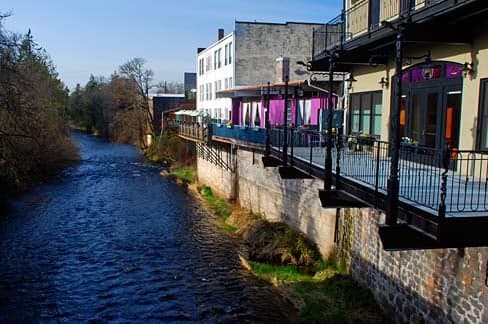
Photo: Wikipedia
Demographics of Silverton, OR
Affluence Level in Silverton, OR
A middle-class area roughly in line with national averages across income, home values, education, and employment.
People of Silverton, OR
Silverton, Oregon, is a predominantly white, family-oriented community of 10,445 residents, where a strong sense of local history and civic pride is paired with a modest but growing Hispanic presence. The city’s population is notably less diverse than the Portland metro area, with a foreign-born share of just 3.1% and a college attainment rate of 30.9%, reflecting its roots as an agricultural and small-manufacturing town. Distinctive identity markers include a well-preserved historic downtown, a strong connection to the nearby Oregon Garden, and a reputation as a quieter, more affordable alternative to the Willamette Valley’s larger cities. The population is stable but slowly aging, with new residents drawn primarily from within Oregon and the Pacific Northwest.
How the city was settled and grew
Silverton’s original inhabitants were the Kalapuya people, who used the area for seasonal hunting and gathering before European-American settlement began in the 1840s. The first permanent white settlers, mostly of English and German stock, arrived via the Oregon Trail and claimed land along Silver Creek. The city was platted in 1854, and its early economy revolved around flour mills, lumber, and fruit orchards. The arrival of the Oregon & California Railroad in the 1880s spurred a second wave of settlement, bringing Irish and Scandinavian immigrants who worked in the mills and on the railroad. These groups built homes in the West Side Historic District, a neighborhood of Victorian-era houses that remains the city’s most architecturally significant area. By 1900, Silverton’s population was nearly entirely white, with a small number of Chinese laborers who had helped build the railroad but were largely gone by the 1920s. The East Hill neighborhood, developed in the early 1900s, became home to middle-class families employed by the city’s growing canneries and the Silverton Lumber Company.
Modern era (post-1965)
After the 1965 Immigration and Nationality Act, Silverton saw little direct impact from new international immigration, as its economy did not offer the industrial or service-sector jobs that drew newcomers to larger cities. Instead, the city’s modern growth has been driven by domestic in-migration from other parts of Oregon and the West Coast, particularly families seeking lower housing costs and a slower pace of life. The Hispanic population, now 14.5% of the total, began to grow in the 1990s, largely through secondary migration from California and from agricultural areas in the Willamette Valley. These families settled primarily in the South Silverton area, near the industrial parks and along Highway 214, where rental housing and mobile home parks are concentrated. The Black population (2.7%) and East/Southeast Asian population (0.1%) remain very small, with most Black residents living in the Silver Creek Estates subdivision, a newer development built in the 2000s. The Indian-subcontinent population is effectively zero. The city’s overall racial composition has shifted only modestly since 2000, with the white share declining from 85% to 76.2%, almost entirely due to Hispanic growth.
The future
Silverton’s population is projected to grow slowly, reaching roughly 12,000 by 2040, driven by continued domestic migration from the Portland metro area and from California. The Hispanic share is expected to rise to around 18-20% as younger Hispanic families have children and as some new arrivals move in for work in construction, landscaping, and food processing. The white population will continue to decline as a percentage, but will remain the overwhelming majority. The North Silverton area, near the Oregon Garden and the new Silverton Health campus, is the primary zone for new single-family home construction, attracting mostly white families from within Oregon. The Downtown Core is seeing a slow revival of small businesses and some higher-density housing, but it remains overwhelmingly white and older. The city’s cultural identity is likely to remain conservative-leaning and family-oriented, with a growing bilingual presence in the schools and in local services. No major shifts in racial or ethnic composition are expected, as Silverton lacks the large employers or housing stock to attract significant international immigration.
For someone moving in now, Silverton offers a stable, predominantly white community with a strong local identity and a modest but growing Hispanic influence. The city is not becoming a diverse hub, but it is slowly becoming more multicultural in a measured, organic way. New residents should expect a place where change is gradual, where the past is visible in the historic neighborhoods, and where the future looks much like the present — only a little more varied.

* Values derived from national, state, county, city and local statistics and may differ in a specific area. Last updated: 2026-07-30T14:11:48.000Z
Narrative content on this page is AI-generated and may contain mistakes. Verify any details that matter before acting on them.
ReloMaps may earn a commission from affiliate links at no extra cost to you.

