
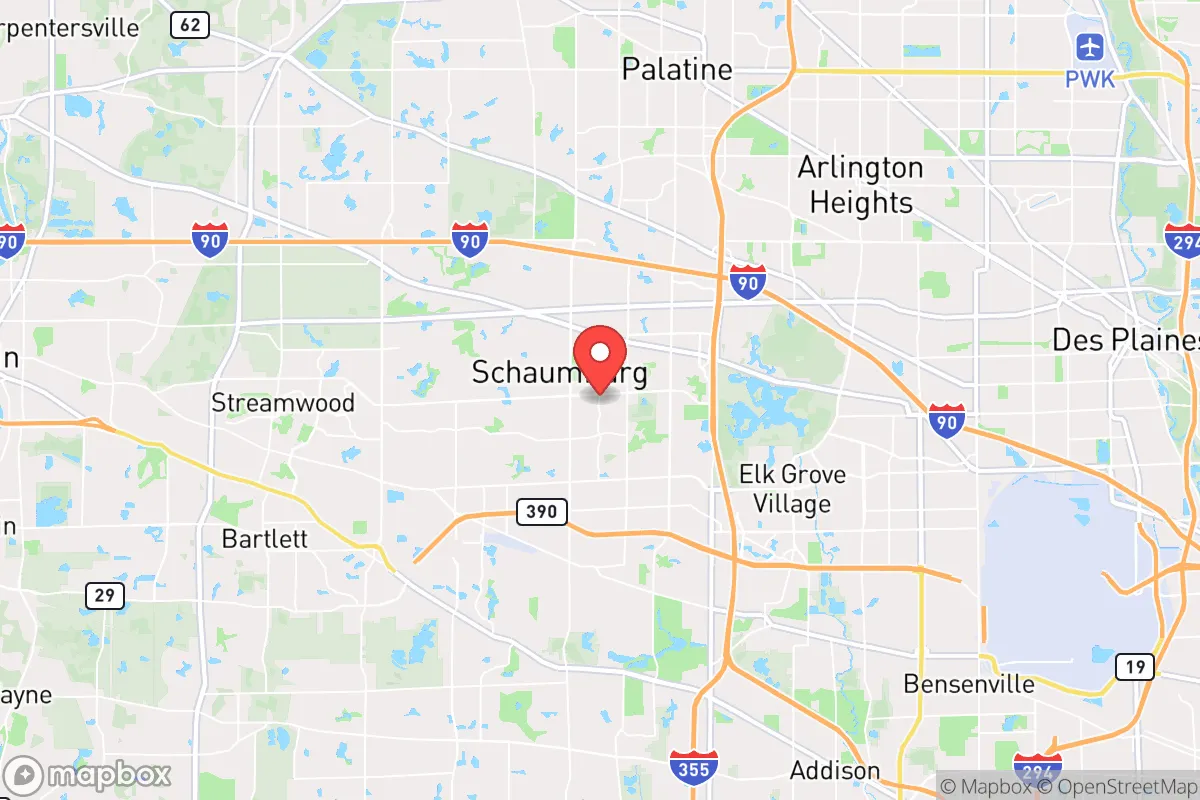
Photo: Wikipedia
Personal Sovereignty in Schaumburg, IL
Viable for self-reliance. Generally workable, though some barriers may limit total independence.
What does Personal Sovereignty tell us?
Personal Sovereignty measures your capacity for self-reliance and independence with minimal government friction. Higher scores mean fewer barriers between you and the way you want to live... but it assumes you have the space you need and good neighbors.
What does this tell us?
Personal Sovereignty measures your capacity for self-reliance and independence with minimal government friction. Higher scores mean fewer barriers between you and the way you want to live... but it assumes you have the space you need and good neighbors.
State Policy
Energy independence: Importer (45% of energy produced in-state)
Personal Liberty
Homesteading

Personal Liberty Analysis
Schaumburg, Illinois, presents a complex and often contradictory environment for personal sovereignty, one that demands careful navigation rather than blind acceptance. While the village offers robust economic opportunity and a high standard of living, it sits squarely within a state whose political machinery has increasingly prioritized collective mandates over individual autonomy. For the survivalist or prepper, Schaumburg is not a sanctuary but a calculated position—a place where you can build resources and community, but only if you are willing to fight for your freedoms at the local level and accept that the state government will be a persistent adversary in your quest for self-reliance.
Tax burden and regulatory posture in a high-cost state
The single greatest threat to personal sovereignty in Schaumburg is the state of Illinois’s aggressive fiscal and regulatory posture. The state’s flat income tax rate of 4.95% is only the beginning. Property taxes in Cook County, where Schaumburg is located, are among the highest in the nation, with effective rates often exceeding 2% of a home’s assessed value annually. For a family owning a $350,000 home, that means roughly $7,000 to $8,000 per year in property taxes alone—money that could otherwise fund your own preps, land, or training. The state also imposes a 6.25% sales tax on most goods, with Schaumburg adding its own local levies, pushing the combined rate to over 10% in many areas. This heavy tax burden directly reduces your disposable income and your ability to stockpile supplies, invest in off-grid infrastructure, or purchase land for a retreat. Furthermore, Illinois’s regulatory environment is dense and intrusive. From strict building codes that can complicate even minor home modifications to environmental regulations that limit rainwater collection and livestock ownership, the state’s bureaucracy constantly reminds you that your property is not truly your own. For the prepper, every permit, every fee, and every inspection is a potential chokepoint for your autonomy.
Self-defense and gun law specifics in Illinois
On the critical issue of self-defense, Illinois presents a deeply frustrating landscape. While the Second Amendment is constitutionally protected, the state has erected significant barriers to its exercise. Illinois is a “may-issue” state for concealed carry, meaning local law enforcement has discretion in granting permits, though in practice, Schaumburg residents with clean records can typically obtain a license after completing a 16-hour training course and paying substantial fees. However, the state’s assault weapons ban, passed in 2023, prohibits the sale and possession of many common semi-automatic rifles and high-capacity magazines. This directly impacts a prepper’s ability to maintain a versatile and effective defensive arsenal. Magazine capacity is limited to 10 rounds for long guns and 15 for handguns. Furthermore, Illinois has no “stand your ground” law; instead, it imposes a “duty to retreat” in public spaces before using deadly force, unless you are in your own home. This legal framework means that even a justified defensive action can lead to expensive legal battles and potential criminal charges. For the individualist who believes in the absolute right to self-defense, these laws are a constant source of friction and a clear sign of government overreach into personal safety.
Self-reliance and homesteading viability in a suburban grid
True self-reliance—the ability to produce your own food, water, and energy—is extremely difficult to achieve within Schaumburg’s suburban confines. The village is almost entirely built out, with typical lot sizes ranging from one-quarter to one-third of an acre. Zoning ordinances are restrictive: keeping chickens is often permitted with a permit, but raising goats, pigs, or other livestock for meat or milk is generally prohibited. Large-scale vegetable gardens are allowed, but you will be limited by space and homeowners’ association covenants in many subdivisions. Rainwater harvesting for potable use is heavily regulated by the state, and installing solar panels requires permits and grid interconnection agreements that can take months. Off-grid living—severing ties to municipal water, sewer, and electricity—is effectively illegal within the village limits. For the serious prepper, Schaumburg is a place to build financial resources and a network of like-minded individuals, but the actual homesteading must happen elsewhere. The best strategy is to view your Schaumburg home as a base of operations and a source of income, while acquiring raw land in a more rural, less regulated county—perhaps in southern Illinois or neighboring Indiana—for a true retreat. The suburban grid is comfortable, but it is a cage, and you must have a key to leave it.
Personal liberties: parental rights, medical autonomy, and free speech
Personal liberties in Schaumburg are under constant pressure from both state and local government. Parental rights, while theoretically protected, have been eroded by state mandates on school curriculum and vaccination requirements. Illinois mandates a broad set of vaccines for school attendance, with limited opt-out provisions that are difficult to navigate. Medical autonomy is similarly constrained; the state has aggressively enforced public health mandates in recent years, and individual choice in medical decisions is often secondary to state-declared emergencies. Free speech is protected by the First Amendment, but local ordinances on noise, signage, and public assembly can be used to suppress dissent. Property rights are the most compromised of all, given the high taxes and extensive zoning codes that dictate what you can do with your own land. For the conservative individualist, these conditions create a feeling of being perpetually managed—your children’s education, your medical choices, and your property use are all subject to approval from a distant bureaucracy. The fight for personal sovereignty here is a daily, grinding battle against a system that assumes it knows better than you do.
In the final analysis, Schaumburg offers a low score for personal sovereignty when compared to states like Texas, Florida, or Tennessee. The tax burden is crushing, gun laws are restrictive, homesteading is nearly impossible, and personal liberties are constantly challenged by state overreach. However, for those who are strategic, it is not a lost cause. The village’s strong economy, excellent schools, and diverse population provide a cover and a resource base. The key is to treat Schaumburg as a temporary or secondary location—a place to earn and save—while actively building your true autonomy elsewhere. If you are unwilling to engage in that two-front strategy, you will find yourself trapped in a comfortable but controlled environment, where your freedoms are always at the mercy of the next Springfield legislative session. For the serious prepper, Schaumburg is a chess piece, not a home base. Play it wisely, or don’t play at all.

* Values derived from national, state, county, city and local statistics and may differ in a specific area. Last updated: 2026-04-19T10:27:51.000Z
Narrative content on this page is AI-generated and may contain mistakes. Verify any details that matter before acting on them.
ReloMaps may earn a commission from affiliate links at no extra cost to you.

