
Photo: Wikipedia
Demographics of Schaumburg, IL
Affluence Level in Schaumburg, IL
A middle-class area roughly in line with national averages across income, home values, education, and employment.
People of Schaumburg, IL
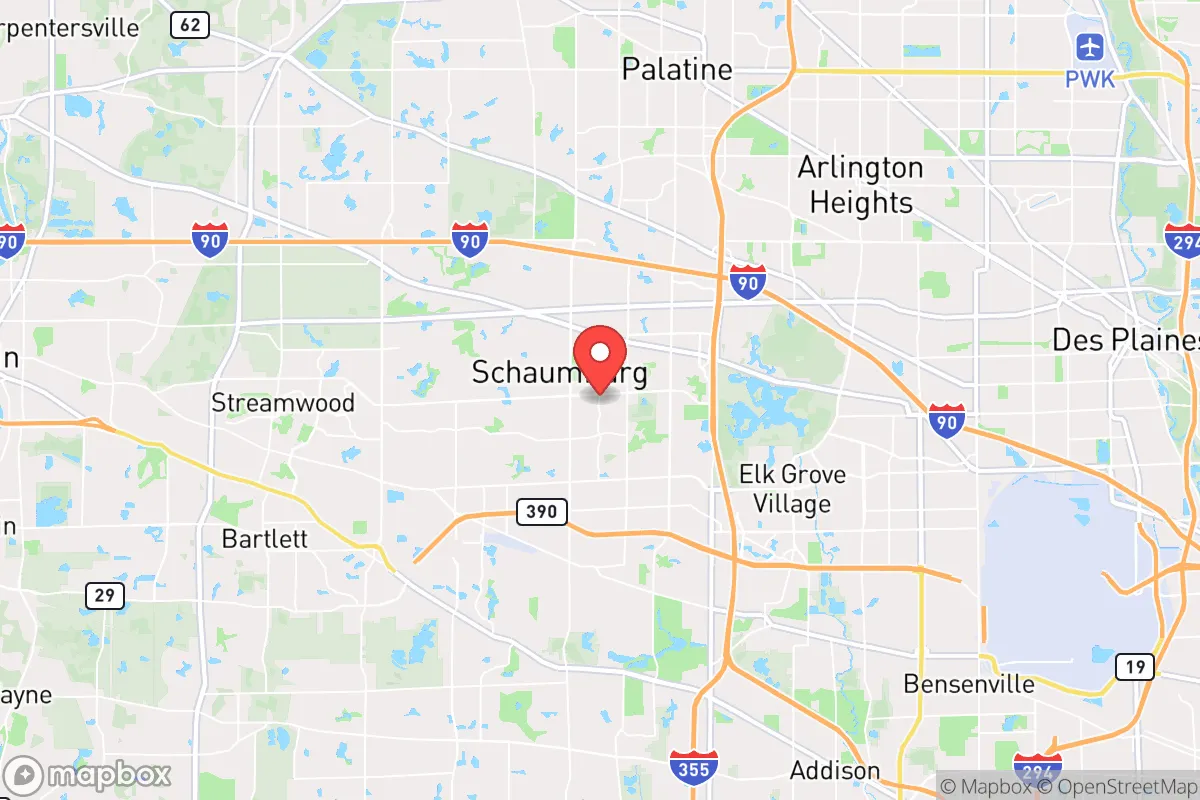
The people of Schaumburg, Illinois, today number 76,780, forming a dense, majority-minority suburb with a distinctive blend of established white-collar families and rapidly growing immigrant communities. The city is characterized by a high college attainment rate of 50.6% and a foreign-born population of 15.3%, creating a demographic profile that is both affluent and ethnically diverse. Its identity is shaped by a large Indian-subcontinent population (14.3%) and a significant East/Southeast Asian community (9.5%), alongside a white population of 56.0%, a Hispanic population of 11.2%, and a Black population of 5.4%.
How the city was settled and grew
Schaumburg was not a 19th-century farming village but a genuine post-World War II planned suburb. The land was originally part of Schaumburg Township, settled sparsely by German and Luxembourger farmers in the 1840s and 1850s, who built small homesteads and churches in what is now the Olde Schaumburg Centre district. This historic core, centered on Schaumburg Road and Roselle Road, retains a few 19th-century structures but never grew beyond a hamlet. The city’s explosive growth began in the 1950s and 1960s, driven by the construction of the Northwest Tollway (I-90) and the development of Motorola’s corporate campus. The original population was overwhelmingly white, drawn from Chicago and other Midwest cities by affordable new housing in subdivisions like Weathersfield and Kimball Hill. These neighborhoods, built with ranch and split-level homes, became the bedrock of Schaumburg’s postwar identity as a middle-class, family-oriented suburb.
Modern era (post-1965)
The 1965 Hart-Cellar Act opened the door for a new wave of immigration that reshaped Schaumburg’s population. The most dramatic shift began in the 1980s and accelerated through the 2000s, as Indian-subcontinent professionals—engineers, doctors, and IT specialists—were recruited by Motorola, Zurich Insurance, and other corporate headquarters in the northwest suburbs. This group concentrated in newer, higher-density developments and townhome communities, particularly around the Woodfield Village area near the Woodfield Mall and along the I-90 corridor. Today, Indian-subcontinent residents make up 14.3% of the population, the largest non-white group. East and Southeast Asian communities (9.5%), including Chinese, Korean, and Vietnamese families, also arrived during this period, settling in neighborhoods like Walden Glen and Briarwood Estates, drawn by the same corporate job base and the highly ranked Township High School District 211. The Hispanic population (11.2%) grew steadily from the 1990s onward, with many families moving into older, more affordable housing stock in the Golfview and Rosedale areas. The white population, which was over 90% in 1980, has declined to 56.0% as of the latest data, reflecting both out-migration to farther exurbs and the natural aging of the original postwar cohort.
The future
Schaumburg’s population is heading toward a stable, multi-ethnic majority-minority status. The Indian-subcontinent community is the fastest-growing segment, driven by continued professional immigration and strong chain migration, and is likely to become the largest single ethnic group within the next decade. East/Southeast Asian and Hispanic populations are growing more slowly but are solidifying their presence, with second-generation families remaining in the area. The white population is projected to continue its gradual decline, though it will remain a significant plurality. The city is not tribalizing into isolated enclaves; rather, neighborhoods like Woodfield Village and Walden Glen are becoming genuinely mixed, with Indian, Asian, and white families living side by side. The main demographic tension is between the aging, white, postwar homeowners in Weathersfield and Kimball Hill and the younger, more diverse families moving into newer or resale homes. Schaumburg is homogenizing in terms of income and education—college attainment is high across all groups—but diversifying in ancestry.
For someone moving in now, Schaumburg is a mature, stable suburb where the population is becoming more diverse and more educated, but where the political and cultural center remains firmly middle-class and family-oriented. The city offers a rare combination of high-density immigrant communities and low-density suburban housing, making it a practical choice for professionals who want both ethnic grocery stores and good public schools. The next 10-20 years will likely see the Indian-subcontinent population become the largest single group, with the city’s identity shifting from a white, postwar suburb to a multi-ethnic, globally connected hub.

* Values derived from national, state, county, city and local statistics and may differ in a specific area. Last updated: 2026-04-19T10:27:51.000Z
Narrative content on this page is AI-generated and may contain mistakes. Verify any details that matter before acting on them.
ReloMaps may earn a commission from affiliate links at no extra cost to you.

