Photo: Wikipedia
Demographics of Ridgeland, MS
Affluence Level in Ridgeland, MS
A middle-class area roughly in line with national averages across income, home values, education, and employment.
People of Ridgeland, MS
The people of Ridgeland, Mississippi, today form a nearly evenly split Black and White population of 24,548, a demographic balance that distinguishes it from many surrounding Jackson-area suburbs. With a foreign-born share of just 4.0%, the city remains predominantly native-born, while a college-educated rate of 50.4% signals a professional-class tilt. Ridgeland’s identity is shaped by its role as a retail and office hub along the I-55 corridor, attracting both longtime Mississippi families and newer arrivals seeking suburban stability within commuting distance of Jackson.
How the city was settled and grew
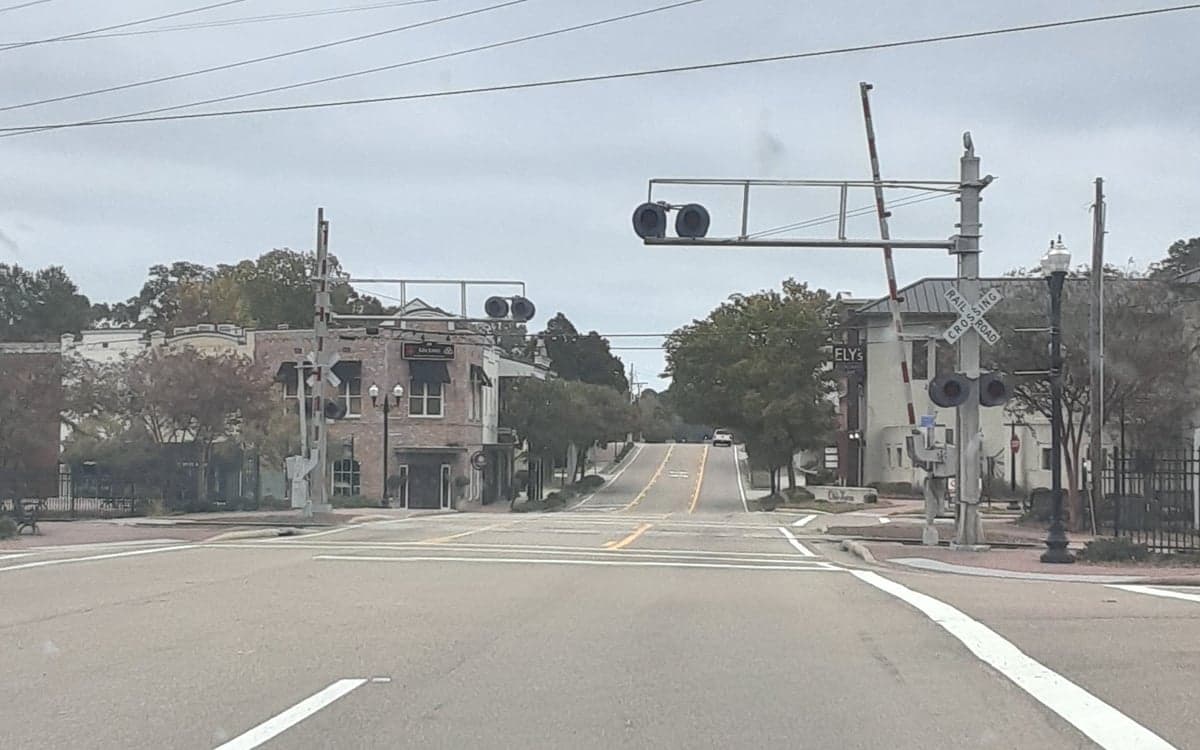
Ridgeland was not a colonial-era settlement but a planned 20th-century suburb. The city was incorporated in 1899 as a railroad stop along the Illinois Central line, but its real growth began after World War II. The original population was overwhelmingly White, drawn by inexpensive land and the construction of the Natchez Trace Parkway in the 1930s, which opened the area to development. The Olde Towne district, centered around the original depot, housed the early railroad workers and small-business owners. Through the 1950s and 1960s, Ridgeland expanded as a bedroom community for Jackson professionals, with subdivisions like Hickory Ridge and Meadowbrook filling with White families moving out of the capital city during the early waves of suburbanization. No significant immigrant or Black population settled during this period; the city was nearly all White until the 1970s.
Modern era (post-1965)
The post-1965 era brought two major demographic shifts. First, the 1970s and 1980s saw the beginning of Black middle-class migration from Jackson into Ridgeland, driven by school desegregation and the search for newer housing stock. This wave concentrated in neighborhoods like Northpark and Lake Harbour, where larger homes on wooded lots became available. By 2000, Ridgeland’s Black population had risen to roughly 30%. Second, the 1990s and 2000s brought a small but notable influx of East/Southeast Asian and Indian families, many drawn by professional opportunities at the University of Mississippi Medical Center in Jackson and at regional corporate offices along the I-55 frontage. These groups settled primarily in the Ridgeland Estates and Reunion subdivisions, where good schools and newer construction were priorities. The Hispanic population, now 7.3%, grew steadily after 2000, largely through construction and service-industry jobs, with a concentration in apartment complexes near the County Line Road commercial corridor. Today, the city is 43.4% White, 43.7% Black, 7.3% Hispanic, 1.7% East/Southeast Asian, and 1.3% Indian—a near-equal Black-White split with small but established minority communities.
The future
Ridgeland’s population is likely to remain stable in size but continue diversifying slowly. The Black and White shares have converged over the past two decades and are expected to stay roughly equal, as both groups are drawn by the same factors: good schools, low crime relative to Jackson, and a strong retail tax base. The Hispanic share may edge upward as service-sector employment grows, but the foreign-born rate (4.0%) suggests immigration will remain a minor factor. The East/Southeast Asian and Indian communities, while small, are well-established in professional roles and are likely to grow modestly through internal migration rather than international arrivals. No single group is creating a distinct ethnic enclave; instead, neighborhoods like Olde Towne are seeing gradual gentrification by younger professionals of all backgrounds, while Northpark remains predominantly Black and Hickory Ridge predominantly White. The city is not tribalizing into sharp enclaves but is experiencing a slow, organic mixing, particularly among college-educated residents.
For someone moving to Ridgeland now, the city offers a stable, middle-to-upper-middle-class suburb where racial balance is the norm rather than a transition. The population is not growing rapidly—it has hovered around 24,000 for a decade—but it is not shrinking either. The key takeaway is that Ridgeland is a mature suburb where the demographic story is one of gradual integration, not rapid change, making it a predictable choice for families and professionals seeking a settled community within the Jackson metro area.

* Values derived from national, state, county, city and local statistics and may differ in a specific area. Last updated: 2026-05-01T12:35:32.000Z
Narrative content on this page is AI-generated and may contain mistakes. Verify any details that matter before acting on them.
ReloMaps may earn a commission from affiliate links at no extra cost to you.

