Photo: Wikipedia
Political ClimatePolitical Climate in Ramsey, NJ
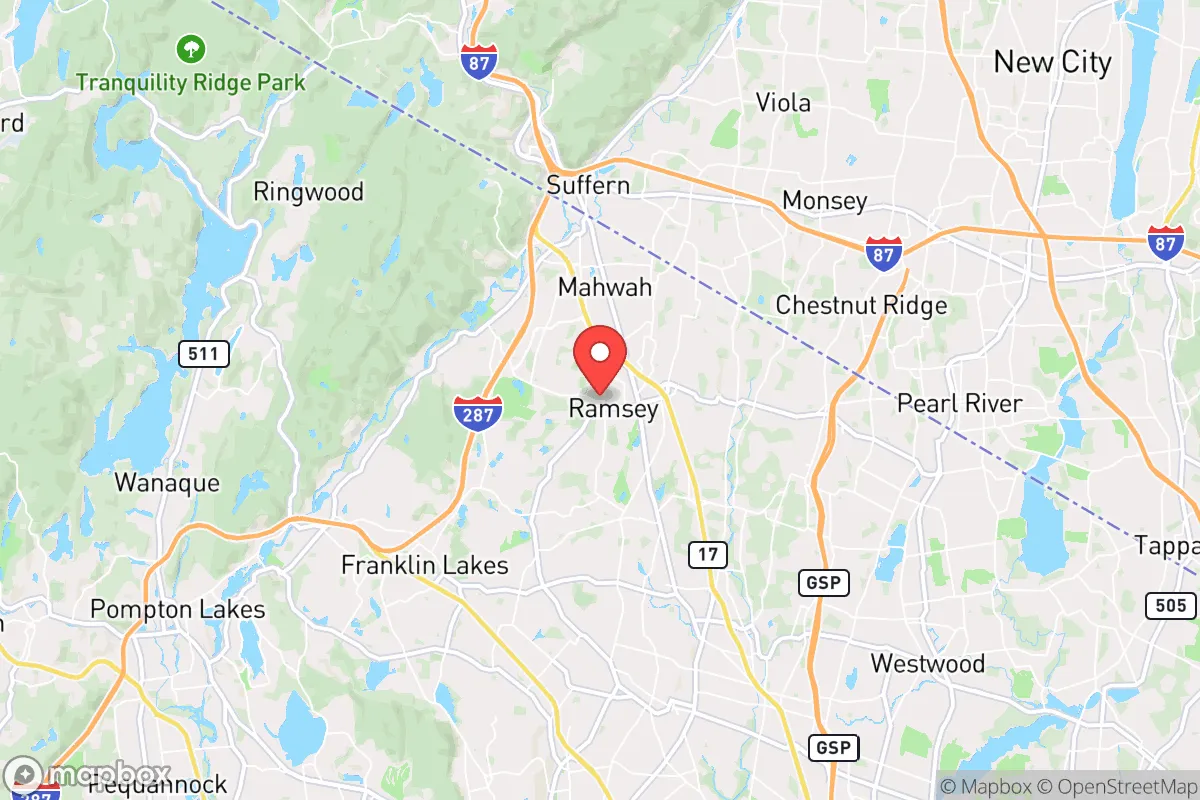
District shown is the primary district for this city’s centroid. Cities may span multiple districts.
Political rankings in New Jersey
- Most Conservative Cities in New Jersey
- Most Liberal Cities in New Jersey
- Best Conservative-Leaning Towns in the Northeast
- Best Conservative-Leaning Towns in the Mid-Atlantic
- Safest Liberal-Leaning Towns on the East Coast
- Safest Conservative-Leaning Towns on the East Coast
- Most Affordable Liberal-Leaning Small Towns in the U.S.
- Safest Liberal-Leaning Cities in the U.S.
- Most Conservative Counties in New Jersey
- Most Liberal Counties in New Jersey
Local Political AnalysisPolitical Analysis of Ramsey, NJ
Ramsey, New Jersey, sits in a political sweet spot that’s a bit more purple than the rest of Bergen County. With a Cook Partisan Voting Index (PVI) of D+2, it leans Democratic, but it’s noticeably less blue than New Jersey as a whole, which carries a D+5 rating. Over the past decade, the town has been slowly shifting left, mirroring the broader suburban trend, but it still holds onto a meaningful conservative minority that keeps local elections competitive and town hall debates lively.
How it compares
Ramsey’s D+2 rating means it’s about three points more Republican than the state average. In practice, that gap shows up in local races: while Bergen County went for Joe Biden by roughly 15 points in 2020, Ramsey’s margin was closer to 8 or 9 points. Drive ten minutes east to Allendale or Saddle River, and you’ll find similar D+2 to D+4 territory. But head west to Mahwah (about D+1) or north to Ringwood (lean Republican), and the tilt flips. The real contrast is with towns like Teaneck or Montclair, which are D+20 or more—Ramsey feels like a different political planet compared to those places. The town’s trajectory is unmistakable: older, more conservative residents are aging out, while younger families moving in from New York City and other blue areas are nudging the needle left. Still, the Republican base here is organized and vocal, especially around school board and zoning issues, so it’s not a one-party show.
What this means for residents
For liberal residents, Ramsey offers a comfortable environment where Democratic candidates are usually competitive, and progressive views on issues like environmental policy or school funding get a fair hearing. You won’t feel isolated, but you also won’t find the activist energy of a deep-blue town. For conservative residents, the picture is more nuanced. You’re not a political outlier—roughly 45-48% of the vote in recent presidential elections went Republican—but you’re definitely in the minority. Local GOP clubs are active, and conservative voices carry weight on property tax debates and development restrictions. The practical reality is that both sides need to engage in coalition-building to get things done, especially on nonpartisan local boards. That dynamic keeps the temperature lower than in hyper-partisan suburbs, but it also means no one gets everything they want.
Culturally, Ramsey’s political climate shapes a few distinct local traits. The town’s strong support for its public schools is a rare point of consensus—both sides generally back the district, though fights erupt over curriculum and budget priorities. On policy, Ramsey has been slower than bluer towns to adopt aggressive affordable housing mandates or sanctuary city resolutions, reflecting its more moderate base. The local newspaper’s letters page is a reliable mix of conservative fiscal complaints and liberal social commentary, which sums up the town’s character: a place where you can disagree with your neighbor at the coffee shop and still wave at them at the train station. If you’re moving here, expect a political climate that’s pragmatic, slightly left of center, and unlikely to make national headlines—but one where your vote genuinely matters in a way it might not in a deeper-blue or deeper-red town.

State Political ClimatePolitical Climate in New Jersey
State Political AnalysisPolitical Environment in the State
New Jersey has a Cook PVI of D+5, making it a solidly Democratic state in presidential elections, but that label masks a far more complicated reality. The state hasn't voted Republican for president since George H.W. Bush in 1988, yet it’s home to some of the most competitive congressional districts in the country and a long tradition of moderate-to-liberal Republican governors. Over the last 10-20 years, the state has shifted leftward, driven by demographic changes in the northern suburbs and an exodus of more conservative-leaning residents to lower-tax states, but the shift has been slower and more uneven than in neighboring New York or Connecticut.
Urban vs. rural divide
The political map of New Jersey is a study in contrasts. The state’s Democratic strongholds are its urban cores: Newark, Jersey City, Paterson, and Camden reliably deliver 70-80% of their votes to Democratic candidates, powered by dense populations of union households, public-sector workers, and minority communities. The northern suburbs of Bergen and Essex counties have also trended sharply blue, with once-competitive towns like Montclair and Maplewood now safely Democratic. The Republican base is concentrated in the state’s rural and exurban areas: Sussex, Warren, and Hunterdon counties in the northwest, and Ocean and Monmouth counties along the shore. These areas vote 55-65% Republican, driven by gun rights, lower taxes, and a more traditional social outlook. The real battleground is the central Jersey suburbs—places like Middlesex and Somerset counties—where Asian-American and Indian-American voters have grown rapidly and tend to split tickets, making districts like NJ-07 (currently held by Republican Tom Kean Jr.) highly competitive. The divide isn’t just urban vs. rural; it’s also a north-south split, with South Jersey (outside of Camden) being more conservative and influenced by Philadelphia’s moderate Democratic machine.
Policy environment
New Jersey’s policy environment is defined by high taxes and heavy regulation. The state has the highest property taxes in the nation (a median of over $9,500 annually), a progressive income tax that tops out at 10.75% for income over $1 million, and a sales tax of 6.625%. The regulatory posture is business-friendly in name but burdensome in practice, with strict environmental rules (the DEP is notoriously aggressive), a strong public-sector union presence, and a minimum wage that hit $15 an hour in 2024. Education policy is a mixed bag: the state spends more per pupil than almost any other, and its public schools rank among the best nationally, but the system is deeply unequal, with wealthy suburbs like Millburn and Princeton offering world-class schools while urban districts struggle. Healthcare is dominated by the state’s robust Medicaid expansion and a strong hospital network, but costs remain high. Election laws are among the most accessible in the country: no-excuse mail-in voting, automatic voter registration, and same-day registration are all in place, which Democrats argue boosts turnout and Republicans argue invites fraud (though no widespread fraud has been proven).
Recent policy direction
Over the past five years, New Jersey has moved decisively left on several fronts. In 2022, Governor Phil Murphy signed a comprehensive gun safety package that banned .50 caliber rifles, required microstamping for handguns, and mandated liability insurance for gun owners. The state also passed a red flag law in 2018 and a magazine capacity limit of 10 rounds. On education, the state has expanded LGBTQ+ inclusive curriculum requirements and passed a law requiring schools to notify parents if a student requests a name or pronoun change (the “Parental Rights” bill, signed in 2023, which was a compromise that angered both sides). On abortion, the state codified Roe v. Wade protections in 2022 and expanded access for out-of-state patients. On property rights, the state has tightened rent control in some municipalities and passed a law making it harder for landlords to evict without cause. On voting, the state expanded mail-in voting and automatic registration. On privacy, New Jersey has one of the strongest biometric privacy laws in the country, but also has a robust surveillance apparatus, with widespread use of automated license plate readers and police body cameras. The state has not passed a comprehensive data privacy law like California’s, but a bill is pending. For a conservative relocator, the policy direction is clearly toward more regulation, higher taxes, and expanded social services, with limited appetite for rollback.
Civil unrest & political movements
New Jersey has a history of organized political activism on both sides. The 2020 Black Lives Matter protests were large and sometimes violent in Newark and Jersey City, leading to calls for police reform that resulted in a 2021 law requiring all police to wear body cameras and banning chokeholds. On the right, the “NJ 2nd Amendment” movement is active, with regular rallies at the Statehouse in Trenton and a strong presence in the rural northwest. The state is a sanctuary state in practice, with a 2018 executive order limiting cooperation between state and local police and ICE, though the policy has been challenged in court. Immigration politics are a flashpoint: towns like Freehold and Perth Amboy have seen tensions over immigrant labor and housing. Election integrity controversies have been muted compared to other states, but the 2020 and 2022 elections saw Republican complaints about mail-in ballot procedures, leading to a 2023 law that tightened signature verification but kept no-excuse mail voting. There is no serious secession or nullification rhetoric in New Jersey; the state is firmly within the national political mainstream. A new resident will notice that political bumper stickers and yard signs are common, but the state’s small size and dense population mean that most people are used to living alongside neighbors with different views.
Projection
Over the next 5-10 years, New Jersey is likely to continue its slow leftward drift, but with significant caveats. The state’s population growth is stagnant—it lost a congressional seat after the 2020 census—and the people leaving tend to be more conservative (retirees heading to Florida, families moving to Texas or the Carolinas for lower taxes). The people moving in are younger, more diverse, and more liberal, especially in the urban and suburban cores. This demographic shift will likely make the state’s PVI even more Democratic, but the suburban swing districts (NJ-07, NJ-11) will remain competitive because of the high cost of living and frustration with property taxes. The state’s fiscal situation is precarious: pension obligations are massive, and the state’s credit rating is middling. This could force a future governor (likely a Democrat) to raise taxes further or cut services, which could accelerate out-migration. For a conservative moving in now, expect a state where your vote in local and state races will be in the minority, but where you can still find like-minded communities in the rural northwest or shore towns. The state will not flip to red in the foreseeable future, but it will remain a place where political engagement is high and the battles are fought over taxes, education, and local control rather than national culture wars.
Bottom line for a new resident: If you’re a conservative, you’ll be in the minority statewide but can find your people in specific towns and counties. You’ll pay high taxes and deal with heavy regulation, but you’ll also get excellent public schools (if you can afford the property taxes), world-class healthcare, and a state that is stable and predictable. If you’re a liberal, you’ll find a state that largely aligns with your values, but you’ll also face a high cost of living and a political system that is often gridlocked by the state’s unique mix of powerful unions, suburban moderates, and urban progressives. Either way, New Jersey is a place where politics is personal, local, and impossible to ignore.
* Values derived from national, state, county, city and local statistics and may differ in a specific area. Last updated: 2026-11-09T06:01:16.000Z
Narrative content on this page is AI-generated and may contain mistakes. Verify any details that matter before acting on them.
ReloMaps may earn a commission from affiliate links at no extra cost to you.

