Photo: Wikipedia
Demographics of Racine, WI
Affluence Level in Racine, WI
A below-average socioeconomic profile. Incomes, home values, and educational attainment trail the U.S., with higher poverty and unemployment.
People of Racine, WI
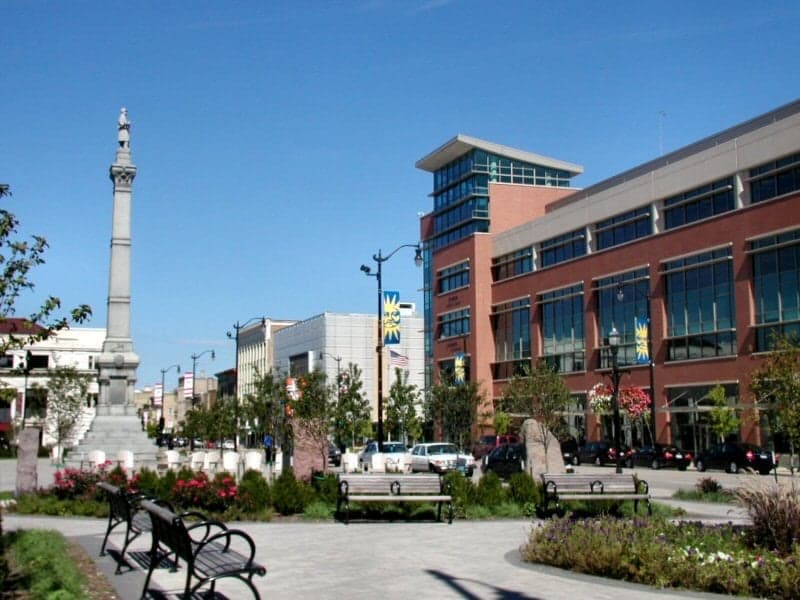
The people of Racine, Wisconsin today form a working-class, racially diverse community of 77,155 residents, shaped by successive waves of European immigration, Great Migration arrivals, and ongoing Hispanic growth. The city is notably less affluent and less college-educated than the national average — only 21.5% of adults hold a bachelor’s degree — and its population has declined roughly 8% since its 1960 peak of 89,144. Racine’s identity is rooted in its industrial past, with a population that is 50.7% White, 23.3% Hispanic, 20.1% Black, 0.5% East/Southeast Asian, and 0.2% Indian (subcontinent), alongside a very low foreign-born share of 3.5%.
How the city was settled and grew
Racine’s founding population arrived in the 1830s and 1840s, drawn by the deep-water harbor on Lake Michigan and the fertile farmland of the Root River valley. The first major wave was Yankee settlers from New England and New York, who established the village’s commercial core along Main Street and laid out the Olde Towne neighborhood. By the 1850s, German immigrants — fleeing political unrest and economic hardship — became the dominant group, settling in what is now the West Racine district around Washington Avenue, where they built breweries, churches, and Turner halls. Danish immigrants followed in the 1870s–1890s, clustering near the harbor in the Uptown area, where they worked in the burgeoning farm-equipment and wagon factories. A smaller wave of Polish and Czech immigrants arrived around 1900, settling in the Southside neighborhoods near the Belle City Malleable Iron works. By 1920, Racine was a heavily German-Scandinavian industrial city, with manufacturing — especially J.I. Case farm machinery and the Horlick’s malted milk plant — employing the vast majority of workers.
Modern era (post-1965)
The post-1965 period brought the two most significant demographic shifts: the Great Migration of Black Americans from the South and the later growth of Hispanic communities. Black families began arriving in significant numbers during the 1940s and 1950s, drawn by wartime factory jobs at J.I. Case and Western Publishing, but the population grew sharply after 1965 as industrial employment remained steady. They settled primarily in the Midtown and Northside neighborhoods, areas that experienced white flight and disinvestment as manufacturing declined in the 1980s. Today, Black residents make up 20.1% of the city’s population, concentrated in these central and northern census tracts. Hispanic migration — predominantly Mexican and Puerto Rican — began in the 1970s and accelerated through the 1990s, with families settling in the West Racine corridor and the Southside near the former Zahn’s department store district. The Hispanic share has grown from roughly 5% in 1990 to 23.3% today, making it the fastest-growing demographic group. East/Southeast Asian and Indian communities remain very small — 0.5% and 0.2% respectively — and are scattered rather than forming distinct ethnic enclaves. The foreign-born share of 3.5% is less than half the national average, reflecting Racine’s limited role as an immigrant destination compared to Milwaukee or Chicago.
The future
Racine’s population trajectory points toward continued slow decline and increasing Hispanic share, with the city likely to become plurality Hispanic within 15–20 years if current trends hold. The White population, which was over 80% as recently as 1980, is aging and shrinking through out-migration to suburbs like Caledonia and Mount Pleasant. The Black population has plateaued since 2010, with some out-migration to southern suburbs and other Midwestern cities. Hispanic growth is driven by both domestic migration and higher birth rates, and the community is consolidating in West Racine and the Southside rather than dispersing. The city is not tribalizing into sharply divided enclaves — most neighborhoods remain mixed — but socioeconomic segregation is deepening, with the Northside and Midtown experiencing higher poverty rates while West Racine and the lakefront areas retain more stability. The low college attainment rate (21.5%) and the absence of a major university mean Racine is unlikely to attract the knowledge-economy migrants that are reshaping nearby Milwaukee and Madison.
For someone moving to Racine now, the city offers a genuinely diverse, affordable, working-class environment — but one that is demographically static and economically challenged. The population is becoming more Hispanic and less White, but the overall trend is shrinkage, not transformation. New residents should expect a community where ethnic identity is lived in distinct neighborhoods — West Racine for Hispanic families, Midtown for Black families, and the lakefront and Uptown for older White residents — but where daily life is more integrated than polarized. The city’s future depends less on who moves in and more on whether the Foxconn-related development in nearby Mount Pleasant can reverse the decades-long job loss that has defined Racine since the 1980s.

* Values derived from national, state, county, city and local statistics and may differ in a specific area. Last updated: 2026-05-03T20:39:03.000Z
Narrative content on this page is AI-generated and may contain mistakes. Verify any details that matter before acting on them.
ReloMaps may earn a commission from affiliate links at no extra cost to you.

