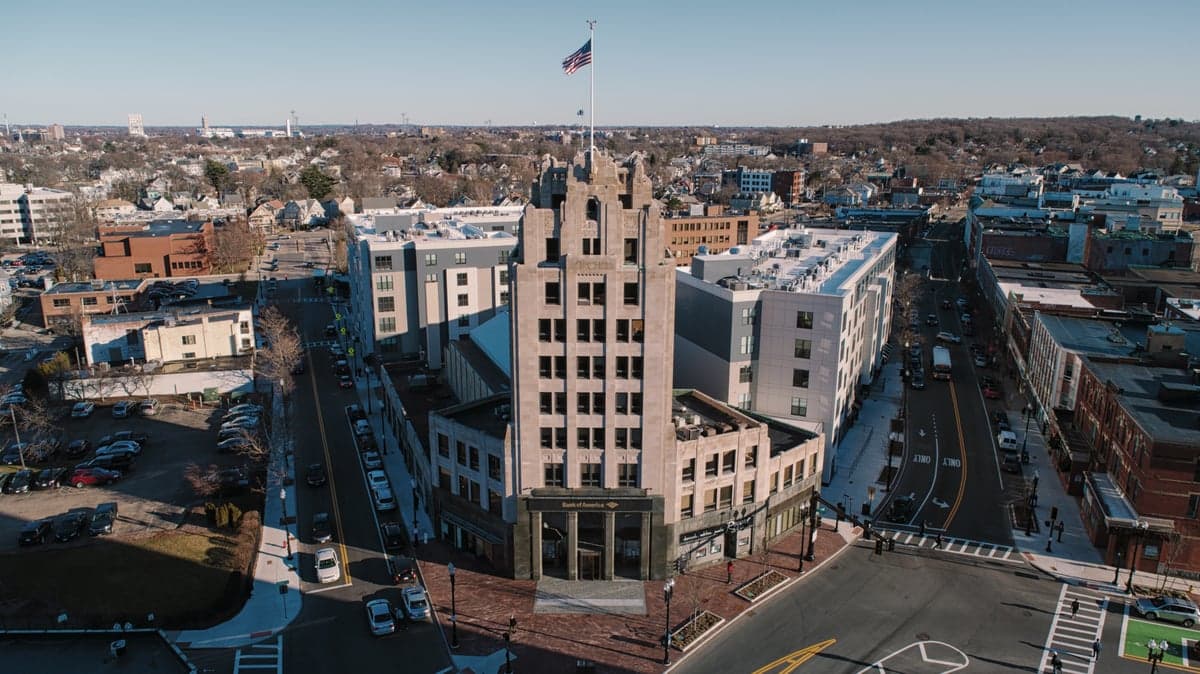
Photo: Wikipedia
Personal Sovereignty in Quincy, MA
Viable for self-reliance. Generally workable, though some barriers may limit total independence.
What does Personal Sovereignty tell us?
Personal Sovereignty measures your capacity for self-reliance and independence with minimal government friction. Higher scores mean fewer barriers between you and the way you want to live... but it assumes you have the space you need and good neighbors.
What does this tell us?
Personal Sovereignty measures your capacity for self-reliance and independence with minimal government friction. Higher scores mean fewer barriers between you and the way you want to live... but it assumes you have the space you need and good neighbors.
State Policy
Energy independence: Importer (5% of energy produced in-state)
Personal Liberty
Homesteading

Personal Liberty Analysis
For a relocation-minded individual or family prioritizing personal sovereignty, Quincy, Massachusetts presents a challenging environment. While the city offers historic charm and proximity to Boston, its autonomy landscape is heavily constrained by state-level policies that consistently rank among the most restrictive in the nation for gun rights, tax burdens, and parental control over education. A prepper or survivalist will find the regulatory climate here fundamentally at odds with self-reliance, though some local conditions—like older housing stock with yards—offer limited room for maneuvering within a system that leans heavily toward collective governance over individual freedom.
Tax burden and regulatory posture in Quincy: what it means for your autonomy
Massachusetts imposes one of the heaviest tax loads in the country, and Quincy residents feel it directly. The state’s flat income tax rate of 5% applies to all earned income, and while there is no local income tax, the property tax burden in Quincy is significant. The city’s effective property tax rate hovers around 1.1% of assessed value, which on a median home value of roughly $600,000 translates to an annual bill of about $6,600. For a prepper trying to stockpile resources or invest in land improvements, that’s a recurring drain on capital. Sales tax is 6.25%, and the state’s estate tax kicks in at just $1 million, hitting families who manage to build generational wealth. Regulatory posture is equally dense: building permits, zoning variances, and environmental reviews are common hurdles for any significant property modification. The state’s strict building codes and wetland protection laws mean that even adding a shed or installing a rainwater catchment system can trigger bureaucratic oversight. For someone seeking to minimize government entanglement in daily finances and property use, Quincy’s tax and regulatory environment is a net negative.
Self-defense and gun law specifics in Quincy: what you can and cannot do
Massachusetts is one of the most restrictive states for firearm ownership, and Quincy residents operate under those same constraints. The state requires a License to Carry (LTC) for any handgun, and the issuing authority—in Quincy, the police department—has significant discretion. While the city is not a “no-issue” jurisdiction, the process is lengthy, includes a background check, a firearms safety course, and an interview. Open carry is effectively banned; concealed carry is the only legal option, and even then, restrictions on “large capacity” magazines and certain firearm features apply. The state’s assault weapons ban remains in effect, and the 2024 law further restricted magazine capacity to 10 rounds for rifles and 10 rounds for handguns. For a prepper, this means no AR-15s with standard magazines, no suppressors, and no carrying in many “sensitive places” like schools, government buildings, and public transit. Stand-your-ground laws do not exist; Massachusetts imposes a duty to retreat if safely possible. Self-defense with a firearm in the home is legally defensible, but the burden of proof is on the homeowner to show reasonable fear of death or great bodily harm. Quincy’s proximity to Boston also means a higher likelihood of encounters with law enforcement who are trained in a restrictive legal framework. For anyone serious about armed self-defense, this is a hostile jurisdiction.
Self-reliance and homesteading viability: lot sizes, zoning, and off-grid feasibility in Quincy
Quincy is a densely settled urban-suburban city, and that reality limits homesteading potential. Typical residential lots range from 5,000 to 10,000 square feet, with many homes on 6,000-square-foot parcels. Zoning is predominantly single-family residential, but setbacks, lot coverage limits, and historic district overlays restrict what you can build. Raising chickens is allowed in some residential zones with a permit, but livestock like goats or pigs are prohibited. Off-grid living is effectively impossible within city limits: the city requires connection to municipal water and sewer, and solar panels must be grid-tied with net metering approval. Rainwater collection for potable use is not permitted under state plumbing codes, though non-potable use (e.g., gardening) is allowed with a permit. Composting toilets are not recognized as a primary sanitation method. For a prepper seeking to grow food, store water, and generate power independently, Quincy’s infrastructure mandates and zoning codes create a high barrier. The best option for a self-reliant lifestyle would be to look at the outer suburbs or rural towns in Plymouth or Worcester counties, where lot sizes of 1-5 acres are common and zoning is less restrictive. Within Quincy, the most viable approach is container gardening, small-scale solar on a roof, and deep pantry storage—all within the bounds of city code.
Personal liberties in Quincy: parental rights, medical autonomy, speech, and property
Parental rights in Massachusetts are under increasing pressure. The state’s 2024 law removed parental opt-out for LGBTQ+ curriculum in public schools, and Quincy Public Schools have implemented policies that allow students to change their names and pronouns without parental notification. For a conservative parent, this represents a direct erosion of authority over a child’s upbringing. Medical autonomy is similarly constrained: Massachusetts has strict vaccine mandates for school attendance, and the state’s public health emergency powers were expanded during COVID-19, with no sunset clause on some provisions. Informed consent for medical procedures is the legal standard, but the state’s health bureaucracy can override parental decisions in cases involving minors, particularly around reproductive health. Free speech is protected under the First Amendment, but Massachusetts has a strong anti-SLAPP law that can be used to silence critics, and the state’s hate crime statutes are broad. Property rights are relatively strong for existing homeowners, but the state’s rent control ban was repealed in 2023, and Quincy has considered local rent stabilization measures. Eminent domain is used sparingly, but the city’s aggressive development agenda—particularly around the Quincy Center redevelopment—has led to disputes over property takings. For a prepper, the key takeaway is that the state’s legal framework prioritizes collective welfare over individual autonomy, and Quincy’s local governance mirrors that philosophy. You can speak your mind, but you may face social and legal pushback for dissenting views on public health, education, or firearms.
Overall, Quincy offers a low sovereignty score relative to other areas in the United States. Compared to states like New Hampshire, Texas, or Idaho, where tax burdens are lower, gun laws are permissive, and parental rights are codified, Massachusetts—and Quincy by extension—ranks near the bottom for personal autonomy. For a single individual or family with a survivalist mindset, the city’s high taxes, restrictive gun laws, limited homesteading potential, and encroaching state control over family decisions make it a poor fit for long-term self-reliance. If relocation to the Boston area is unavoidable, the best strategy is to treat Quincy as a temporary base while scouting property in New Hampshire or Maine, where the legal and regulatory climate aligns more closely with personal sovereignty. Within Quincy itself, the focus should be on legal compliance, deep community networks, and low-profile preparedness—not on pushing the boundaries of what the system allows.

* Values derived from national, state, county, city and local statistics and may differ in a specific area. Last updated: 2026-05-02T14:10:01.000Z
Narrative content on this page is AI-generated and may contain mistakes. Verify any details that matter before acting on them.
ReloMaps may earn a commission from affiliate links at no extra cost to you.

