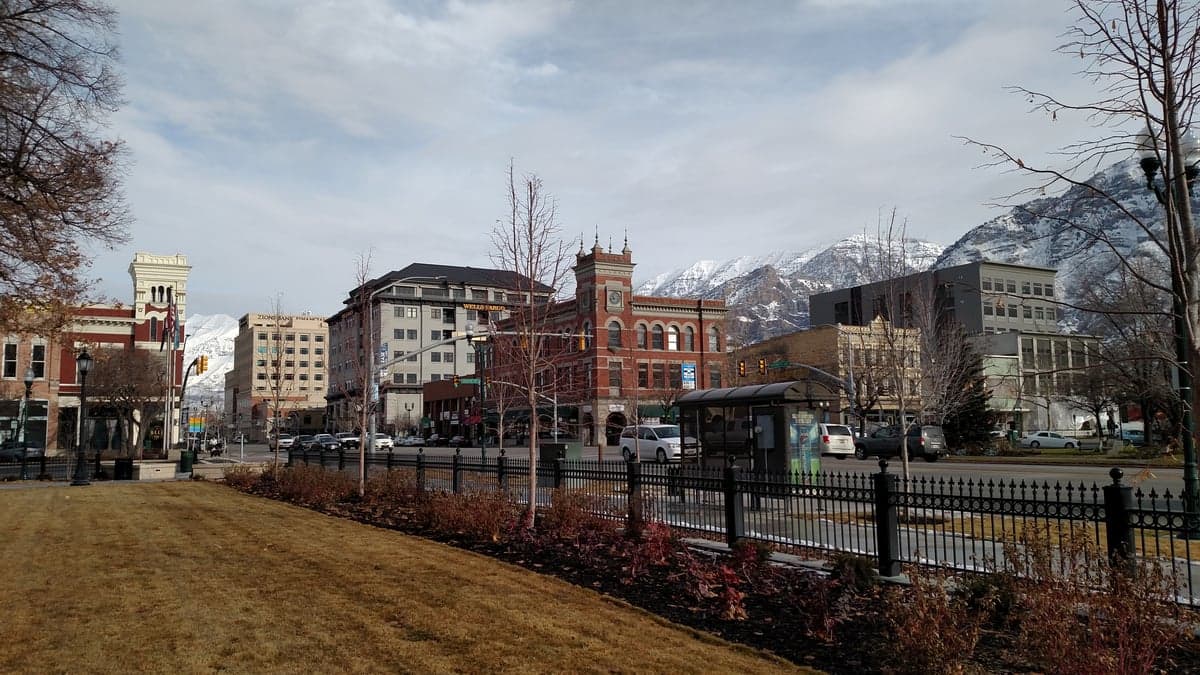
Photo: Wikipedia
Personal Sovereignty in Provo, UT
Viable for self-reliance. Generally workable, though some barriers may limit total independence.
What does Personal Sovereignty tell us?
Personal Sovereignty measures your capacity for self-reliance and independence with minimal government friction. Higher scores mean fewer barriers between you and the way you want to live... but it assumes you have the space you need and good neighbors.
What does this tell us?
Personal Sovereignty measures your capacity for self-reliance and independence with minimal government friction. Higher scores mean fewer barriers between you and the way you want to live... but it assumes you have the space you need and good neighbors.
State Policy
Energy independence: Self-sufficient (80% of energy produced in-state)
Personal Liberty
Homesteading

Personal Liberty Analysis
Provo, Utah, offers a notably high degree of personal sovereignty compared to many urban centers on the West Coast or in the Northeast, largely due to Utah’s state-level constitutional protections and a deeply ingrained culture of self-reliance. While no city is a libertarian utopia, Provo’s legal and social environment leans heavily toward individual autonomy, particularly in areas of self-defense, parental rights, and property use. The city sits within a state that has a strong track record of pushing back against federal overreach, and its local governance generally aligns with a philosophy of minimal interference in personal and family matters. For a single individual or parent evaluating relocation from a high-regulation state, Provo presents a strategic environment where the state is more partner than adversary in your pursuit of independence.
Tax burden and regulatory posture: How Utah’s fiscal policies affect your autonomy
Utah’s tax structure is designed to maximize what you keep and control, directly supporting personal sovereignty. The state levies a flat income tax rate of 4.65% (as of 2025), with no progressive brackets that penalize higher earnings or entrepreneurial success. Property taxes in Utah County are moderate, with effective rates around 0.6% of assessed value, and Provo’s city-level taxes are not burdensome. Critically, Utah has no state-level estate or inheritance tax, meaning your assets pass to your heirs without the government taking a cut. On the regulatory front, Utah is a “right-to-work” state, meaning you cannot be forced to join a union as a condition of employment, and it has a strong track record of occupational licensing reform—fewer professions require state permission to work. For a prepper or survivalist mindset, this means less bureaucratic drag on starting a side business, building a workshop, or engaging in trade. The state’s regulatory posture is generally permissive: there are no state-level rent control laws, no bans on gas stoves or natural gas hookups, and no aggressive environmental regulations that would prevent you from modifying your property for self-sufficiency. The biggest autonomy risk is property tax increases via bond measures, but these are voted on locally and often fail in conservative Utah County.
Self-defense and gun law specifics: What you can legally do to protect yourself and your family
Provo sits in a state that is among the most firearm-friendly in the nation, which is a cornerstone of personal sovereignty for many in the survivalist community. Utah is a “constitutional carry” state—since 2021, any law-abiding adult 21 or older can carry a concealed firearm without a permit. Open carry is also legal without a permit for those 18 and older. There is no state-level waiting period, no universal background check requirement for private sales, and no ban on “assault weapons” or standard-capacity magazines. The state has a strong “Stand Your Ground” law, codified in Utah Code 76-2-402, which removes any duty to retreat before using deadly force if you are lawfully present and reasonably believe it is necessary to prevent death or great bodily harm. Castle Doctrine protections are explicit: your home, vehicle, and occupied structure are considered places where no retreat is required. For parents, this means you can legally defend your family on your property without fear of prosecution for standing your ground. Provo itself has a low violent crime rate (roughly 1.5 per 1,000 residents, well below national averages), but the legal framework ensures you are not dependent on police response times. The only notable restriction is that carrying a firearm into a church or private residence with posted signage can be a trespassing offense, but this is rarely enforced against lawful carriers. For a prepper, the ability to stockpile ammunition, own suppressors (with federal tax stamp), and build a defensive arsenal without state-level harassment is a major sovereignty advantage.
Self-reliance and homesteading viability: Lot sizes, zoning, and off-grid feasibility in Provo
Self-reliance and homesteading viability: Lot sizes, zoning, and off-grid feasibility in Provo
Provo’s zoning and land-use policies offer a mixed but generally favorable picture for those seeking self-reliance. Within the city limits, most residential lots are standard suburban sizes—typically 0.15 to 0.25 acres in older neighborhoods, with newer subdivisions offering slightly larger parcels up to 0.5 acres. This is enough for a substantial vegetable garden, a few fruit trees, and a small chicken coop (chickens are allowed in most residential zones with a permit, though roosters are prohibited). However, true homesteading—keeping goats, pigs, or larger livestock—is restricted to agricultural zones, which are mostly found in the outlying areas of Utah County like Elk Ridge, Payson, or rural unincorporated land. Provo’s city code does allow for “urban agriculture” as a conditional use, but the permitting process can be cumbersome. For off-grid feasibility, the picture is more constrained: Provo is fully connected to municipal water, sewer, and power grids, and the city does not permit new construction without these connections. Rainwater collection is legal in Utah (since 2010) but limited to 2,500 gallons per property without a water right, and you must register with the state. Solar panels are widely permitted and encouraged, with net metering available through Rocky Mountain Power, but going fully off-grid (disconnecting from the grid) is not practical within city limits due to building codes. For a prepper seeking true independence, the better play is to buy land in unincorporated Utah County—where lot sizes start at 1 acre and go up to 40 acres—and commute to Provo for work. The nearby towns of Springville, Mapleton, and Spanish Fork have more permissive zoning for small-scale agriculture and livestock, and are within 15-20 minutes of Provo’s amenities.
Personal liberties: Parental rights, medical autonomy, free speech, and property rights
Utah is a national leader in protecting parental rights, which is a critical component of personal sovereignty for families. The state’s “Parental Rights in Education” law (HB 331, 2023) requires schools to notify parents of any curriculum changes related to sexuality or gender identity and prohibits instruction on these topics in grades K-3. More broadly, Utah law explicitly recognizes parents’ “fundamental right and duty” to direct their children’s education, healthcare, and moral training (Utah Code 62A-4a-201). This means you can opt your child out of any school activity or lesson without being labeled a problem parent. On medical autonomy, Utah has resisted federal mandates aggressively: it was one of the first states to ban COVID-19 vaccine mandates for public employees and students, and it prohibits discrimination based on vaccination status. The state also has a robust “Right to Try” law for terminally ill patients and allows for broad exemptions to vaccine requirements for schoolchildren (medical, religious, and personal belief). Free speech protections are strong—Utah has no “hate speech” laws that criminalize political or religious expression, and the state’s constitution provides broader free speech protections than the First Amendment in some areas (e.g., speech in “traditional public forums” like sidewalks and parks is heavily protected). Property rights are reinforced by Utah’s “private property rights” act (HB 400, 2021), which requires government agencies to compensate property owners if a regulation reduces property value by 20% or more—a powerful check against zoning overreach. For a survivalist, this means your ability to build a bunker, store supplies, or run a home-based business is less likely to be shut down by arbitrary code enforcement.
Overall, Provo offers a sovereignty profile that ranks among the strongest in the Intermountain West, particularly for families and individuals who prioritize self-defense, parental control, and economic independence. The city’s main trade-offs are its urban density (which limits large-scale homesteading) and its reliance on municipal utilities, but the state-level legal framework compensates by giving you wide latitude in how you live, defend, and provide for your family. Compared to cities like Portland, Seattle, or Denver, Provo is a fortress of personal autonomy—where the government is more likely to stay out of your way than to get in it. For a prepper or survivalist, the strategic play is to use Provo as a base for employment and community while securing land in the surrounding county for true self-reliance. The combination of constitutional carry, strong parental rights, low taxes, and a culture that values independence makes this one of the more sovereign places you can live without going completely rural.

* Values derived from national, state, county, city and local statistics and may differ in a specific area. Last updated: 2026-04-15T23:40:26.000Z
Narrative content on this page is AI-generated and may contain mistakes. Verify any details that matter before acting on them.
ReloMaps may earn a commission from affiliate links at no extra cost to you.

