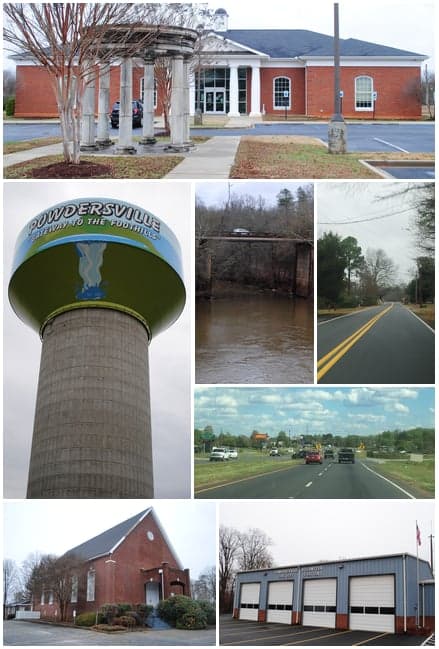
Photo: Wikipedia
Political ClimatePolitical Climate in Powdersville, SC
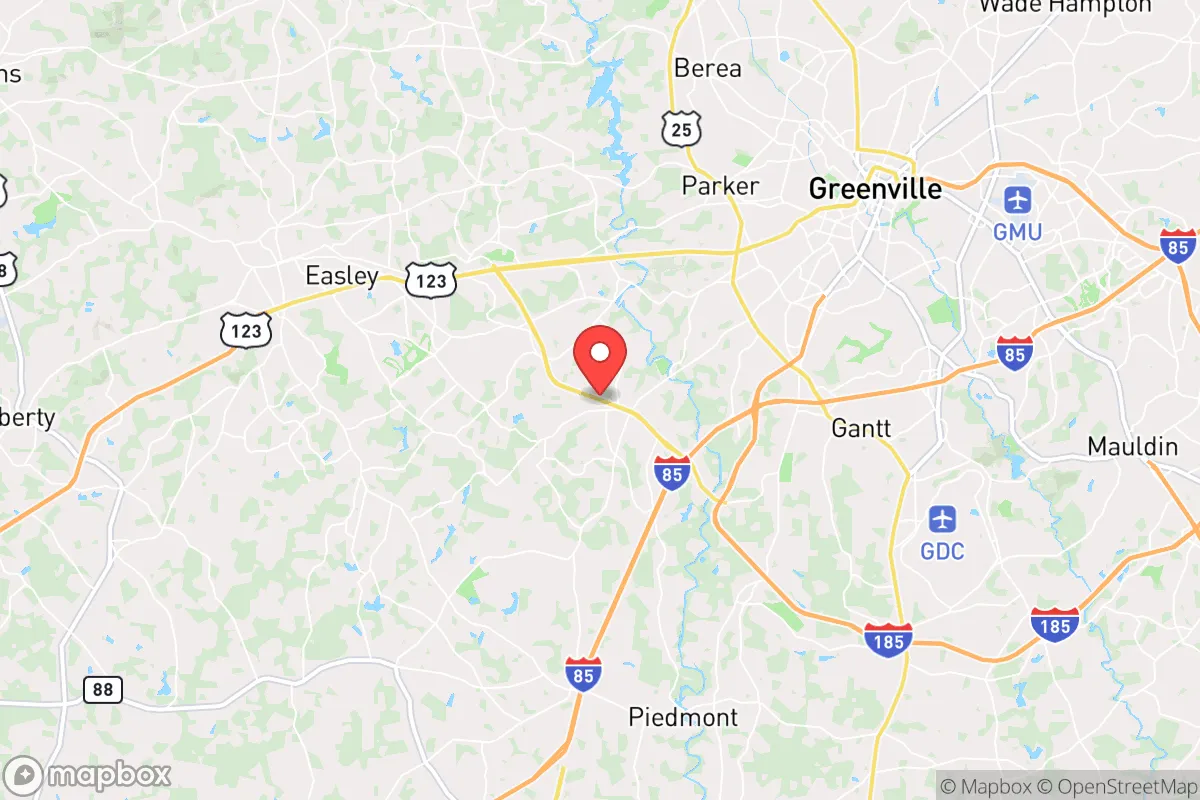
District shown is the primary district for this city’s centroid. Cities may span multiple districts.
Local Political AnalysisPolitical Analysis of Powdersville, SC
Powdersville is about as reliably red as it gets in the Upstate. The area sits in a Cook PVI of R+21, which is more than double the statewide lean of South Carolina’s R+8. That gap isn’t just a number — it reflects a community where Republican candidates routinely win by 20 points or more in local and national races. If you’re looking at the political trajectory, it’s been steady: Powdersville has gotten a bit more conservative over the last decade as new subdivisions have drawn families from even redder parts of the state, but the core has been deeply Republican for as long as anyone can remember.
How it compares
To understand Powdersville’s politics, you have to look at the surrounding towns. Just a few miles east, Greenville city proper leans more moderate-to-liberal, with a Cook PVI closer to R+5 in the urban core and some precincts voting blue in recent cycles. Drive west toward Anderson, and you’re back in R+15 territory. But Powdersville itself is the outlier — it’s more conservative than either of those anchors. The difference is stark: in the 2024 presidential race, Powdersville precincts gave the Republican ticket around 72% of the vote, while Greenville city precincts hovered near 55% for the Democrat. That’s a 27-point swing in less than 15 miles. The surrounding unincorporated areas of Anderson County, where Powdersville sits, also lean harder right than the county as a whole (Anderson County is about R+16). So if you’re comparing it to South Carolina overall, Powdersville is essentially the state’s conservative lean turned up to 11.
What this means for residents
For conservative residents, this political climate means local policies align closely with their values. The county council and school board elections are rarely competitive, so tax rates stay low, gun laws are permissive, and development tends to favor single-family homes over denser housing. For liberal residents, it can feel isolating. There’s no real progressive infrastructure — no Democratic party office in Powdersville, no local activist groups that meet regularly. You’ll have to drive into Greenville for that. The practical effect is that local elections are often decided in the Republican primary, so the general election in November is usually a formality. That can make the political conversation feel one-sided, but it also means the community is stable and predictable — no sudden policy shifts, no heated ballot measures. The trajectory is likely more of the same: as Powdersville grows (and it is growing fast, with new subdivisions off Highway 81), the new arrivals tend to be families looking for that same conservative environment, so the lean isn’t softening.
Culturally, this plays out in small but noticeable ways. The local churches are predominantly evangelical, the public schools emphasize traditional values, and you’ll see more American flags and “In God We Trust” signs than in Greenville proper. There’s no local sales tax on groceries, and the county keeps property taxes among the lowest in the state. For someone moving from a blue state, the biggest adjustment isn’t just the voting patterns — it’s the absence of any real political friction in daily life. People here don’t argue about politics over the fence; they assume everyone agrees. That’s either comforting or claustrophobic, depending on your perspective. Either way, Powdersville is a place where the political reality is baked into the landscape, and it’s not changing anytime soon.

State Political ClimatePolitical Climate in South Carolina
State Political AnalysisPolitical Environment in the State
South Carolina has been a reliably Republican state for a generation, with a Cook PVI of R+8 that understates its current solidity. The GOP holds every statewide office, supermajorities in both legislative chambers, and both U.S. Senate seats. But the state wasn’t always this way — as recently as the 1990s, Democrats still controlled the legislature and held the governorship. The realignment accelerated after 2010, driven by the suburbanization of the Upstate and the Lowcountry, the collapse of the old conservative Democratic “Blue Dog” coalition, and in-migration of retirees and families from the Northeast and Midwest who lean right on taxes and regulation. Today, the state is deeply red, but the margins are not uniform — and the internal political geography is more interesting than the statewide numbers suggest.
Urban vs. rural divide
The political map breaks into three distinct zones. The Upstate — anchored by Greenville, Spartanburg, and Anderson — is the engine of the state’s Republican majority. Greenville County alone cast over 60% of its vote for Trump in 2024, and the surrounding counties are even redder. The Lowcountry, centered on Charleston and Mount Pleasant, is more competitive: Charleston County has trended Democratic in recent cycles, flipping blue in presidential races since 2020, driven by the city’s tech and tourism workforce and a growing Black professional class. The rural “Corridor of Shame” counties along I-95 — Allendale, Bamberg, Orangeburg — are overwhelmingly Black and vote 70-80% Democratic, but their populations are small and shrinking. The real battleground is the suburban ring around Columbia (Richland and Lexington counties): Richland is reliably blue, Lexington is deep red, and the swing precincts in between decide state legislative races. The Myrtle Beach area (Horry County) is a wild card — fast-growing, heavily retiree, and reliably Republican in general elections, but with a libertarian streak that occasionally backs primary challengers against establishment incumbents.
Policy environment
South Carolina’s policy posture is unmistakably conservative. There is no state income tax on Social Security benefits, and the top marginal income tax rate was cut from 7% to 6.2% in 2023, with a path to 6% by 2025. Property taxes are low by national standards, though local school bond referendums can push millage rates up in fast-growing suburbs. The state is a right-to-work state with a 5.1% unemployment rate (as of early 2026), and it aggressively recruits manufacturing and logistics — BMW, Boeing, and Volvo all have major plants. Education policy is dominated by the school choice movement: the state’s Education Scholarship Trust Fund program, expanded in 2024, now provides roughly $7,000 per student for private school tuition or homeschooling expenses, with no income cap. Healthcare is a mixed picture: the state did not expand Medicaid under the ACA, leaving roughly 200,000 low-income adults in the coverage gap, but it has a robust network of federally qualified health centers. Election laws are among the strictest in the South: voter ID is required, early voting was expanded to two weeks in 2022, but absentee ballot drop boxes are limited to one per county, and the state purges inactive voters from rolls every two years. There is no state-level data privacy law, no comprehensive hate crime statute, and no shield law for journalists.
Recent policy direction
The last three legislative sessions have been a sprint to the right. In 2023, the state passed a near-total abortion ban at six weeks (the “Fetal Heartbeat Act”), with no exceptions for rape or incest, only for life of the mother and fatal fetal anomalies. The law is currently in effect after the state Supreme Court reversed its earlier block. On guns, South Carolina became a permitless carry state in 2024 — anyone 18 or older who can legally possess a firearm may carry it concealed without a permit. The state also passed a “Second Amendment Preservation Act” in 2023 that purports to nullify federal gun laws, though it has not been tested in court. On education, the “Parents’ Bill of Rights” (2023) requires schools to notify parents of any changes to a student’s mental, emotional, or physical health, and prohibits instruction on sexual orientation or gender identity in K-5 classrooms. On property rights, the state strengthened eminent domain protections in 2024, requiring a higher burden of proof for takings. On voting, the state enacted a ban on ballot harvesting and shortened the absentee application window. On medical freedom, the state banned COVID-19 vaccine mandates for state employees and contractors in 2023. There is no state-level privacy or surveillance law, but the legislature is considering a bill to limit the use of facial recognition by law enforcement.
Civil unrest & political movements
South Carolina has a long history of political activism on both sides. The Confederate flag removal from the Statehouse grounds in 2015, after the Charleston church shooting, was a watershed moment that reshaped the state’s national image but also energized a grassroots conservative backlash. The “Molon Labe” movement — a loose network of gun-rights activists and constitutional sheriffs — is visible in rural counties like Oconee and Pickens, where local officials have passed resolutions declaring their counties “Second Amendment sanctuaries.” On the left, the “Moral Monday” protests, led by the NAACP and progressive clergy, draw hundreds to the Statehouse each year to oppose abortion restrictions, voter ID laws, and education cuts. Immigration politics are relatively quiet compared to border states, but the 2024 “Secure the Border” law (which requires local law enforcement to cooperate with ICE) has sparked lawsuits from immigrant advocacy groups. There is no sanctuary city in the state — Columbia briefly considered a non-cooperation policy in 2023 but backed down under legislative pressure. Election integrity remains a flashpoint: the 2022 gubernatorial race saw a minor candidate challenge the results in court, and the state GOP has pushed for hand-counting of ballots in some counties, though that effort failed. A new resident would notice the Confederate monuments on courthouse lawns in most counties, but also the growing number of Black elected officials — the state has more Black legislators per capita than any other Southern state except Mississippi.
Projection
Over the next 5-10 years, South Carolina will likely stay red but become more internally contested. The key demographic driver is in-migration: the state is adding roughly 100,000 new residents per year, mostly from the Northeast and Midwest. These newcomers tend to be older, wealthier, and more conservative on taxes and regulation, but they are also less culturally Southern — they may support school choice and low taxes but be uneasy with the state’s abortion ban or its Confederate legacy. The Upstate will continue to be the GOP’s stronghold, but the Charleston and Columbia suburbs will become more competitive as younger, college-educated voters move in. The rural Black belt will continue to lose population, reducing the Democratic base. The wild card is the state’s growing Hispanic population, concentrated in the Greenville and Spartanburg areas, which is currently voting Republican at higher rates than Hispanic voters nationally — if that trend holds, it could lock in the GOP majority for another decade. The legislature will likely continue to push right on cultural issues — expect further restrictions on abortion, a possible ban on gender-affirming care for minors, and expansion of the school choice program. But the state’s business-friendly posture will remain bipartisan: no serious political figure in South Carolina advocates for raising taxes or weakening right-to-work.
For a new resident, the practical takeaway is this: if you are conservative, you will find a state that largely aligns with your values on taxes, guns, education, and regulation, and where your vote carries real weight in primaries. If you are liberal, you will find a state where your vote is largely symbolic in statewide races, but where you can find like-minded communities in Charleston, Columbia, and parts of Greenville, and where local elections in those cities are genuinely competitive. The state’s politics are not monolithic — the divide between the coastal suburbs and the rural interior is real, and the culture war battles are fought out in school board meetings and county council chambers, not just in the Statehouse. Come for the low taxes and the beaches; stay for the barbecue and the political reality that, for better or worse, South Carolina is what it is — and it’s not changing fast.
* Values derived from national, state, county, city and local statistics and may differ in a specific area. Last updated: 2026-08-11T13:03:14.000Z
Narrative content on this page is AI-generated and may contain mistakes. Verify any details that matter before acting on them.
ReloMaps may earn a commission from affiliate links at no extra cost to you.

