Photo: Wikipedia
Demographics of Portland, ME
Affluence Level in Portland, ME
A middle-class area roughly in line with national averages across income, home values, education, and employment.
People of Portland, ME
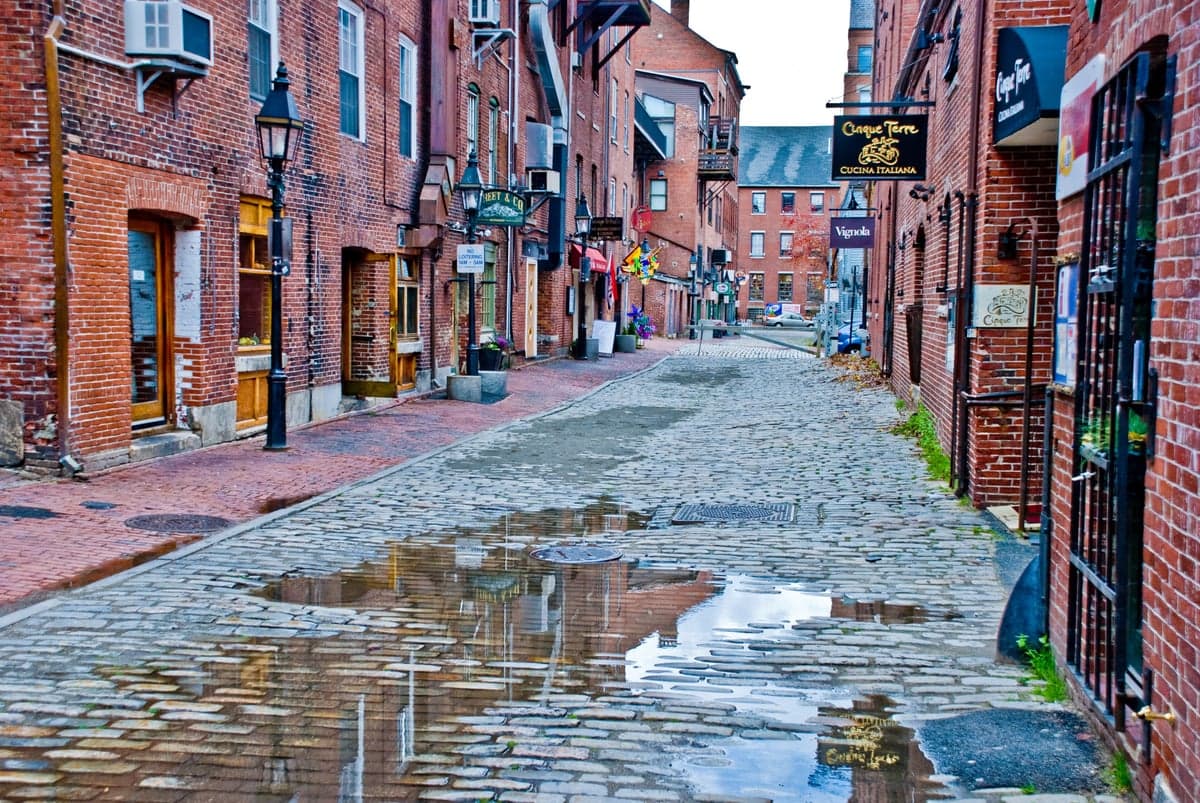
Portland, Maine, is a compact, historically white city of 68,505 residents that has become increasingly college-educated and diverse in recent decades, though it remains less ethnically varied than many New England peers. The city’s character is shaped by a 79.5% white population, a notable 59.2% college attainment rate, and a small but growing foreign-born share of 6.2%. Distinctive identity markers include a strong local food scene, a working waterfront that still supports a fishing industry, and a reputation as a liberal enclave within a politically mixed state. The city’s human history is one of successive waves — from English settlers and Irish laborers to French-Canadian mill workers and, most recently, African and East African refugees — each leaving a visible imprint on specific neighborhoods.
How the city was settled and grew
Portland was founded in 1632 as a fishing and trading post by English colonists, but its population grew slowly due to repeated conflicts with Native Wabanaki tribes and devastating raids. The city’s first major growth spurt came after the American Revolution, when its deep, ice-free harbor made it a center for shipbuilding, trade, and privateering. By the mid-19th century, Irish immigrants fleeing the Great Famine arrived in large numbers, settling in the Bayside and Munjoy Hill neighborhoods, where they built St. Dominic’s Church and established a working-class Catholic community that remains culturally influential today. A second major wave came between 1880 and 1920, when French-Canadian families from Quebec migrated south for jobs in Portland’s textile mills, lumber yards, and railroad yards. These French-Canadians concentrated in the Libbytown and Riverton sections of the city, creating a Franco-American identity that still shapes local surnames, parish life, and the annual La Kermesse festival. By the 1950s, Portland was overwhelmingly white, with small Black and Jewish communities centered near the West End and the old India Street neighborhood, respectively.
Modern era (post-1965)
The 1965 Hart-Celler Act opened immigration channels that slowly reshaped Portland’s demographics, but the most dramatic change came after 2000. The city’s foreign-born population rose from roughly 4% in 1990 to 6.2% today, driven primarily by refugee resettlement programs. The largest modern wave has been Somali and other East African communities, who began arriving in the early 2000s and now constitute a visible presence in the Oakdale and North Deering neighborhoods, where Somali-owned businesses and mosques have opened along Forest Avenue. Smaller but growing populations include East/Southeast Asian groups (2.6%), primarily Vietnamese and Cambodian families who arrived as secondary migrants from other U.S. cities, and a small Indian-subcontinent community (0.5%) concentrated among medical professionals at Maine Medical Center. The Black population has risen to 8.8%, with about half being African-born and half African American. Meanwhile, the Hispanic share (3.1%) is modest but growing, with Puerto Ricans and Mexicans settling in the East Bayside area. Domestic in-migration — particularly from Boston, New York, and Washington, D.C. — has accelerated since 2010, driving up housing costs and the college-educated share from 45% in 2010 to 59.2% today. This influx has gentrified Munjoy Hill and the Old Port, pushing lower-income and longer-term residents toward the city’s outskirts or neighboring towns like Westbrook and South Portland.
The future
Portland’s population is likely to continue growing slowly, with the foreign-born share rising toward 8-10% over the next decade, driven by ongoing refugee resettlement and secondary migration from larger East Coast cities. The East African community is the fastest-growing ethnic group and shows signs of consolidating into a durable enclave in the North Deering and Riverton corridors, with Somali-language media, halal markets, and community organizations reinforcing its presence. The white population, while still dominant, is aging and being partially replaced by younger, college-educated newcomers from out of state — a trend that is homogenizing the city’s cultural character even as its racial diversity slowly increases. The city is not tribalizing into sharply divided enclaves; rather, it is experiencing a mild form of gentrification-driven displacement, with the most affordable housing remaining in the northern neighborhoods. For a conservative-leaning newcomer, Portland offers a stable, safe urban environment with low violent crime, strong public schools in some districts, and a growing tax base — but also a political culture that is overwhelmingly liberal, with high property taxes and zoning policies that limit new construction. The city is becoming more educated, more expensive, and slightly more diverse, but it remains a predominantly white, New England-style city where community ties still run deep through parish, neighborhood, and waterfront traditions.

* Values derived from national, state, county, city and local statistics and may differ in a specific area. Last updated: 2026-04-24T01:43:05.000Z
Narrative content on this page is AI-generated and may contain mistakes. Verify any details that matter before acting on them.
ReloMaps may earn a commission from affiliate links at no extra cost to you.

