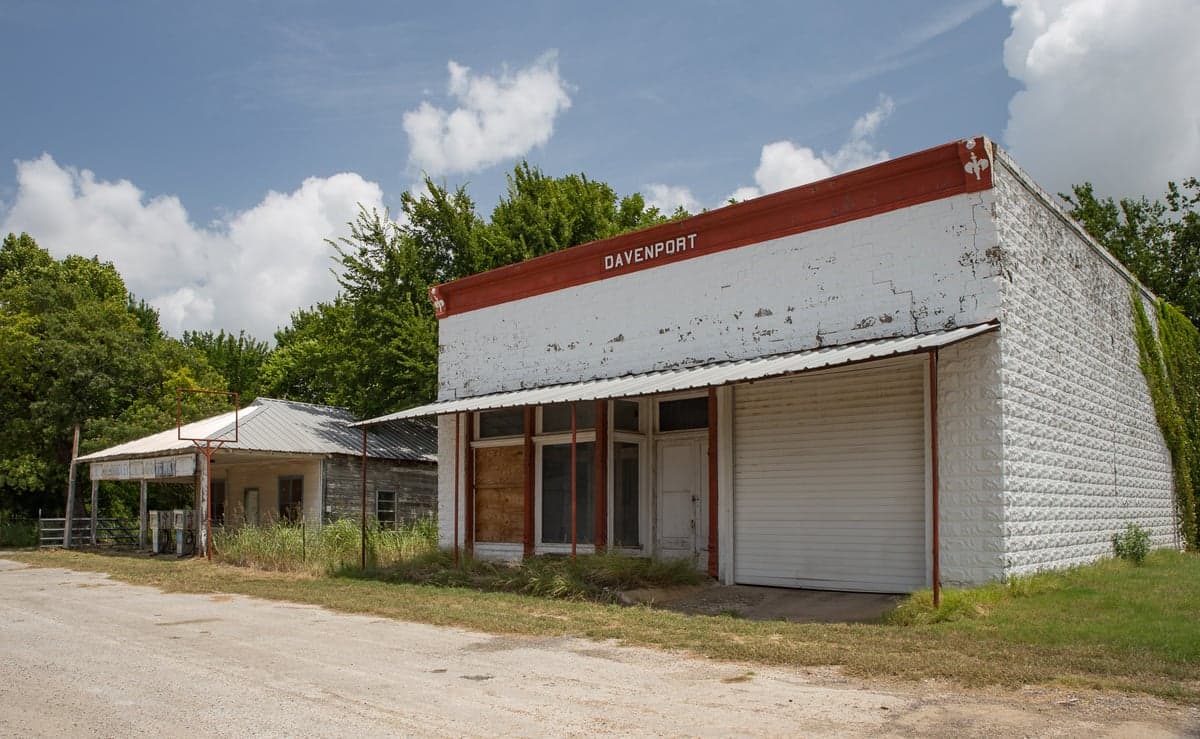
Photo: Wikipedia
Personal Sovereignty in Poolville, TX
Strong independent fundamentals that actively favor personal liberty and low regulation.
What does Personal Sovereignty tell us?
Personal Sovereignty measures your capacity for self-reliance and independence with minimal government friction. Higher scores mean fewer barriers between you and the way you want to live... but it assumes you have the space you need and good neighbors.
What does this tell us?
Personal Sovereignty measures your capacity for self-reliance and independence with minimal government friction. Higher scores mean fewer barriers between you and the way you want to live... but it assumes you have the space you need and good neighbors.
State Policy
Energy independence: Net exporter (195% of energy produced in-state)
Personal Liberty
Homesteading

Personal Liberty Analysis
Poolville, Texas, offers a personal sovereignty environment that is among the most permissive in the nation, driven by a combination of state-level preemption, minimal local zoning, and a deeply embedded culture of self-reliance. For individuals and families who prioritize autonomy—whether in taxation, self-defense, land use, or medical decisions—this unincorporated Parker County community provides a legal and practical framework where government intervention is the exception, not the rule. The area’s sovereignty profile is defined less by what the local government does and more by what it does not do, creating a default state of personal liberty that is increasingly rare in suburban and urban Texas.
Tax burden and regulatory posture: how light is the local touch?
Poolville’s tax and regulatory environment is exceptionally light, benefiting from Texas’s lack of a state income tax and Parker County’s relatively low property tax rates. The total property tax rate in Parker County hovers around 2.1% to 2.3% of assessed value, which is moderate by Texas standards but significantly lower than in nearby Tarrant County (Fort Worth) or Dallas County. There is no local sales tax beyond the state’s 6.25% and the county’s additional 0.5%, for a combined rate of 6.75%—well below the 8.25% ceiling in many Texas cities. Crucially, Poolville is unincorporated, meaning there is no city government to impose additional municipal taxes, business license fees, or local ordinances on matters like noise, signage, or land use. The regulatory posture is best described as “permissive by default.” There are no local building codes, no city planning department, and no zoning board to approve or deny property improvements. The primary regulatory touchpoints come from the state level: Texas Department of Licensing and Regulation for certain trades, Texas Commission on Environmental Quality for septic systems and water wells, and the county for subdivision platting (if splitting land into five or more lots). For a single-family homeowner or small-scale homesteader, the day-to-day regulatory burden is near zero. This creates a sovereignty advantage for those who wish to build, modify, or use their property without bureaucratic delays or fees.
Self-defense and gun law specifics: what the Castle Doctrine and permitless carry mean here
Poolville sits in a jurisdiction where self-defense rights are among the strongest in the United States. Texas law provides a robust Castle Doctrine (Texas Penal Code §9.32) that eliminates any duty to retreat before using deadly force in a person’s home, vehicle, or workplace, and extends a presumption of reasonable fear if an intruder unlawfully enters. The state’s Stand Your Ground law (Texas Penal Code §9.31) extends this principle to any place where a person has a legal right to be, meaning no retreat is required in public spaces either. Since September 2021, Texas has allowed permitless (constitutional) carry for handguns by anyone 21 or older who is not prohibited from possessing a firearm under state or federal law. This means a resident of Poolville can carry a concealed or openly carried handgun without a license, background check, or training requirement. For those who still wish to obtain a License to Carry (LTC), the process involves a background check and a four- to six-hour training course, but the LTC also provides reciprocity in 37 other states. Parker County is a Second Amendment Sanctuary County, with a 2021 resolution affirming that county resources will not be used to enforce federal gun laws deemed unconstitutional. Local law enforcement, the Parker County Sheriff’s Office, is known for a pro-Second Amendment stance, and there are no local ordinances restricting magazine capacity, firearm types, or storage requirements. For a resident prioritizing self-defense sovereignty, Poolville offers a legal environment where the right to carry and use force is maximized and local interference is minimized.
Self-reliance and homesteading viability: lot sizes, zoning, and off-grid feasibility
Poolville’s unincorporated status makes it a prime location for homesteading and off-grid living, with few legal barriers to self-sufficiency. Minimum lot sizes in Parker County’s unincorporated areas are generally 1 to 5 acres depending on the subdivision and water availability, but many properties in the Poolville area are sold in 5- to 20-acre parcels, providing ample space for gardens, livestock, and alternative energy systems. There are no county-level zoning ordinances that restrict the keeping of chickens, goats, cattle, or horses, nor any limits on the number of structures (barns, sheds, workshops) on a property. Off-grid feasibility is high: rainwater catchment is legal and encouraged, with no permit required for systems under 10,000 gallons. Private water wells are common and require a permit from the Texas Department of Licensing and Regulation (costing roughly $100–$200), but there are no restrictions on drilling for personal use. Septic systems must comply with TCEQ standards, but the county does not impose additional requirements. Solar panels and wind turbines are permitted without local approval, and there are no homeowner association (HOA) restrictions in the unincorporated area—though buyers should verify that a property is not part of a deed-restricted subdivision. The Texas Property Code allows for the creation of a homestead exemption (up to 20 acres for a family, 100 acres for a single adult) that protects the property from forced sale by most creditors. For a family seeking to grow food, generate their own power, and manage their own water, Poolville presents a regulatory environment that is essentially hands-off, with the primary constraints being state-level health and safety standards rather than local land-use restrictions.
Personal liberties: parental rights, medical autonomy, speech, and property
Poolville’s personal liberties environment is shaped by Texas state law and the absence of local ordinances that might curtail individual choice. Parental rights are strongly protected under Texas law, which grants parents the right to direct the education, upbringing, and medical care of their children. The state has no mandatory vaccination requirements for school attendance beyond the standard immunizations, and parents can claim a conscientious exemption (for philosophical or religious reasons) without needing a medical waiver. Homeschooling is legal with minimal regulation: parents are not required to register with the state, submit curricula, or administer standardized tests, though they must teach reading, spelling, grammar, mathematics, and good citizenship. Medical autonomy is similarly broad: Texas does not have a state-level vaccine passport mandate, and there are no local health orders in Parker County that restrict access to medical treatments or impose mask mandates. The state’s Right to Try law (Texas Health and Safety Code §169.001) allows terminally ill patients to access experimental treatments without FDA approval, and there is no state-level prescription drug monitoring program that restricts access to controlled substances beyond federal requirements. Free speech is protected under the First Amendment, and there are no local noise ordinances, sign ordinances, or public assembly restrictions in unincorporated Poolville—meaning residents can display political signs, hold gatherings, or express opinions without needing permits or facing local censorship. Property rights are reinforced by Texas’s strong eminent domain protections (Texas Property Code §21.011), which require that any taking be for a public use and that the landowner receive full market value plus attorney’s fees. The absence of a local zoning code means that property use is governed almost entirely by state law and common law nuisance principles, giving landowners broad discretion to use their land as they see fit.
Overall, Poolville offers a level of personal sovereignty that is among the highest in Texas and the United States. The combination of no city government, minimal county regulation, strong self-defense laws, and state-level protections for parental and medical autonomy creates an environment where the default answer to most personal decisions is “yes, unless state law specifically says no.” For a conservative-leaning individual or family seeking maximum independence from government oversight—whether in taxation, land use, self-defense, or personal health choices—Poolville represents a strategic relocation option that is difficult to match in more densely regulated areas like the Dallas-Fort Worth metroplex or even many other Texas counties. The trade-off is the lack of municipal services (police, fire, water, sewer) and the need for self-reliance in infrastructure and emergency response, but for those who prioritize sovereignty, that is precisely the point.

* Values derived from national, state, county, city and local statistics and may differ in a specific area. Last updated: 2026-11-23T19:40:28.000Z
Narrative content on this page is AI-generated and may contain mistakes. Verify any details that matter before acting on them.
ReloMaps may earn a commission from affiliate links at no extra cost to you.

