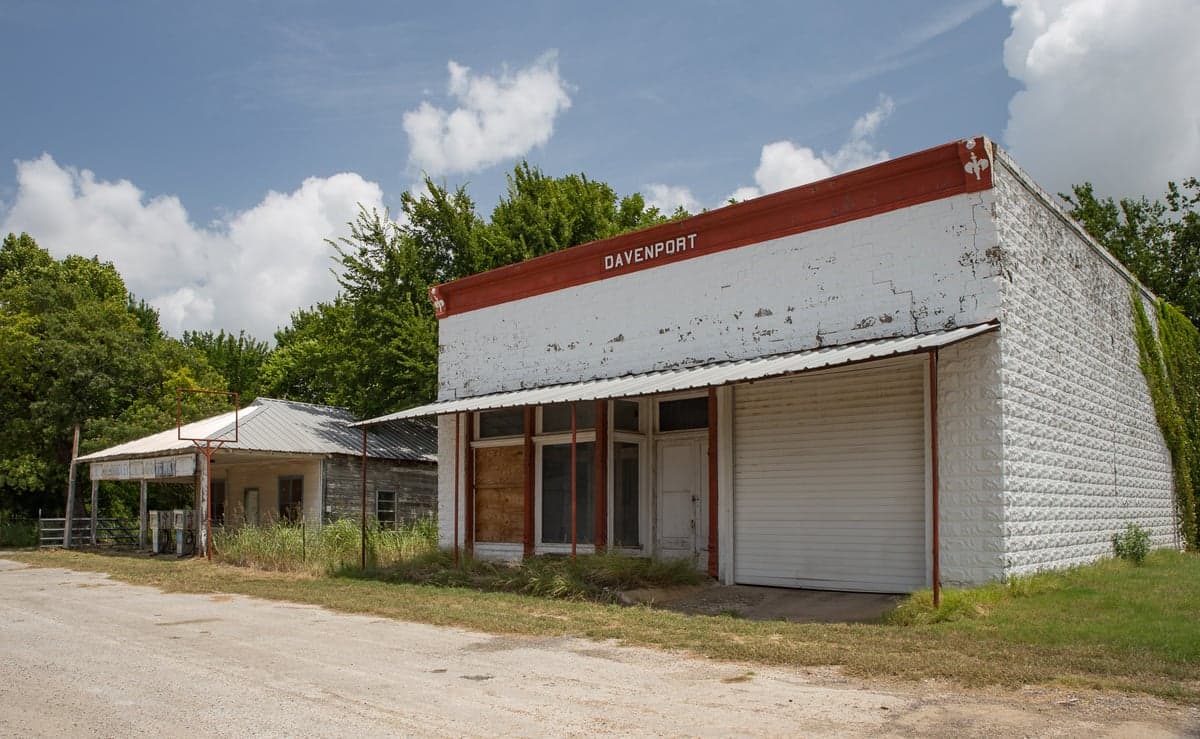
Photo: Wikipedia
Demographics of Poolville, TX
Historical data isn't available for Poolville, TX. Trends shown are for Parker County, TX.
Affluence Level in Poolville, TX
A middle-class area roughly in line with national averages across income, home values, education, and employment.
People of Poolville, TX
The people of Poolville, Texas, today number 3,771, forming a tight-knit, predominantly white community with a notably small foreign-born population of 2.9%. The city’s character is distinctly rural and family-oriented, with a low college attainment rate of 16.0% reflecting a workforce rooted in trades, agriculture, and local services. Hispanic residents make up 8.7% of the population, while Black (0.4%), East/Southeast Asian (0.0%), and Indian subcontinent (0.0%) communities are virtually absent, giving Poolville a demographic profile that is both less diverse than the national average and more homogeneous than nearby Fort Worth.
How the city was settled and grew
Poolville’s origins trace to the mid-19th century, when Anglo-American settlers from the U.S. South—primarily Tennessee, Kentucky, and Arkansas—arrived via the Peters Colony land grants. These early families, drawn by cheap, fertile land in the Cross Timbers region, established small farms and ranches. The community’s first cluster, now known as Old Town Poolville around the intersection of Farm to Market Road 1886 and County Road 4320, was built by these Southern migrants, who erected a one-room school and a Methodist church by the 1870s. A second wave of settlers, including German and Czech immigrants, arrived in the 1880s and 1890s, drawn by railroad expansion and the promise of cotton farming. They concentrated in what is today Czech Settlement, a loose collection of homes along County Road 4315, where a small Catholic cemetery and a few original farmhouses remain. By 1900, Poolville’s population hovered around 200, with the economy entirely agrarian—cotton, corn, and livestock—and the social fabric defined by Protestant church life and extended family networks.
Modern era (post-1965)
The post-1965 period brought no major immigration wave to Poolville; the city remained overwhelmingly native-born and white. The most significant demographic shift was domestic: a slow trickle of families from the Dallas-Fort Worth metroplex seeking cheaper land and a quieter lifestyle. This suburban spillover accelerated after 2000, as exurban development pushed northwest from Fort Worth. Newcomers—mostly white, middle-class families—settled in newer subdivisions like Poolville Meadows (off FM 1886) and Heritage Estates (near the high school), which feature larger lots and modern homes. Meanwhile, the Hispanic share grew modestly from near zero in 1990 to 8.7% today, driven by workers in construction, landscaping, and the nearby oil-and-gas fields of the Barnett Shale. These Hispanic households are concentrated in older rental properties along Main Street and in a small mobile-home park called Oak Ridge Trails on the town’s western edge. The Black population, at 0.4%, remains negligible, and no East/Southeast Asian or Indian subcontinent communities have formed. The city’s college-educated share—just 16.0%—is well below the Texas average of 31%, reflecting a workforce that prioritizes vocational skills over four-year degrees.
The future
Poolville’s population is projected to grow modestly, reaching roughly 4,500 by 2040, driven almost entirely by white exurban migration from Tarrant County. The Hispanic share may inch upward to 10-12% as service-sector jobs multiply, but the city is unlikely to see significant growth in Black, Asian, or Indian subcontinent populations due to limited rental housing stock and a lack of major employers. New development is concentrating in Poolville Ranch, a master-planned community approved in 2023 on the town’s north side, which will add 400 homes on one-acre lots—targeting the same white, family-oriented demographic that already dominates. The cultural identity of Poolville is evolving from a purely agricultural community to a bedroom suburb, but it retains a strong conservative, church-centered ethos. For a newcomer, this means a place where neighbors know each other, schools are small (Poolville ISD enrolls about 600 students), and the pace of life is slow—but where ethnic diversity and urban amenities are minimal.
Poolville is becoming a quieter, more residential version of its former self: a white, family-centric exurb where growth is steady but homogeneous. For someone moving in now, the city offers affordable housing, low crime, and a strong sense of community, but little racial or cultural variety. It is a place for those seeking stability and space, not for those looking for a diverse or cosmopolitan environment.

* Values derived from national, state, county, city and local statistics and may differ in a specific area. Last updated: 2026-11-23T19:40:28.000Z
Narrative content on this page is AI-generated and may contain mistakes. Verify any details that matter before acting on them.
ReloMaps may earn a commission from affiliate links at no extra cost to you.

