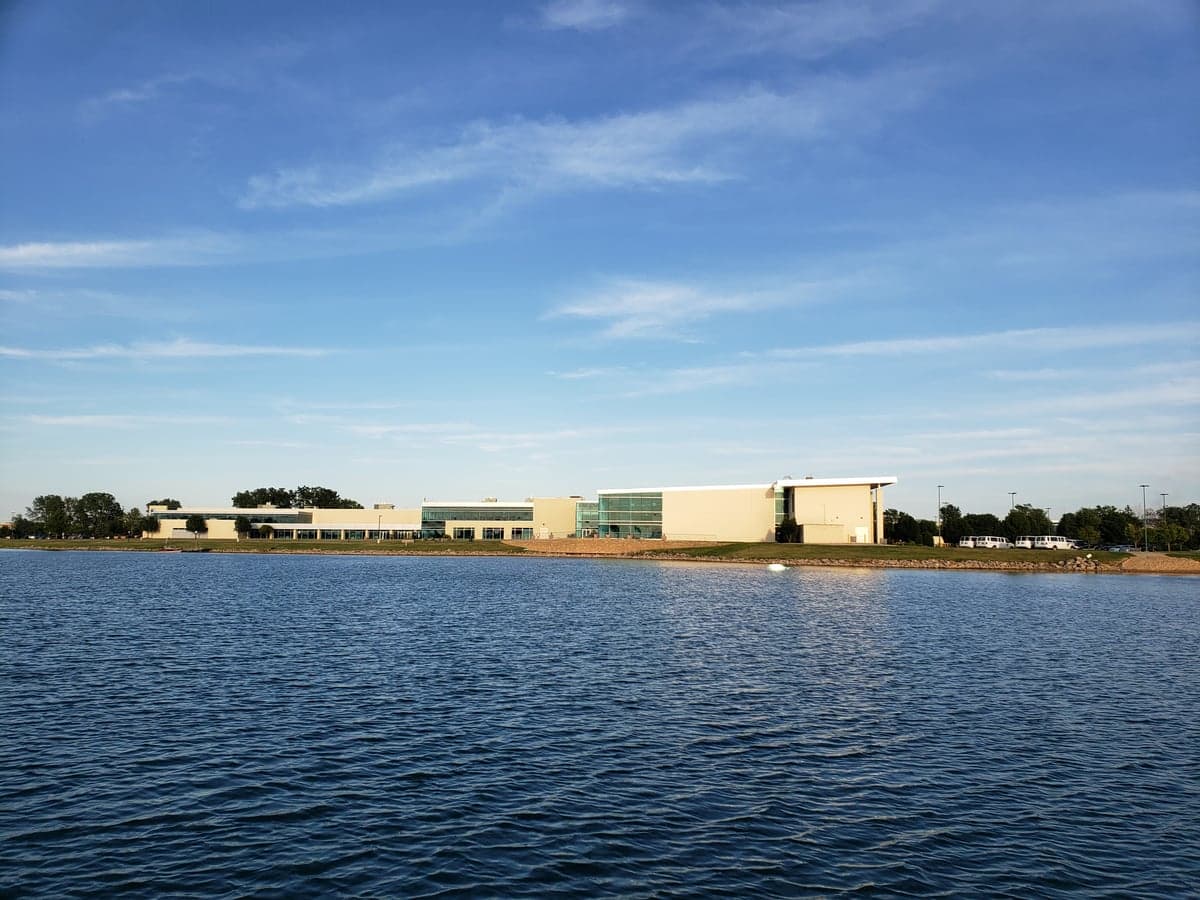
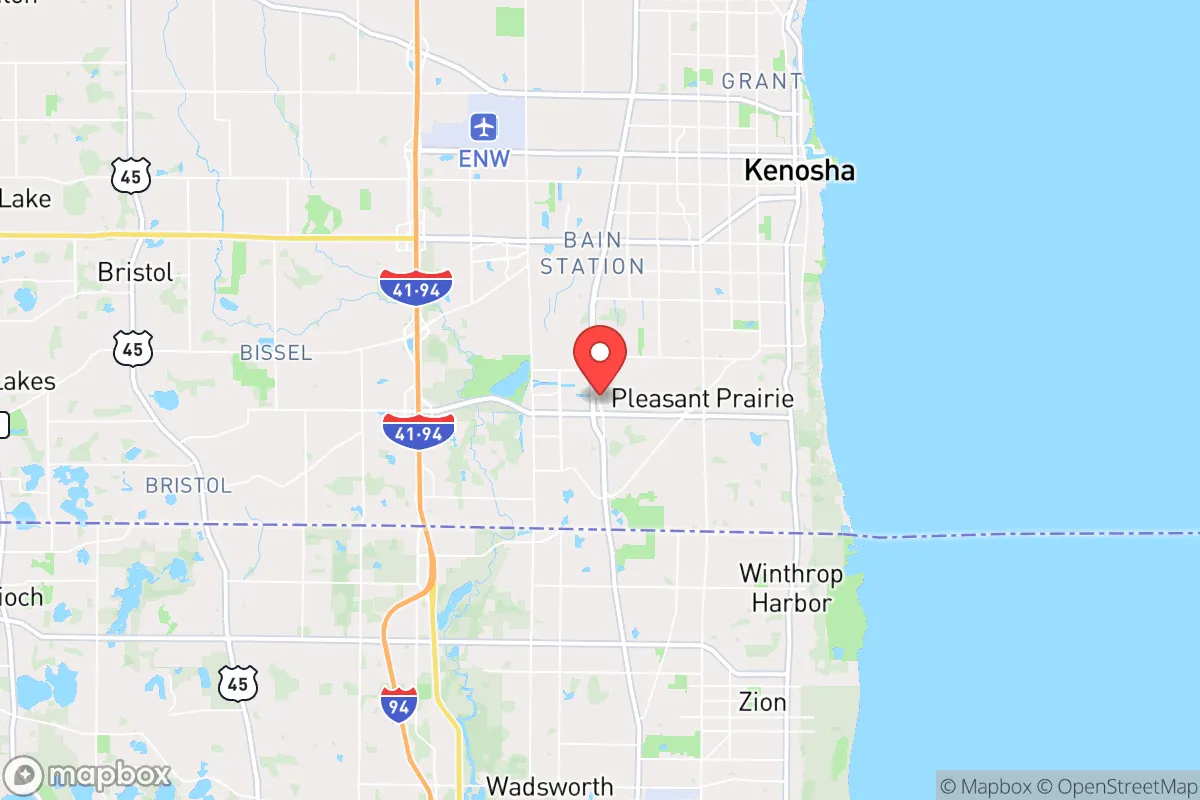
Photo: Wikipedia
Demographics of Pleasant Prairie, WI
Affluence Level in Pleasant Prairie, WI
A middle-class area roughly in line with national averages across income, home values, education, and employment.
People of Pleasant Prairie, WI
Pleasant Prairie, Wisconsin, is a predominantly white, family-oriented suburb of 21,515 residents that has transformed from a rural crossroads into a master-planned community. The city’s population is notably homogeneous — 80.6% white, 10.7% Hispanic, 2.0% Black, 1.2% East/Southeast Asian, and 1.0% Indian — with a low foreign-born share of 2.9% and a college-educated rate of 39.8%. Its character is defined by newer subdivisions, big-box retail corridors, and a strong sense of local governance, attracting conservative-leaning families seeking space and amenities near the Illinois border.
How the city was settled and grew
Pleasant Prairie was originally part of the Town of Pleasant Prairie, settled in the 1830s and 1840s by Yankee and German farmers drawn to the fertile glacial plains along Lake Michigan. The first wave of settlers — primarily of English, German, and Irish stock — built small farmsteads in what is now the Prairie Springs area, near the Des Plaines River. The arrival of the Chicago and North Western Railway in the 1850s established a depot at Kenosha Station (now part of the city’s industrial corridor), but the area remained sparsely populated through the early 1900s, with fewer than 1,000 residents. A second wave of European immigrants — mostly Polish and Italian — arrived between 1900 and 1920 to work in Kenosha’s auto and manufacturing plants, settling in the LakeView Corporate Park vicinity, then a cluster of worker cottages. The city did not incorporate until 1956, and its early identity was that of a rural buffer between Kenosha and Illinois.
Modern era (post-1965)
The post-1965 era brought suburbanization and domestic in-migration, not foreign immigration. The 1970s and 1980s saw the development of large subdivisions like Prairie Ridge and Woodland Hills, which attracted white-collar families from Chicago and northern Illinois seeking lower taxes and newer schools. These neighborhoods remain overwhelmingly white and owner-occupied. The Hispanic population — now 10.7% — began growing in the 1990s, driven by construction and service jobs in the expanding LakeView Corporate Park industrial zone. Hispanic families concentrated in the Village at Prairie Springs area and along the 31st Street corridor, where older, more affordable housing stock exists. The Black population (2.0%) is small and dispersed, with no single concentrated neighborhood, while the East/Southeast Asian (1.2%) and Indian (1.0%) communities are recent arrivals, largely professionals working at Abbott Laboratories, Uline, and Amazon distribution centers in LakeView. These groups tend to settle in newer subdivisions like Bristol Woods and Prairie Highlands, where home prices range from $350,000 to $500,000.
The future
Pleasant Prairie’s population is projected to grow modestly, reaching roughly 24,000 by 2035, driven by continued industrial expansion in LakeView Corporate Park and the build-out of the Prairie Highlands master plan. The white share is slowly declining — from 85% in 2010 to 80.6% today — as Hispanic and Asian-origin families move in, but the city is not tribalizing into ethnic enclaves. Instead, new subdivisions are economically integrated, with most growth occurring in the $400,000–$600,000 price bracket, which filters for higher-income households regardless of ethnicity. The foreign-born share (2.9%) is likely to plateau, as most population growth comes from domestic migration from Illinois and other Midwest states. The Indian and East/Southeast Asian communities are growing but remain small, and they are assimilating into the broader suburban culture rather than forming distinct ethnic neighborhoods. The city’s conservative political character — Kenosha County voted +14 R in 2024 — is expected to persist, as new residents are drawn by low crime, high-performing schools, and a business-friendly tax climate.
For a conservative-leaning mover, Pleasant Prairie is becoming a stable, family-oriented suburb with a slowly diversifying but still predominantly white population. The city offers a predictable environment where new subdivisions and industrial growth coexist, and where demographic change is gradual enough to avoid the cultural friction seen in faster-changing suburbs. It is a place for those who want a quiet, orderly, and well-resourced community near the Illinois line, not a melting pot or a rapidly shifting landscape.

* Values derived from national, state, county, city and local statistics and may differ in a specific area. Last updated: 2026-04-21T10:13:15.000Z
Narrative content on this page is AI-generated and may contain mistakes. Verify any details that matter before acting on them.
ReloMaps may earn a commission from affiliate links at no extra cost to you.

