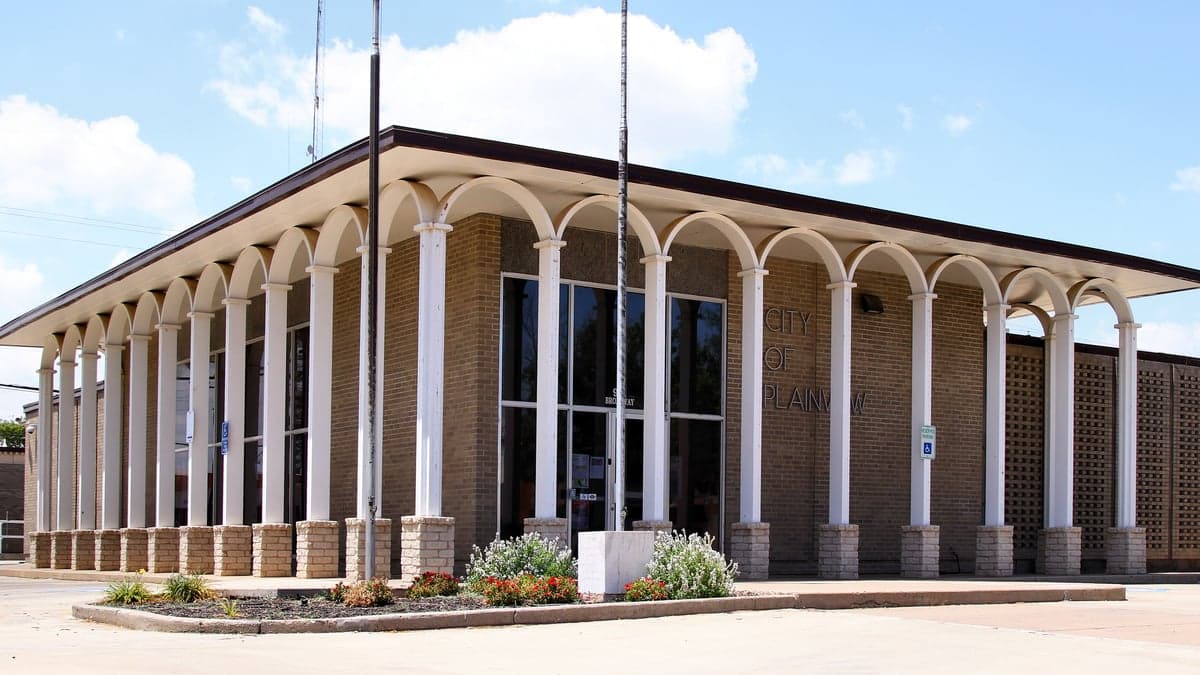
Photo: Wikipedia
Strategic Assessment of Plainview, TX
Workable tactical position. Some exposure to population density or targets, but generally defensible in a crisis.
What does the Strategic Assessment tell us?
Our Strategic Assessment grades tactical survivability of an area. Major population centers, military targets, fallout zones, natural disasters, and border exposure all drive risk — lower exposure means a more defensible position in a crisis.
This is heavily inspired by Joel Skousen's Strategic Relocation book. Highly recommended you checkout the book ($)What does this tell us?
Our Strategic Assessment grades tactical survivability of an area. Major population centers, military targets, fallout zones, natural disasters, and border exposure all drive risk — lower exposure means a more defensible position in a crisis.
This is heavily inspired by Joel Skousen's Strategic Relocation book. Highly recommended you checkout the book ($)Strategic Pillars

Key Distances
Regional Safe Places
Below is our recommended "safe zones" in Texas and the surrounding area based on our strategic heuristics. For most people, it's unrealistic to live in a “safe zone” full-time due to work, family or other personal reasons. They tend to be more rural. However, many of these areas are perfect for second homes and retreat properties that double as a vacation home or even a short-term rental.

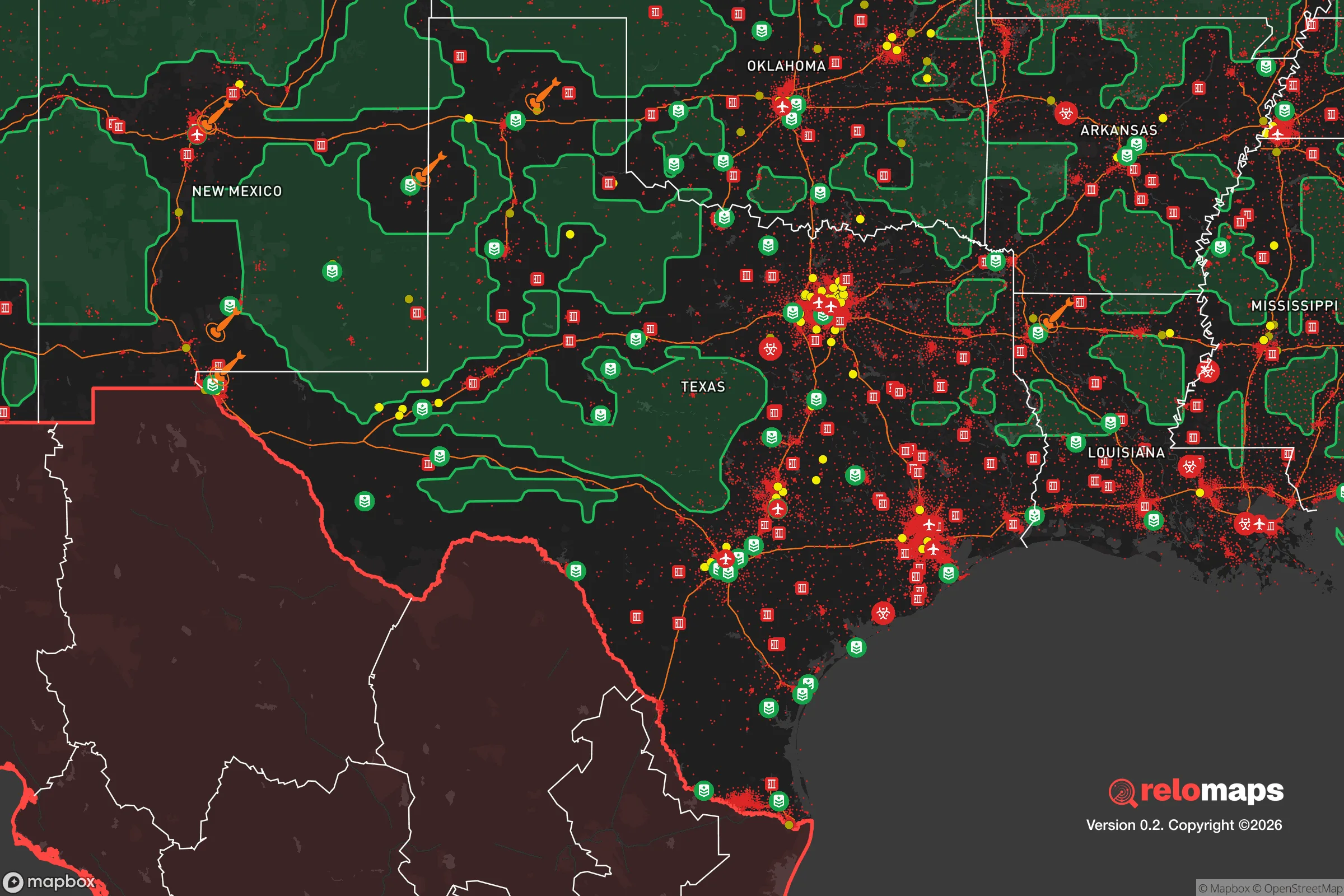


Important Note: For informational purposes only. This does not mean nothing bad ever happens in the green zones. Please use common sense. This is based on public data and modeled with AI. We tried to take a conservative approach but mistakes happen. We update this regularly as new information becomes available.
Solar Generator Recommendations
Backup power matters more here than in safer locations. We've picked three solar generators across budgets and capacity tiers — start with the budget unit if you only need a few essentials, or step up if you want to run a fridge and HVAC for days at a time.

Jackery Portable Power Station Explorer 300
Budget OptionPower on the Go: Weighing only 11 lbs, it's convenient to set up and store with book-sized foldable solar panels

BLUETTI Portable Power Station AC180
Designed for both indoor and outdoor scenarios, AC180 is highly capable as it has a robost capacity and continuous output power.

EF ECOFLOW DELTA Pro Ultra Power Station
Upgraded PickEcoFlow DELTA Pro Ultra is a whole-home energy system designed to grow with your family. Integrated with the Smart Home Panel 2, it scales to meet your evolving energy needs — keeping your home powered, intelligent, and secure through every stage of life.
We earn a commission, at no additional cost to you.
Strategic Assessment Analysis
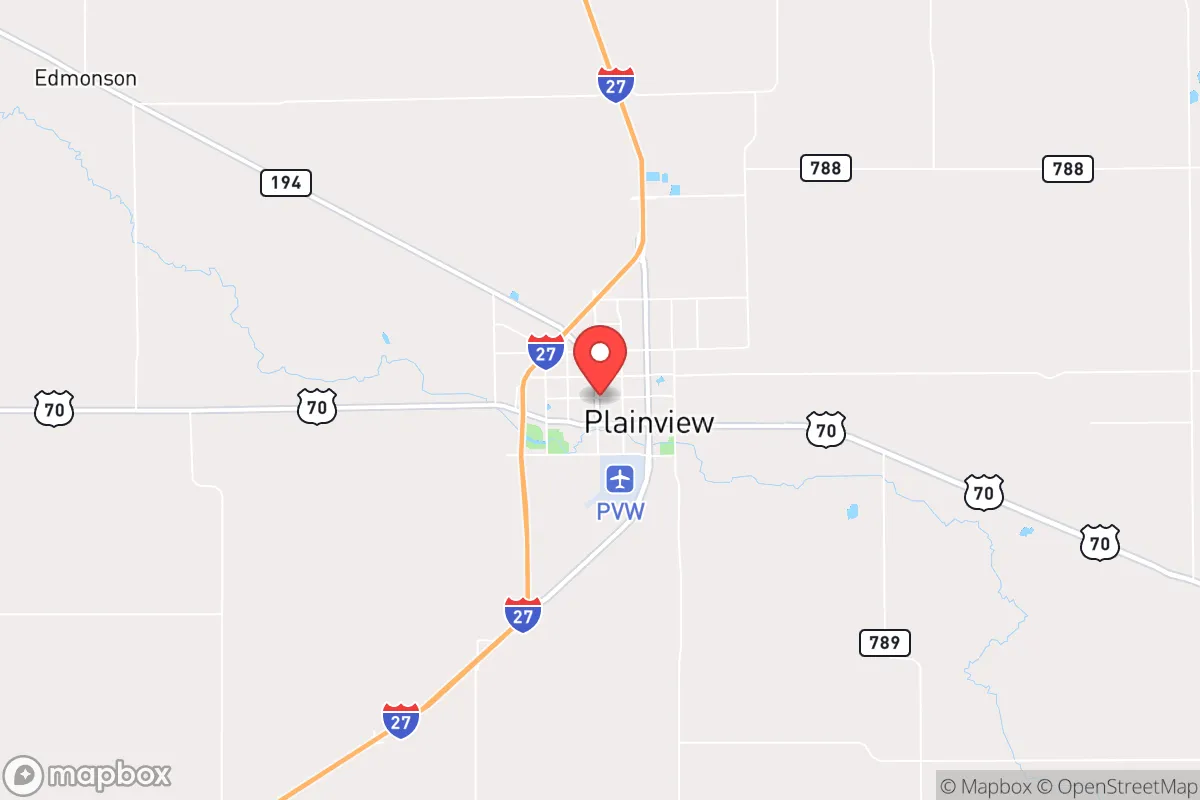
Plainview, Texas, offers a compelling mix of geographic isolation and practical self-sufficiency that makes it a serious contender for a relocation focused on resilience and preparedness. Situated on the High Plains of the Llano Estacado, the city sits roughly 45 miles north of Lubbock and 100 miles south of Amarillo, placing it far from the major metropolitan corridors that often become chokepoints in a crisis. Its location provides a strategic buffer—close enough to access regional resources, yet distant enough to avoid the immediate fallout of a major disruption in a large urban center. For a single individual or family looking to build a more self-reliant life, Plainview’s position offers a rare blend of seclusion and practical connectivity.
Geographic position and natural advantages on the High Plains
Plainview’s primary geographic advantage is its position on the flat, open expanse of the High Plains, which provides excellent long-range visibility and a natural defensive buffer. The terrain offers few natural obstacles, but that same openness means a relocator can easily survey their surroundings—a key consideration for security-minded individuals. The area sits atop the Ogallala Aquifer, one of the largest freshwater aquifers in the world, which underpins the region’s agricultural economy and provides a reliable, deep groundwater source. This is a critical asset for long-term water security, as surface water sources in Texas are increasingly stressed. The climate is semi-arid, with average annual precipitation around 20 inches, which supports dryland farming but also means that water conservation and rainwater harvesting are practical, not just theoretical, strategies. The region’s low population density—Hale County has roughly 33,000 residents spread over 1,005 square miles—reduces competition for resources and lowers the risk of disease transmission or social unrest spreading quickly. The flat terrain also makes the area well-suited for renewable energy installations, particularly wind and solar, which are already common across the South Plains.
Risks, exposures, and proximity to fallout-relevant landmarks
While Plainview’s isolation is a strength, it is not without risks. The most significant natural threat is severe weather, particularly tornadoes and hailstorms, which are common on the High Plains during spring and early summer. The flat terrain offers no natural shelter from these events, so a relocator must invest in a storm shelter or reinforced safe room. Drought is a recurring concern; the region has experienced multi-year dry spells that can stress local agriculture and water supplies. Wildfire risk is moderate, as the surrounding grasslands can carry a fast-moving fire, but the area’s low fuel load and sparse tree cover reduce the likelihood of catastrophic blazes. From a man-made risk perspective, Plainview’s distance from major military installations, nuclear power plants, and large industrial complexes is a net positive. The nearest significant potential target is the Pantex nuclear weapons plant near Amarillo, roughly 100 miles to the north. While this is a concern, the prevailing winds in the region are from the south-southwest, meaning fallout from a Pantex incident would likely be carried away from Plainview. The city is also far from the major petrochemical hubs along the Gulf Coast and the strategic targets in the Dallas-Fort Worth metroplex, which is over 300 miles to the east. Proximity to Lubbock (45 miles) is a double-edged sword: it provides access to medical and supply resources, but also means that a major event in that city could create a refugee flow or disrupt regional logistics. Overall, Plainview’s risk profile is dominated by natural hazards rather than man-made threats, which is favorable for a relocator focused on preparedness.
Practical resilience for a relocator: food, water, energy, and defensibility
Plainview’s practical resilience is anchored in its agricultural base. The city is surrounded by farms producing cotton, corn, wheat, and sorghum, as well as cattle feedlots and dairies. This means that local food production is not just a hobby but a core economic activity, and a relocator can tap into a network of farmers’ markets, co-ops, and direct-from-producer sources. The presence of large-scale grain elevators and processing facilities also provides a buffer against supply chain disruptions. Water security is strong due to the Ogallala Aquifer, but it is not infinite; the aquifer is being depleted at a rate of roughly 1-2 feet per year in this region. A prudent relocator should plan for a deep well (300-500 feet) and consider rainwater catchment as a supplement. Energy resilience is excellent: the area has abundant wind and solar resources, and many rural properties already have backup generators or off-grid solar setups. The local utility, South Plains Electric Cooperative, offers net metering, making it feasible to generate your own power. Defensibility is a mixed bag. The open terrain makes it difficult to secure a large property without significant investment in fencing, lighting, and surveillance. However, the low population density and strong community ties in rural Hale County mean that neighbors are often known and trusted, which can be a force multiplier for security. The city itself has a small police force and a volunteer fire department, so a relocator should not rely on public services for immediate response. Instead, the emphasis should be on self-reliance: stockpiling supplies, maintaining a well-stocked first aid kit, and developing a network of like-minded locals. The local hospital, Covenant Health Plainview, provides basic care, but serious emergencies require a 45-minute drive to Lubbock, so medical preparedness is essential.
The overall strategic picture for Plainview is one of a solid, if unglamorous, base for a resilience-minded relocation. It offers a rare combination of deep water, local food production, and renewable energy potential, all within a low-density, low-target environment. The trade-offs are real: harsh weather, a semi-arid climate, and the need for significant upfront investment in infrastructure like wells, shelter, and security. But for a family or individual willing to put in the work, Plainview provides a foundation that is both defensible and sustainable. It is not a prepper fantasyland, but a working agricultural community where self-sufficiency is a practical necessity, not a lifestyle choice. The city’s isolation from major targets and its access to the Ogallala Aquifer make it a location worth serious consideration for anyone prioritizing long-term resilience over convenience or glamour.

* Values derived from national, state, county, city and local statistics and may differ in a specific area. Last updated: 2026-08-25T23:24:49.000Z
Narrative content on this page is AI-generated and may contain mistakes. Verify any details that matter before acting on them.
ReloMaps may earn a commission from affiliate links at no extra cost to you.

