Photo: Wikipedia
Demographics of Pittsfield, MA
Affluence Level in Pittsfield, MA
A below-average socioeconomic profile. Incomes, home values, and educational attainment trail the U.S., with higher poverty and unemployment.
People of Pittsfield, MA
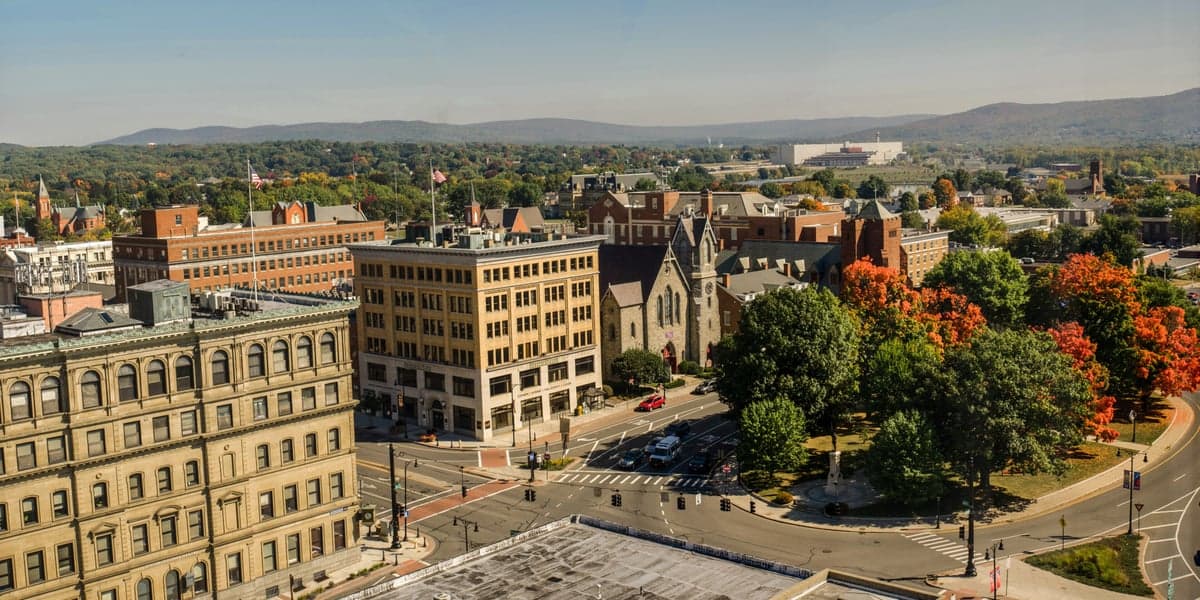
Today, Pittsfield’s 43,559 residents form a predominantly white (77.4%) and older-than-state-average population, with a notable Hispanic minority (9.0%) and smaller Black (4.8%) and East/Southeast Asian (1.0%) communities. The city’s character remains shaped by its industrial past—a blue-collar, union-minded ethos that coexists with a growing college-educated cohort (34.2%) drawn to the Berkshires’ cultural amenities. Pittsfield is denser than most Western Massachusetts towns, with a compact urban core surrounded by leafy residential neighborhoods, and its identity is increasingly split between longtime working-class families and newer arrivals seeking lower costs relative to Boston or New York.
How the city was settled and grew
Pittsfield’s original European settlers arrived in the 1740s as part of a land grant from the Province of Massachusetts Bay, displacing the Mohican people who had used the Housatonic River valley for seasonal hunting. The town grew slowly as an agricultural center until the 19th century, when the General Electric (GE) plant opened in 1903, triggering the city’s defining population wave. GE drew thousands of Italian, Polish, French-Canadian, and Irish immigrants and domestic migrants, who built dense ethnic neighborhoods around the factory. The West Side became heavily Italian and Polish, with three-decker homes and corner groceries; the Morningside neighborhood filled with Irish and French-Canadian families working at GE and the Crane paper mill. By 1950, Pittsfield’s population peaked at roughly 57,000, nearly all white, with a small Black community concentrated near the First Street corridor in the downtown flats. The city’s Jewish population, largely German and Eastern European, settled around South Street and established Congregation Knesset Israel in 1912.
Modern era (post-1965)
The 1965 Hart-Cellar Act had a muted effect on Pittsfield compared to gateway cities—foreign-born residents today are just 3.3%, well below the national average. The major demographic shift after 1965 was domestic: the collapse of GE employment from 13,000 workers in the 1970s to fewer than 1,000 by the 1990s triggered a sustained out-migration of white working-class families, especially to the Allendale and Lakewood neighborhoods in the city’s north end, which suburbanized as Pittsfield’s population shrank by 24% between 1970 and 2020. Hispanic migration, primarily Puerto Rican and Dominican, began in the 1980s, settling in the West Side and Downtown areas where housing was cheapest; the Hispanic share grew from 2% in 1990 to 9.0% today. The Black population, historically small, has remained stable at 4.8%, concentrated in the Morningside and West Side rental stock. East/Southeast Asian residents (1.0%) are mostly Chinese and Vietnamese families who arrived post-2000, often as medical professionals at Berkshire Medical Center, living in the East Side near the hospital. The Indian-subcontinent population (0.4%) is tiny and scattered, with no distinct enclave.
The future
Pittsfield’s population is slowly stabilizing after decades of decline, but it is not homogenizing—rather, it is tribalizing into distinct enclaves by income and ethnicity. The white population is aging and shrinking (down from 86% in 2000), while the Hispanic share is growing steadily through both birth rates and continued migration from Puerto Rico and the Dominican Republic. The West Side is becoming the city’s de facto Hispanic hub, with bodegas and Spanish-language signage increasing, while the Allendale and Lakewood neighborhoods remain overwhelmingly white and older. The college-educated cohort (34.2%) is rising as remote workers and retirees from Boston and New York buy into the South Street historic district and the Berkshire Common area, but this influx is small—perhaps 200–300 households per year—and concentrated in the downtown core. The foreign-born share is unlikely to rise above 5% in the next decade given the lack of entry-level manufacturing jobs and the city’s remote location. The next 10–20 years will likely see Pittsfield become a bifurcated city: a gentrifying, culturally active downtown and East Side, and a shrinking, older white periphery in the north and west, with the Hispanic population growing into a near-majority in the West Side and parts of Morningside.
For a conservative-leaning mover, Pittsfield offers a low-cost, low-crime environment relative to the rest of Massachusetts, but the city’s demographic trajectory means the political and cultural center of gravity is shifting toward a more diverse, younger, and slightly more liberal population in the core neighborhoods. The safest bet for families seeking stability is the Allendale or Lakewood areas, where homeownership rates are high and schools are solid, while the West Side and Downtown are where the city’s future—and its growing Hispanic community—is being shaped.

* Values derived from national, state, county, city and local statistics and may differ in a specific area. Last updated: 2026-04-24T08:07:05.000Z
Narrative content on this page is AI-generated and may contain mistakes. Verify any details that matter before acting on them.
ReloMaps may earn a commission from affiliate links at no extra cost to you.

