

Photo: Wikipedia
Political ClimatePolitical Climate in Picayune, MS
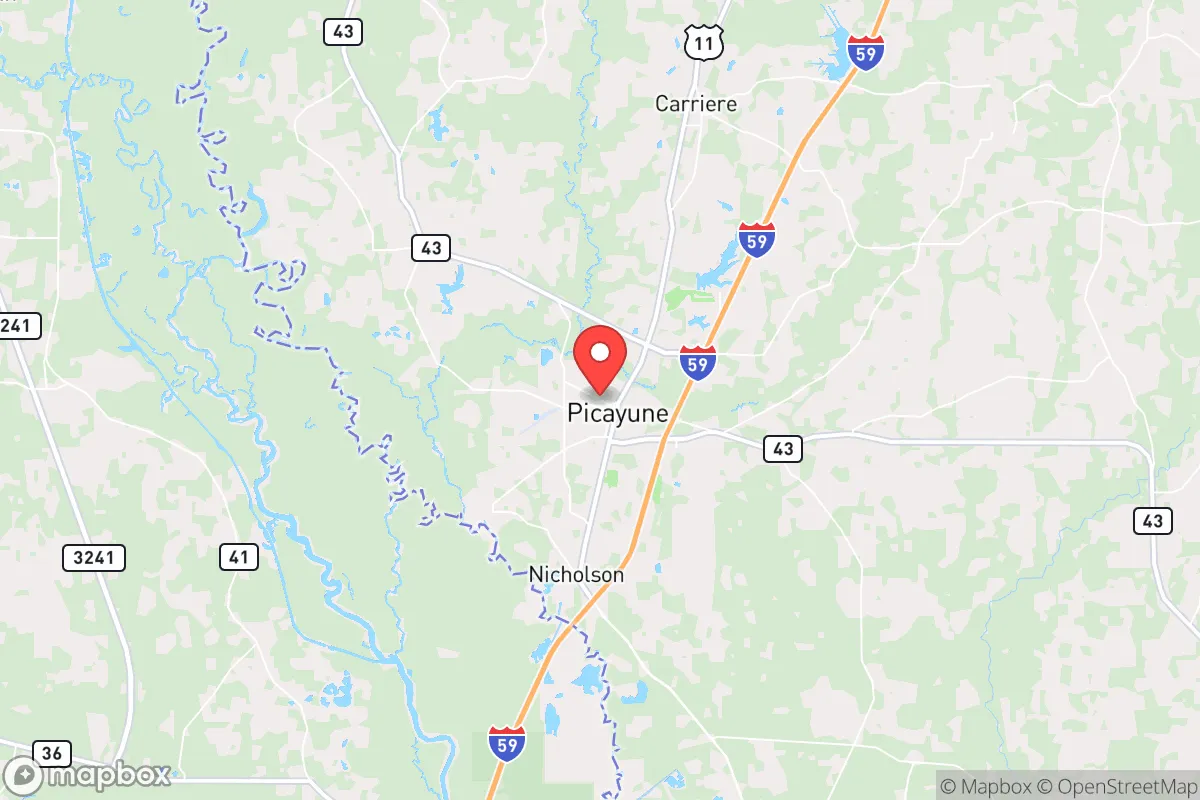
District shown is the primary district for this city’s centroid. Cities may span multiple districts.
Local Political AnalysisPolitical Analysis of Picayune, MS
Picayune, Mississippi, sits deep in solidly conservative territory, with a Cook PVI of R+21 that reflects generations of traditional values and a healthy skepticism of government overreach. This isn't a place that's suddenly flipped; it's been reliably red for as long as anyone can remember, and the local culture still prizes personal responsibility and limited interference from Jackson or Washington. That said, like a lot of small Southern towns, you can feel the winds shifting a bit — not enough to flip the map, but enough to make a long-time resident pay attention to what's creeping in from the coasts.
How it compares
Drive 30 minutes south and you hit Slidell, Louisiana, which leans conservative too but has a more suburban, New Orleans-adjacent feel — a bit more purple in local races, with some progressive pockets near the lakefront. Head north toward Hattiesburg, and you'll find a younger, more transient college-town vibe that's noticeably less conservative than Pearl River County. Picayune itself is the anchor of a deeply red county; the surrounding unincorporated areas like Carriere and McNeill are even more staunchly traditional. The contrast is sharpest if you go east to Gulfport or Biloxi, where tourism and a larger military presence bring in more moderate and even left-leaning voices. Here in Picayune, though, the political DNA is still small-government, pro-Second Amendment, and wary of any policy that looks like it's coming from D.C. or state-level bureaucrats who don't know the first thing about life on the Pearl River.
What this means for residents
For folks living here, the conservative tilt isn't just about who gets elected — it shapes daily life in tangible ways. Property taxes stay low, zoning is minimal, and there's a general live-and-let-live attitude as long as you're not causing trouble. You won't see mask mandates or business shutdowns being enforced with any enthusiasm; the local leadership tends to err on the side of personal choice. That's a big deal for anyone who moved here to escape the overreach they saw in places like New Orleans or even Hattiesburg. The downside? If you're hoping for rapid infrastructure investment or progressive social programs, you'll be disappointed. The county commission moves slow, and there's a deep distrust of federal grants that come with strings attached. Most residents see that as a feature, not a bug.
What's worth watching is the cultural drift. A few years back, you'd never hear talk of diversity initiatives or climate action plans at city council meetings. Now, there's the occasional whisper of it — usually from newcomers or folks who commute to the coast. It's not a threat yet, but it's a reminder that no place is an island. The school board and local library have become quiet battlegrounds over curriculum and book content, with most long-time residents pushing back hard against anything that smells like indoctrination. For now, Picayune holds the line, but it takes vigilance. If you value your freedoms and want a place where the government stays out of your business, this is still one of the best spots in the state — just keep an eye on the horizon.

State Political ClimatePolitical Climate in Mississippi
State Political AnalysisPolitical Environment in the State
Mississippi has long been one of the most reliably conservative states in the country, with a Republican lean that has only deepened over the past two decades. The state has not voted for a Democratic presidential candidate since 1976, and in 2024, Donald Trump carried it by over 16 points. The dominant coalition is a mix of rural and suburban voters, evangelical Christians, and a growing number of conservative-leaning newcomers drawn by low taxes and a slower pace of life. Over the last 10-20 years, the shift has been steady: once a "blue dog" Democratic stronghold in local races, Mississippi now holds a Republican supermajority in both chambers of its legislature, and every statewide elected office is held by a Republican.
Urban vs. rural divide
The political map of Mississippi is starkly divided between its handful of urban centers and the vast rural countryside. The Jackson metro area, including Hinds, Madison, and Rankin counties, is the only real Democratic stronghold—Hinds County voted over 70% for Joe Biden in 2020, driven by a large African American population and a shrinking but still active progressive base. But even here, the suburbs tell a different story: Madison County, just north of Jackson, is reliably Republican, with Trump winning it by 12 points in 2024. The Gulf Coast, anchored by Biloxi and Gulfport, leans Republican but has pockets of Democratic support in working-class communities. The real engine of conservative dominance is the rural "Golden Triangle" region—Columbus, Starkville, and West Point—along with the Delta counties like DeSoto, which is a fast-growing Memphis exurb that votes heavily Republican. The northeastern hill country around Tupelo and Oxford (home to the University of Mississippi) is more mixed, with Oxford itself trending leftward as the university grows, but the surrounding counties remain deeply red.
Policy environment
Mississippi’s policy environment is among the most conservative in the nation, with a strong emphasis on limited government and traditional values. The state has no income tax on wages—a major draw for relocating families—and a flat 4% corporate income tax that is being phased out entirely by 2028. Property taxes are among the lowest in the country, with a median effective rate of just 0.65%. Education policy is a mixed bag: the state has a school choice program (the Mississippi Education Scholarship Account) that allows parents to use public funds for private or homeschool expenses, but public schools remain underfunded and struggle with low test scores. Healthcare is a flashpoint—Mississippi has not expanded Medicaid under the Affordable Care Act, leaving a coverage gap for low-income adults, but the state has passed some of the strongest pro-life laws in the country, including a near-total abortion ban that took effect in 2022. Election laws are strict: voter ID is required, and the state has no early voting or no-excuse absentee voting, which conservatives argue protects election integrity. The Second Amendment is broadly protected—Mississippi is a constitutional carry state, meaning no permit is needed to carry a concealed firearm.
Trajectory & freedom
Over the past five years, Mississippi has moved decisively toward expanding personal freedom in several key areas, though some trends are concerning. On the positive side, the state passed the Mississippi Parental Rights Act in 2023, which requires schools to notify parents before any instruction on sexual orientation or gender identity—a major win for family autonomy. The same year, the legislature banned gender transition procedures for minors, making Mississippi one of the first states to do so. Gun rights have been strengthened: the 2021 "stand your ground" law expanded self-defense protections, and the state has resisted any federal attempts at firearm regulation. On the economic front, the phase-out of the corporate income tax and the elimination of the state income tax on wages (effective 2022) have made Mississippi one of the most tax-friendly states in the South. However, there are red flags: the state’s reliance on federal funding (over 40% of its budget comes from Washington) creates a vulnerability to federal overreach, and the growing influence of out-of-state money in local elections—particularly from left-leaning PACs targeting judicial races—is a trend to watch. The 2024 election saw a surge in dark money spending in Mississippi’s Supreme Court races, which could erode judicial independence.
Civil unrest & political movements
Mississippi has not seen the kind of widespread civil unrest that has hit larger states, but there have been notable flashpoints. The 2020 Black Lives Matter protests in Jackson were relatively small and peaceful compared to other cities, but they did lead to the removal of several Confederate monuments, including the statue of Jefferson Davis in the state capitol. The state’s immigration politics are quiet—Mississippi has no sanctuary cities, and the legislature passed a law in 2023 requiring local law enforcement to cooperate with federal immigration authorities. The most visible political movement in recent years has been the rise of the "Mississippi Freedom Caucus," a group of hardline conservatives in the state House who have pushed for further tax cuts, school choice expansion, and stricter election laws. On the left, the Mississippi Poor People’s Campaign has organized around Medicaid expansion and criminal justice reform, but it has little electoral impact. Election integrity remains a hot-button issue: the 2023 law requiring all absentee ballots to be notarized or witnessed by two adults was challenged in court but upheld, and there is ongoing debate about the security of the state’s voting machines, which are still paperless in many counties.
Projection
Over the next 5-10 years, Mississippi is likely to remain deeply conservative, but demographic shifts could introduce new tensions. The state’s population is aging and slowly declining, with the biggest growth happening in DeSoto County (Memphis exurbs) and the Gulf Coast, both of which attract conservative-leaning migrants from other states. The Jackson metro area will continue to lose population as white and middle-class black families move to the suburbs, further solidifying the urban-rural divide. The biggest wildcard is the state’s education system: if school choice continues to expand, it could attract more families from blue states, but if public schools continue to decline, it could accelerate the brain drain of young professionals. The political trajectory is toward even more conservative policies—look for a full repeal of the corporate income tax, further restrictions on abortion (including a potential ban on out-of-state travel for the procedure), and a push to eliminate property taxes entirely. The biggest threat to freedom in Mississippi is not a leftward shift in the electorate, but the growing power of federal mandates and the state’s dependence on federal dollars, which could force compliance with progressive policies down the road.
For a new resident, the bottom line is this: Mississippi offers a high degree of personal freedom in terms of taxes, gun rights, and parental control over education, but you need to be aware of the trade-offs. The public school system is weak, healthcare access is limited in rural areas, and the state’s economy is heavily dependent on federal money. If you value low taxes, strong Second Amendment protections, and a culture that respects traditional values, Mississippi is a solid choice—just make sure you have a plan for your kids’ education and your own healthcare. The state is not going to turn blue anytime soon, but the fight over local control versus federal overreach is just beginning.
* Values derived from national, state, county, city and local statistics and may differ in a specific area. Last updated: 2026-04-19T05:36:22.000Z
Narrative content on this page is AI-generated and may contain mistakes. Verify any details that matter before acting on them.
ReloMaps may earn a commission from affiliate links at no extra cost to you.

