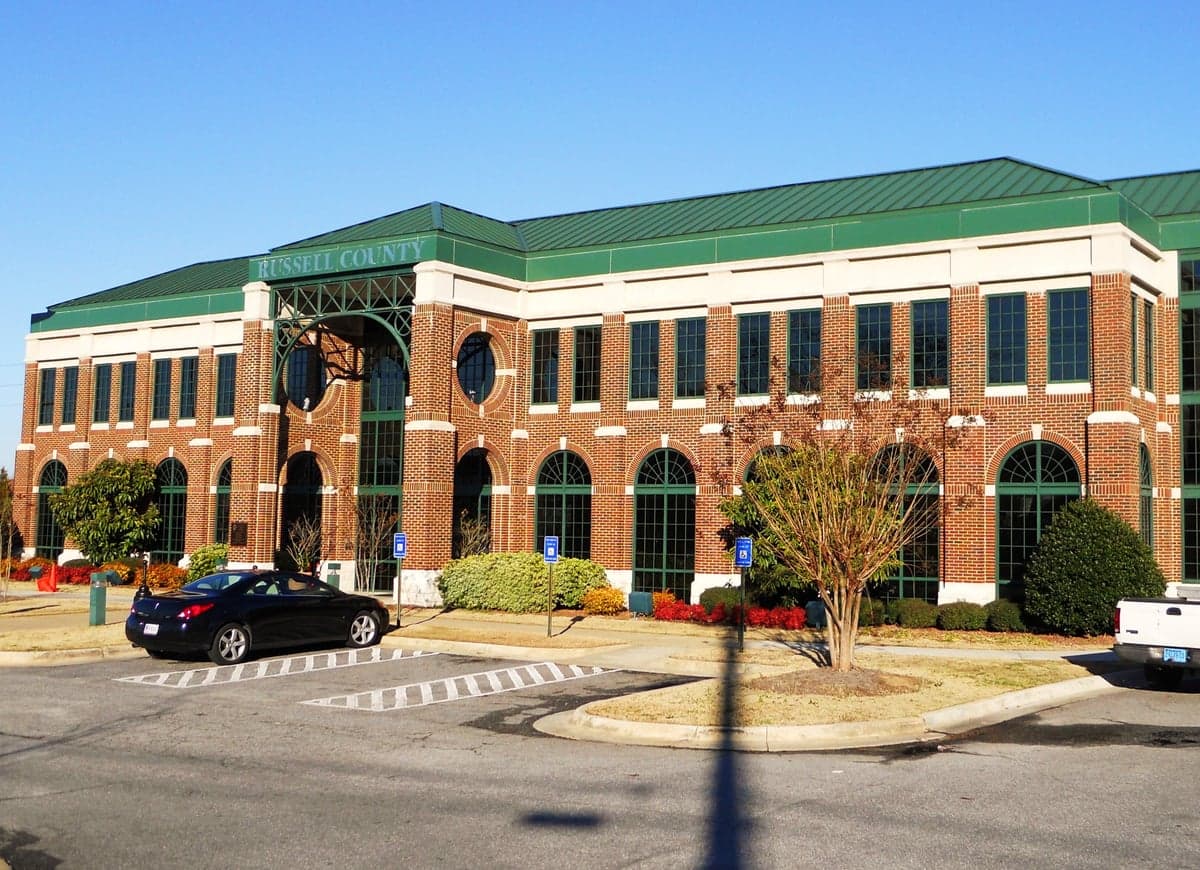
Photo: Wikipedia
Demographics of Phenix City, AL
Affluence Level in Phenix City, AL
A below-average socioeconomic profile. Incomes, home values, and educational attainment trail the U.S., with higher poverty and unemployment.
People of Phenix City, AL
Phenix City, Alabama, is a city of roughly 38,500 residents defined by a near-even split between Black (45.6%) and White (41.6%) populations, with a small but growing Hispanic community (6.3%) and a minimal foreign-born share of just 1.5%. Its people are overwhelmingly native-born, working-class, and shaped by a history of industrial booms, racial transition, and cross-river spillover from Columbus, Georgia. The city’s identity is neither Deep South rural nor Sun Belt suburban—it is a gritty, affordable, majority-minority border town where 23.3% of adults hold a college degree, reflecting a blue-collar base that has persisted for generations.
How the city was settled and grew
Phenix City was not a colonial-era settlement. It emerged after the Civil War as a railroad and river-trade outpost on the Chattahoochee River opposite Columbus, Georgia. The original white settlers were mostly yeoman farmers and merchants from Georgia and the Carolinas who arrived in the 1870s–1880s, drawn by cheap land and the new rail connections. The city incorporated in 1883, and its early growth centered on the Girard district—the historic core on the riverfront—where sawmills, cotton gins, and a small textile industry employed both white and Black laborers. By the early 1900s, Black families had established a distinct community in the South Girard neighborhood, working as domestic servants, mill hands, and dock workers. The first major population wave came during World War I and the 1920s, when Fort Benning (now Fort Moore) opened across the river, drawing soldiers, camp followers, and service workers to Phenix City’s cheap housing and vice-tolerant atmosphere. The city’s notorious “Sin City” reputation in the 1940s–1950s—gambling, prostitution, moonshine—attracted a transient, mostly white male population, but the permanent base remained the Black and white working poor who built the neighborhoods of Idle Hour and Lakewood on the city’s east side.
Modern era (post-1965)
The 1965 Hart-Cellar Act had almost no effect on Phenix City—its foreign-born share today is just 1.5%, and the city never received significant immigration from Asia, Latin America, or Africa. Instead, the post-1965 story is one of domestic racial turnover and suburbanization. From the 1970s through the 1990s, white families steadily left the older riverfront neighborhoods—Girard and South Girard—for newer subdivisions on the city’s northern and eastern edges, such as Lakewood and the Fox Run area. Black families moved into the vacated housing stock, shifting the city from majority-white to majority-Black by the 2000 census. Today, Black residents are concentrated in Girard, South Girard, and the central corridor along 14th Street, while white residents are more heavily represented in the newer subdivisions east of US-431 and north of the railroad tracks. The Hispanic population, though small at 6.3%, has grown since 2000, settling mostly in the Idle Hour and Lakewood neighborhoods, drawn by low rents and construction jobs tied to Fort Moore and the Columbus metro. East/Southeast Asian residents (1.3%) are a thin presence, largely professionals and military-affiliated families living in the newer subdivisions near the Georgia border. Indian-subcontinent residents are statistically zero.
The future
Phenix City’s population is likely to remain overwhelmingly native-born and bifurcated by race, with no major immigrant wave on the horizon. The Hispanic share may rise slowly—perhaps to 8–10% by 2035—as families follow construction and service-sector jobs, but the city lacks the anchor industries or refugee resettlement programs that drive rapid diversification elsewhere. The Black and white populations will continue to live in largely separate neighborhoods: Black residents in the older, denser west side (Girard, South Girard) and white residents in the newer, lower-density east side (Lakewood, Fox Run). This pattern is not tribalizing into conflict but is a stable, quiet segregation by income and housing stock. The college-educated share (23.3%) is below the national average and unlikely to rise sharply unless Fort Moore expands its professional workforce or remote workers discover Phenix City’s low cost of living. The city is homogenizing in the sense that it is becoming more uniformly working-class and native-born, even as its racial composition remains split.
For someone moving in now, Phenix City offers a straightforward trade-off: very low housing costs and proximity to Columbus, Georgia’s jobs and amenities, in exchange for a population that is overwhelmingly native-born, racially divided by neighborhood, and unlikely to change character quickly. It is not a melting pot or a boomtown—it is a stable, affordable, majority-minority border city where the next decade will look much like the last.

* Values derived from national, state, county, city and local statistics and may differ in a specific area. Last updated: 2026-04-19T19:05:55.000Z
Narrative content on this page is AI-generated and may contain mistakes. Verify any details that matter before acting on them.
ReloMaps may earn a commission from affiliate links at no extra cost to you.

