Photo: Wikipedia
Demographics of Blair County
Affluence Level in Blair County
A below-average socioeconomic profile. Incomes, home values, and educational attainment trail the U.S., with higher poverty and unemployment.
People of Blair County
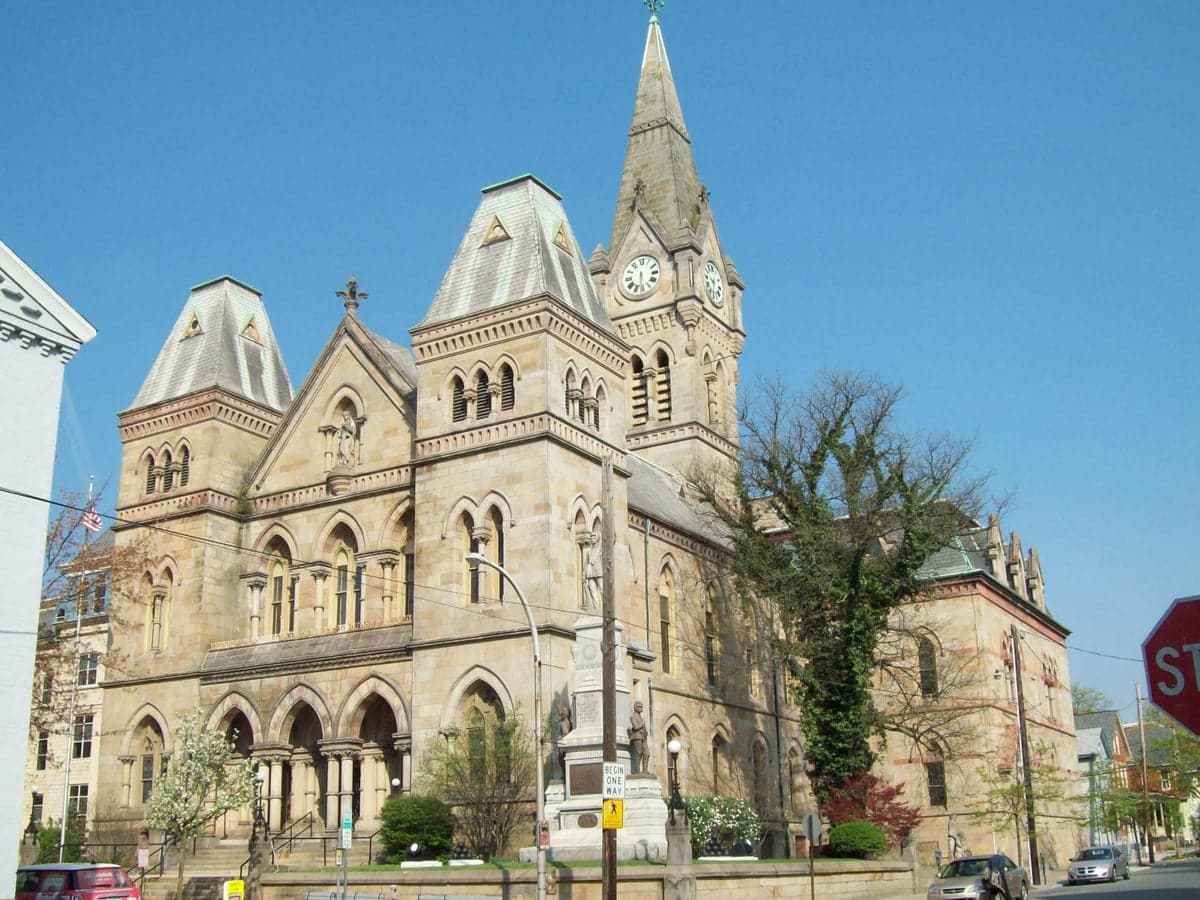
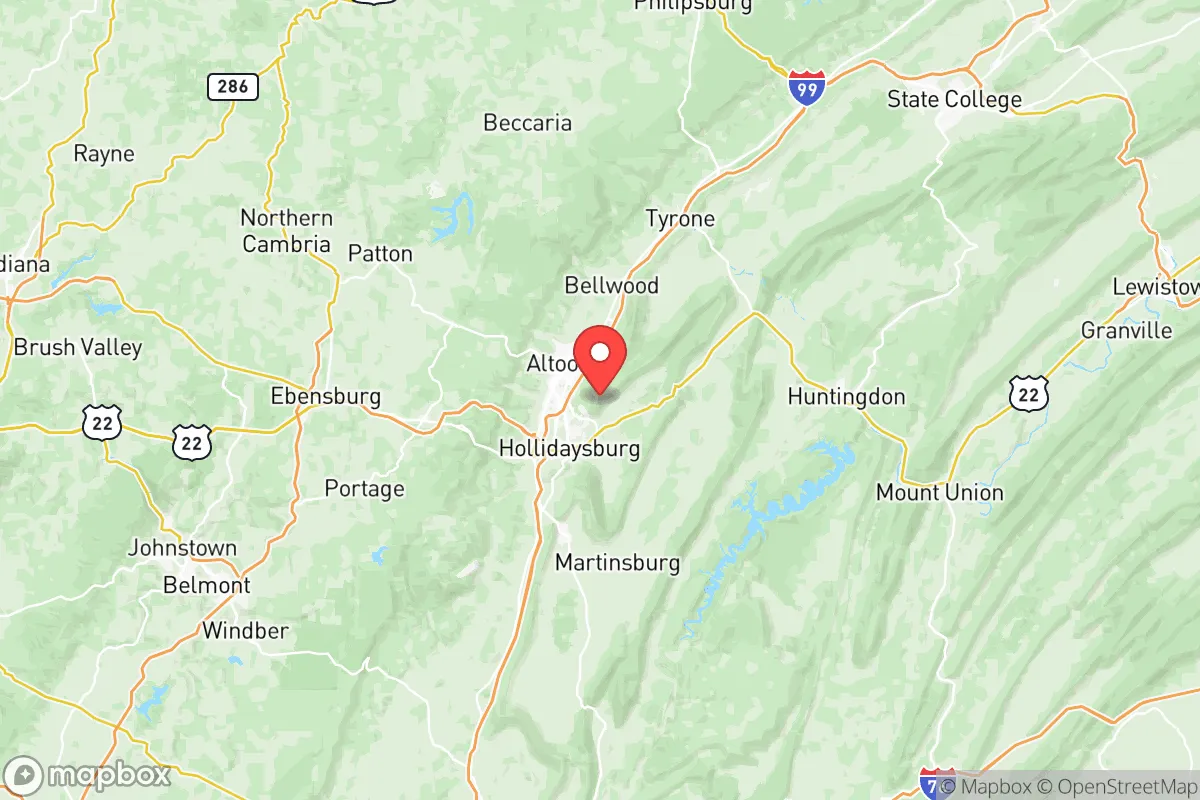
Blair County, Pennsylvania, is a predominantly white, working-class region of 121,854 residents, anchored by the city of Altoona and shaped by a deep railroad and industrial heritage. The population is notably homogenous, with 92.6% identifying as white, a foreign-born share of just 0.7%, and a college attainment rate of 24.1% that trails the national average. The county’s identity is rooted in its Appalachian and Rust Belt character, marked by a strong sense of local community, a conservative-leaning political culture, and a population that has been slowly declining for decades.
Settlement & growth (pre-1960)
Before European settlement, the region that is now Blair County was inhabited by the Iroquois Confederacy, particularly the Seneca and Susquehannock nations, who used the area for hunting and as a corridor through the Allegheny Front. The first European presence was sparse, with French and British traders passing through during the 18th century, but no permanent colonial settlements were established until after the American Revolution.
The first major wave of settlers arrived between 1790 and 1820, primarily Scots-Irish and German farmers pushing westward from the older settlements of Lancaster and York counties. These pioneers cleared the dense forests of the Juniata River valley and established small agricultural communities like Hollidaysburg (founded 1796) and Martinsburg (laid out 1799). Hollidaysburg, in particular, became a critical early hub as the terminus of the Allegheny Portage Railroad, a key link in the Pennsylvania Main Line Canal system that connected Philadelphia to Pittsburgh by the 1830s.
The defining event in Blair County’s population history was the arrival of the Pennsylvania Railroad (PRR) in the 1850s. The railroad chose the rugged Horseshoe Curve near Altoona as a critical crossing of the Allegheny Mountains, and the PRR established its massive Altoona Works—a sprawling complex of locomotive repair and manufacturing shops—in the 1850s and 1860s. This industrial boom triggered a second, much larger wave of immigration. Between 1880 and 1920, tens of thousands of immigrants arrived to work in the railroad shops and related industries. The largest groups were Italians (especially from southern Italy and Sicily), Poles, Slovaks, Germans, and Irish. These groups settled overwhelmingly in Altoona, forming distinct ethnic neighborhoods: the “Little Italy” district around 7th Avenue and 12th Street, the Polish enclave in the “Pleasant Valley” area, and the Irish community concentrated near the railroad yards. Smaller numbers of Greek and Lithuanian immigrants also arrived, opening restaurants and small businesses. By 1920, Altoona’s population had surged past 60,000, making it one of Pennsylvania’s largest cities.
Outside Altoona, the railroad’s influence was less direct. Tyrone, a borough in the northern part of the county, grew as a railroad junction and manufacturing center, attracting a mix of German and Irish workers. Roaring Spring, in the south, developed around paper mills and limestone quarries, drawing a largely native-born white workforce. The county’s African American population remained tiny throughout this period—less than 2%—as the region’s industrial jobs were largely reserved for white immigrants and their descendants. The Great Migration of Black Americans from the South largely bypassed Blair County, as the railroad industry was already in decline by the 1940s.
Modern era (post-1965)
The post-1965 period in Blair County is defined not by new immigration but by population stagnation and decline. The 1965 Hart-Cellar Act, which dramatically reshaped U.S. immigration patterns, had almost no effect here. The county’s foreign-born population remains at just 0.7%, one of the lowest rates in Pennsylvania. The small number of immigrants who have arrived since the 1970s are primarily East/Southeast Asian (0.4% of the population) and Indian subcontinent (0.2%), many of whom work as healthcare professionals at UPMC Altoona or as engineers at local manufacturing firms. These groups are dispersed rather than concentrated in any single neighborhood, and no significant ethnic enclave has formed.
The dominant demographic story of the modern era is domestic out-migration. The decline of the Pennsylvania Railroad, which merged into Conrail in 1976 and eventually shed most of its Altoona operations, cost the county thousands of jobs. Between 1970 and 2020, Blair County’s population fell from 135,000 to 121,854, a loss of nearly 10%. Young adults, in particular, have left for larger cities like State College, Harrisburg, and Pittsburgh, seeking opportunities in education, technology, and professional services. This “brain drain” has contributed to the county’s low college attainment rate of 24.1% and an aging population: the median age is 43.5, well above the national median of 38.8.
The Hispanic population, at 1.5%, has grown modestly since 2000, driven by a small number of Mexican and Central American workers employed in agriculture, construction, and food processing. Most of this growth has occurred in rural townships like Greenfield Township and Woodbury Township, where farms and distribution centers offer seasonal work. The Black population, at 1.7%, has remained stable and is concentrated in Altoona, particularly in the city’s older neighborhoods near the former railroad shops. Suburbanization has been limited: Altoona’s population has declined from 57,000 in 1970 to roughly 43,000 today, while the surrounding townships—such as Logan Township and Blair Township—have seen modest growth as residents move to newer housing developments while still commuting to Altoona for work and services.
The future
Blair County’s population is projected to continue its slow decline over the next 10-20 years, driven by an aging population and limited in-migration. The county’s demographic profile is unlikely to become significantly more diverse: the white share of the population is expected to remain above 90%, and the foreign-born share will likely stay below 1.5%. The small Hispanic and Asian communities may grow incrementally, but they will remain a tiny fraction of the total population. New residents are most likely to be domestic retirees seeking lower housing costs, or remote workers attracted by the county’s relatively affordable real estate—median home values in Altoona are around $90,000, compared to the state median of $200,000.
Cultural identity in Blair County is evolving slowly. The old ethnic divisions between Italian, Polish, and Irish neighborhoods in Altoona have largely faded, replaced by a broader, more homogenized white working-class identity. The county’s political leanings have shifted rightward: Donald Trump won Blair County by 35 points in 2020, up from 28 points in 2016, reflecting a broader trend of rural and exurban areas becoming more Republican. The county’s economy is diversifying away from its railroad roots, with healthcare (UPMC Altoona is the largest employer), manufacturing (including Appvion paper in Roaring Spring and Kennametal in Altoona), and logistics (warehousing along the I-99 corridor) providing the bulk of jobs.
For someone moving in now, Blair County offers a stable, affordable, and culturally conservative environment with a strong sense of local history. The trade-offs are clear: limited diversity, a shrinking job market for young professionals, and a population that is older and more insular than the national average. The county is not becoming a destination for newcomers; it is a place where people stay, and where those who leave are not being replaced.

* Values derived from national, state, county, city and local statistics and may differ in a specific area. Last updated: 2026-07-27T07:52:59.000Z
Narrative content on this page is AI-generated and may contain mistakes. Verify any details that matter before acting on them.
ReloMaps may earn a commission from affiliate links at no extra cost to you.

