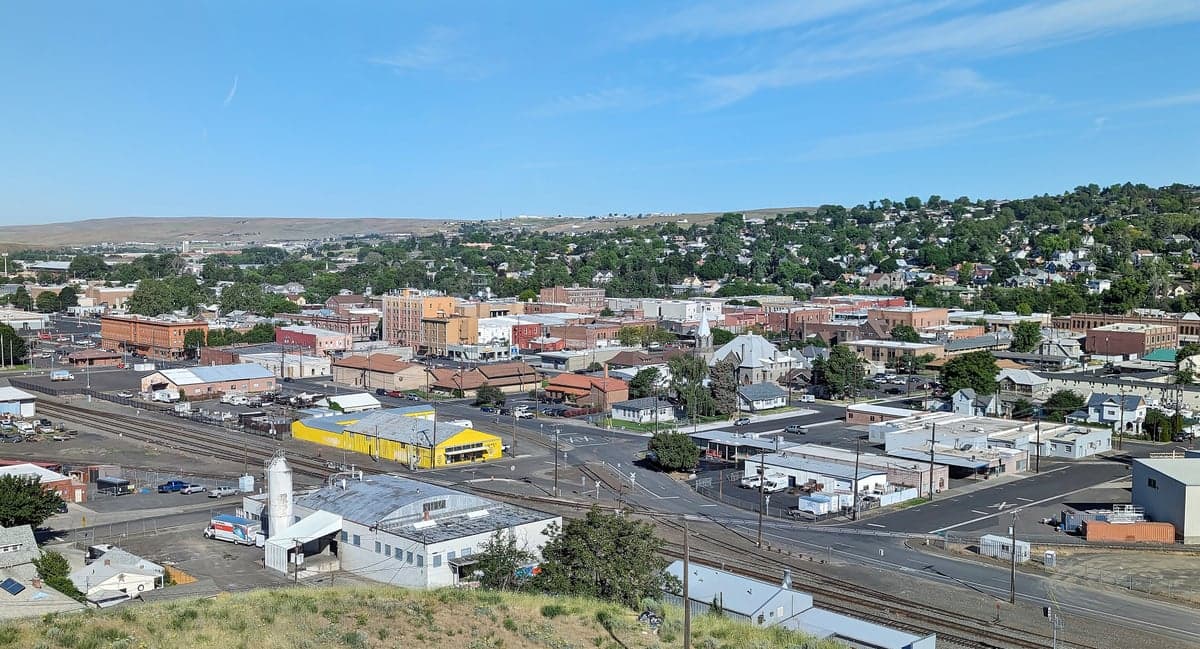
Photo: Wikipedia
Personal Sovereignty in Pendleton, OR
Viable for self-reliance. Generally workable, though some barriers may limit total independence.
What does Personal Sovereignty tell us?
Personal Sovereignty measures your capacity for self-reliance and independence with minimal government friction. Higher scores mean fewer barriers between you and the way you want to live... but it assumes you have the space you need and good neighbors.
What does this tell us?
Personal Sovereignty measures your capacity for self-reliance and independence with minimal government friction. Higher scores mean fewer barriers between you and the way you want to live... but it assumes you have the space you need and good neighbors.
State Policy
Energy independence: Importer (35% of energy produced in-state)
Personal Liberty
Homesteading

Personal Liberty Analysis
In Pendleton, Oregon, personal sovereignty is less a legal abstraction and more a lived reality shaped by the state's uneven regulatory landscape and the town's fiercely independent Eastern Oregon culture. While the state-level political climate in Salem often leans toward expansive government, Pendleton sits in a region where local enforcement, cultural norms, and geographic isolation create a buffer of practical autonomy. For those prioritizing self-determination—whether through homesteading, firearm ownership, or resisting government overreach—this area offers a tangible, if imperfect, bastion of personal freedom compared to the Willamette Valley. The key is understanding where state law imposes limits and where local practice provides de facto liberty.
Tax burden and regulatory posture in Eastern Oregon
Oregon's tax structure is a mixed bag for those focused on minimizing government dependency. The state has no sales tax, which is a direct advantage for large purchases and everyday goods, but it levies a progressive income tax with top marginal rates reaching 9.9%—a significant bite for high earners or those running a side business. Property taxes in Umatilla County are moderate, typically ranging from 1.0% to 1.2% of assessed value, which is lower than many coastal or urban counties. The regulatory posture in Pendleton itself is notably lighter than in Portland or Bend. Zoning enforcement is less aggressive, and the city’s approach to business licensing and home-based enterprises is practical rather than punitive. For the survivalist-minded, the real advantage lies in the county's limited appetite for code enforcement battles—if you're not bothering neighbors, county officials tend to look the other way. However, state-level regulations on water rights, septic systems, and building permits still apply, so due diligence on those fronts is necessary before assuming complete freedom.
Self-defense environment and specific gun laws in Pendleton
Oregon is a shall-issue state for concealed handgun licenses, but the local landscape in Pendleton is far friendlier to self-defense than the state's recent legislative trends suggest. Pendleton’s sheriff’s office and local law enforcement are known for practical, common-sense application of gun laws, and there are no local ordinances that restrict magazine capacity, firearm types, or storage requirements beyond state mandates. The 2022 voter-approved Measure 114—which would require a permit to purchase and ban magazines over ten rounds—is currently blocked by court injunction, meaning the old statute remains in effect as of early 2026. For now, Pendleton residents can carry openly without a permit, and concealed carry permits are issued relatively quickly (typically 30-45 days) with no local resistance. The broader context is that Umatilla County voted overwhelmingly against Measure 114, and local law enforcement has signaled they will not prioritize enforcing laws they view as unconstitutional. For the prepper, this means you can maintain a fully stocked armory without bureaucratic harassment, but you should monitor the legal status of Measure 114 closely, as a future court ruling could change the landscape.
Self-reliance and homesteading viability: lot sizes, zoning, and off-grid feasibility
Pendleton’s surrounding area offers genuine potential for off-grid living and small-scale self-sufficiency, though zoning and water rights are the critical gatekeepers. Inside city limits, standard residential lots average 7,000 to 10,000 square feet, and while backyard chickens and small gardens are generally permitted, raising livestock or building detached structures for workshops requires a permit. The real opportunity lies in unincorporated Umatilla County, where parcels of 5 to 40 acres are common and reasonably priced (often $3,000–$8,000 per acre). County zoning allows for agricultural use, including livestock, orchards, and beekeeping, without the restrictive covenants found in subdivisions. Off-grid utilities are feasible but not simple: Oregon law requires a building permit for any habitable structure, and the county health department mandates a septic system for wastewater. Solar panels are unrestricted, but you must still connect to a state-approved electrical system if you want to sell power back—or you can go fully independent with battery storage. Water rights are the biggest hurdle; drilling a well requires a permit, and new wells in certain areas are subject to groundwater restrictions. For the determined prepper, this is manageable but requires upfront research and legal compliance.
Personal liberties: parental rights, medical autonomy, speech, and property
In Pendleton, the cultural default is live-and-let-live, which translates into strong informal protections for parental rights, medical choice, and free expression. Parental rights in Oregon are legally protected under the state’s "parental rights" statutes, but Salem has increasingly mandated school curriculum around health and social-emotional learning that some conservative families find intrusive. Locally, Pendleton School District has shown more deference to parent input than urban districts, and there is a robust homeschooling community with several co-ops and support networks. Medical autonomy is a gray area: Oregon allows physician-assisted suicide and has liberal vaccine mandates for school attendance, but enforcement in Eastern Oregon is lax, and many rural families simply opt for religious or philosophical exemptions. The First Amendment is strongly respected here—speech, assembly, and religious practice face no local hostility. Property rights are generally robust, with no county-wide rent control, no local moratoriums on new construction, and minimal HOAs outside planned subdivisions. However, the state's land use planning system (Goal 3 for agricultural land and Goal 11 for rural development) restricts what you can do on unzoned rural property, so a conversation with the planning department is essential before purchasing land with plans for a bunker or large-scale farming operation.
Compared to most of the West Coast, Pendleton represents a rare pocket where personal sovereignty is still a practical reality for those willing to navigate state-level overreach. The tax burden is moderate, the self-defense environment is solid, homesteading is viable with proper water rights, and local culture strongly supports individual freedom. The trade-off is that Oregon’s state government remains a persistent threat to these liberties, and national trends do not favor rural autonomy. For the conservative survivalist or prepper, Pendleton offers a strong foundation—but it is not a fortress. Pair it with a deep understanding of local regulations, a network of like-minded neighbors, and a willingness to engage politically to keep Salem at arm’s length, and this place can serve as a solid home base for a self-reliant life.

* Values derived from national, state, county, city and local statistics and may differ in a specific area. Last updated: 2026-05-30T09:23:09.000Z
Narrative content on this page is AI-generated and may contain mistakes. Verify any details that matter before acting on them.
ReloMaps may earn a commission from affiliate links at no extra cost to you.

