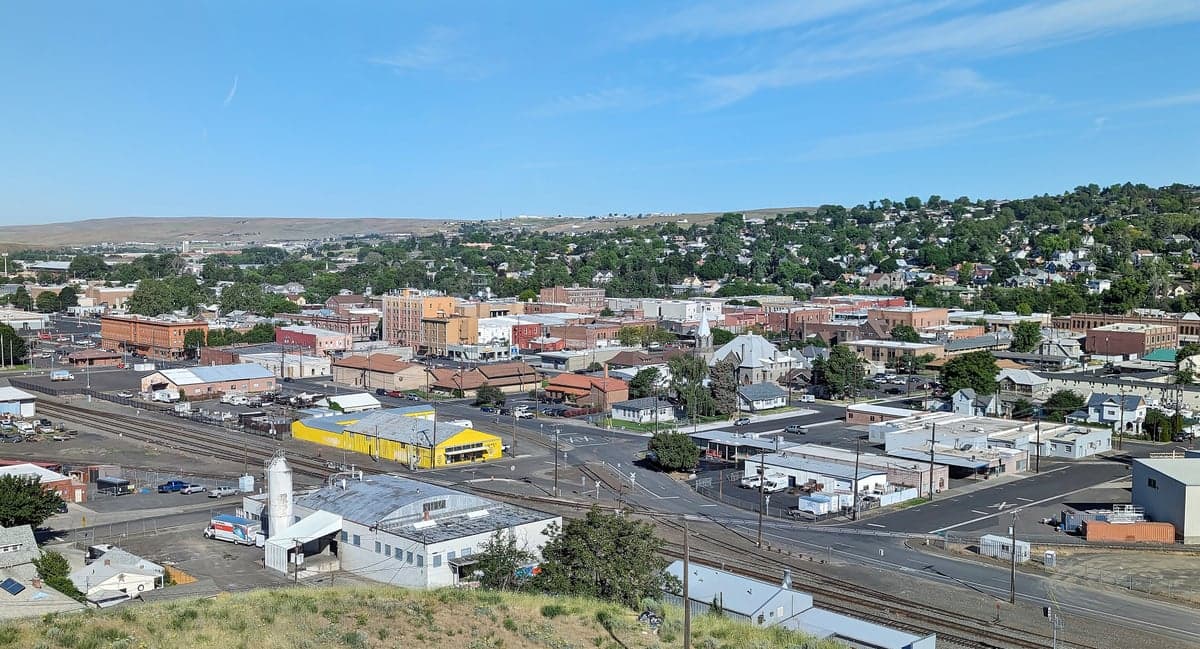
Photo: Wikipedia
Demographics of Pendleton, OR
Affluence Level in Pendleton, OR
A below-average socioeconomic profile. Incomes, home values, and educational attainment trail the U.S., with higher poverty and unemployment.
People of Pendleton, OR
Today, Pendleton, Oregon, is a city of 17,070 residents that remains overwhelmingly white (78.1%) with a significant Hispanic (10.6%) minority, reflecting its agricultural roots and modern meatpacking economy. The city is notably less diverse than Oregon as a whole and lacks a substantial immigrant presence (foreign-born: 1.4%), giving it a stable, insular character. Longtime residents often describe Pendleton as a working-class cowboy town where family ties run deep and newcomers are readily noticed. Its identity is shaped by the Pendleton Round-Up, the woolen mills, and a strong sense of local independence that resonates with conservative-leaning individuals.
How the city was settled and grew
Pendleton was founded in the 1860s as a supply point for gold miners in the Blue Mountains, but its permanent population began with the Oregon land grant railroad era. The arrival of the Oregon Railway & Navigation Company in the 1880s transformed it into a regional wool and wheat shipping hub. This drew a wave of European immigrants—primarily German, Irish, and Scandinavian families—who settled in the historic Old Town district near the rail yards. By 1900, the town's wool scouring plants and the Pendleton Woolen Mills (est. 1909) attracted skilled weavers, many of whom were second-generation Scandinavian and German craftsmen. These workers built modest bungalows in the South Hill neighborhood, a working-class area that still retains its early-1900s character. A smaller but distinct wave of Chinese laborers, originally brought for railroad construction, established a small enclave along the Umatilla River bank near the current airport—a community that largely dispersed by the 1920s due to exclusion laws. By 1930, Pendleton's population was nearly 100% white, with a handful of African American railroad porters living near the Edgewater district along the river.
Modern era (post-1965)
The post-1965 period brought two notable shifts. First, the expansion of the Pendleton meatpacking plant (then owned by IBP, now Tyson Foods) in the 1970s and 1980s drew a new workforce: Hispanic migrants from rural Mexico and Texas, who settled in the North Pendleton area, near the plant and along Highway 11. This enclave grew steadily through the 1990s and 2000s, making Hispanics the largest minority group at 10.6% today. Second, the city's overall population plateaued after peaking near 17,000 in the 1980s; it has since hovered in a narrow band. Domestic in-migration has been minimal, with most growth coming from Hispanic families and the return of some retired locals. Meanwhile, Pendleton's small East/Southeast Asian community (0.1%) is almost entirely composed of a few Hmong and Filipino families who work in healthcare at the St. Anthony Hospital. The city's Indian subcontinent population (0.2%) consists of a handful of physicians and engineers, mostly living near the Hospital District south of downtown. African American residents (1.1%) are concentrated in the old Edgewater neighborhood, a legacy of railroad porters and military families from the Umatilla Chemical Depot era. The post-1965 story is one of modest diversification rather than rapid change—Pendleton remains a predominantly white, working-class community, with its Hispanic segment gradually becoming more integrated into the town's economic life.
The future
Pendleton's demographic future points toward slow homogenization rather than tribalism. The Hispanic population is growing at a moderate pace (approximately 0.3% per year), but many second- and third-generation Hispanic families are assimilating linguistically and residentially—moving out of the initial North Pendleton enclave into broader neighborhoods like South Hill and the newer subdivisions east of town. The white population is aging but stable, sustained by organic growth and a trickle of retirees from Portland and California who seek lower taxes and a slower pace. No immigrant community is growing fast enough to create a distinct enclave; the East/Southeast Asian and Indian populations are essentially static. The biggest demographic wild card is whether the planned multimodal freight hub at the Port of Umatilla (15 miles east) attracts new industrial jobs and, with them, a more diverse workforce. Realistically, Pendleton in 2035 will look very much like Pendleton today: 78-80% white, 12-14% Hispanic, with tiny Asian and Black populations. The city is not homogenizing in a dramatic sense—it already was homogeneous—but rather it is slowly accepting the Hispanic minority as a permanent, assimilated part of the fabric.
For someone moving in now, Pendleton offers a rare combination in the Pacific Northwest: a town that has largely avoided the region's rapid demographic churn, with a stable population that values tradition, community, and self-reliance. The trade-off is limited ethnic diversity and a social scene that can feel insular to newcomers, but for those seeking a place where neighbors are known and values are shared, it remains a distinctively old-fashioned choice.

* Values derived from national, state, county, city and local statistics and may differ in a specific area. Last updated: 2026-05-30T09:23:09.000Z
Narrative content on this page is AI-generated and may contain mistakes. Verify any details that matter before acting on them.
ReloMaps may earn a commission from affiliate links at no extra cost to you.

