 Popular
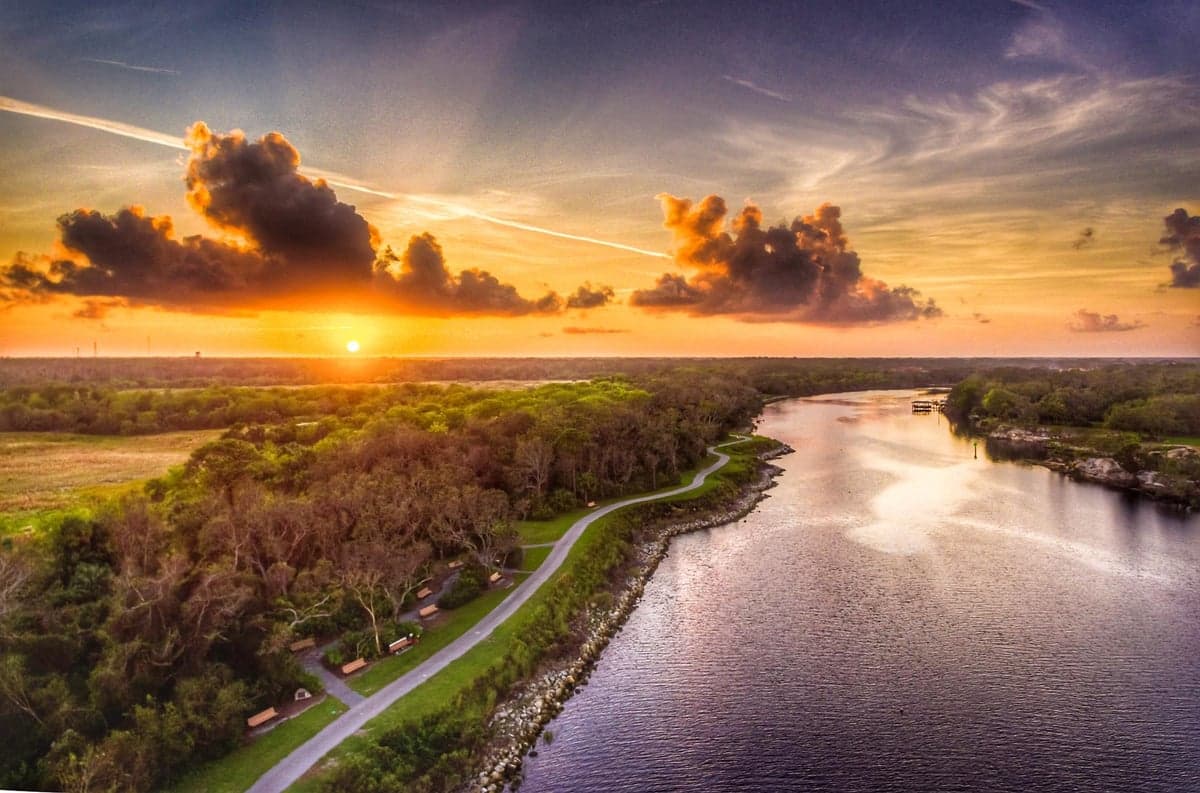
Photo: Wikipedia
Demographics of Palm Coast, FL
Affluence Level in Palm Coast, FL
A middle-class area roughly in line with national averages across income, home values, education, and employment.
People of Palm Coast, FL
The people of Palm Coast, Florida, today number roughly 94,362, forming a predominantly white (69.3%) and notably older community, with a median age near 50. The city’s identity is shaped by its origin as a planned retirement and second-home destination, giving it a quieter, more suburban character than nearby Daytona Beach or St. Augustine. A significant Hispanic minority (13.2%) and a smaller Black population (10.6%) add growing diversity, while the foreign-born share remains low at 4.4%, reflecting a population built primarily on domestic in-migration rather than international immigration.
How the city was settled and grew
Palm Coast is a genuine post-1900 planned community, with no colonial or 19th-century settlement core. Its human history begins in 1969, when ITT Community Development Corporation purchased 42,000 acres of pine flatwoods and swampland along the Intracoastal Waterway. The original population was drawn by a master-planned vision of affordable waterfront living for retirees and second-home buyers from the Northeast and Midwest. The first wave of residents—largely white, middle-class, and over 50—settled in the Palm Harbor and Pine Grove neighborhoods, where the earliest homes and the first shopping center (Palm Coast Plaza) were built. By the 1980s, the city’s population had reached about 10,000, almost entirely white and domestic-born, with a handful of service workers from nearby Flagler County.
Modern era (post-1965)
The post-1965 immigration reforms had little direct effect on Palm Coast’s early growth, as the city was not a traditional immigrant gateway. Instead, the modern era (roughly 1990–2020) saw a surge in domestic in-migration from the Northeast and Midwest, driven by retirees seeking lower taxes and warmer winters. The population exploded from 28,000 in 2000 to 75,000 by 2010, with new subdivisions like Grand Haven and Indian Trails absorbing the influx. These neighborhoods remain heavily white and older, with Grand Haven in particular known as a gated golf-course community for affluent retirees. The Hispanic population began to grow noticeably after 2000, reaching 13.2% by 2020, concentrated in the Belle Terre and Western Palm Coast areas near the more affordable housing stock. The Black population (10.6%) is largely concentrated in the R-Section and W-Section neighborhoods, where lower home prices attracted younger families and service workers. East/Southeast Asian communities (1.9%) are small but visible in the Palm Coast Park area, while Indian-subcontinent residents (0.6%) are scattered without a distinct ethnic enclave. The college-educated share (28.8%) is below the national average, reflecting the city’s blue-collar and service-oriented employment base.
The future
Palm Coast’s population is heading toward modest diversification, but the city is not homogenizing into a melting pot. The white share is slowly declining (down from 80% in 2010), while Hispanic and Black shares are rising steadily, driven by younger families moving into the more affordable W-Section and R-Section neighborhoods. The immigrant communities—both Hispanic and East/Southeast Asian—are growing but remain small and are assimilating into the broader suburban fabric rather than forming distinct ethnic enclaves. The Indian-subcontinent population is plateauing, with no major employer or cultural institution drawing further growth. Over the next 10–20 years, the city will likely become slightly younger and more diverse, but the core identity as a retirement and second-home destination will persist. The biggest demographic shift may be the aging of the original ITT-era retirees, whose homes in Palm Harbor and Pine Grove are increasingly turning over to younger families and out-of-state investors.
For someone moving in now, Palm Coast is becoming a more balanced community—less exclusively a retirement haven, more a working- and middle-class suburb with growing diversity. The neighborhoods remain fairly segmented by income and race, but the overall trajectory is toward a younger, more Hispanic, and slightly more Black population. The low foreign-born share means English is the dominant language, and the cultural feel remains distinctly American suburban, with none of the ethnic enclave dynamics seen in larger Florida cities.

* Values derived from national, state, county, city and local statistics and may differ in a specific area. Last updated: 2026-09-21T19:02:13.000Z
Narrative content on this page is AI-generated and may contain mistakes. Verify any details that matter before acting on them.
ReloMaps may earn a commission from affiliate links at no extra cost to you.

