

Photo: Wikipedia
Political ClimatePolitical Climate in Owensboro, KY
District shown is the primary district for this city’s centroid. Cities may span multiple districts.
Local Political AnalysisPolitical Analysis of Owensboro, KY
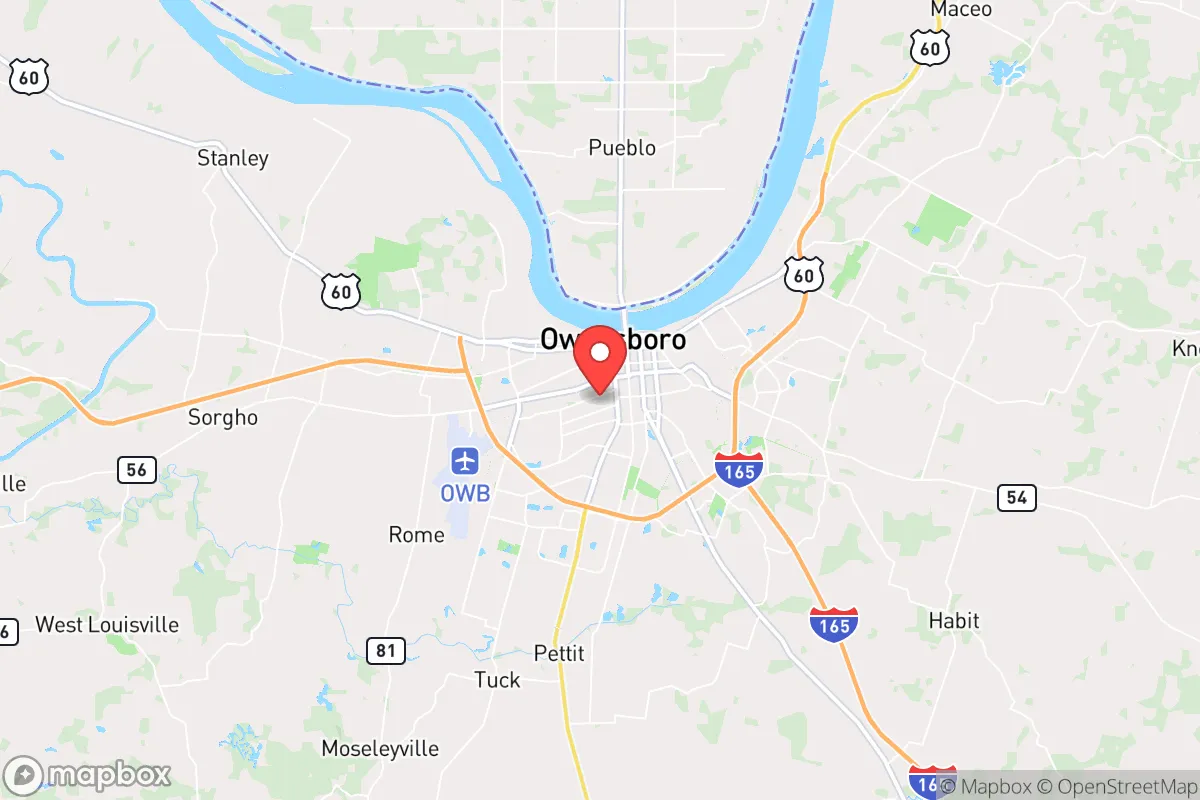
Owensboro is about as reliably red as they come in Kentucky, with a Cook PVI of R+20 that tells you pretty much everything you need to know about the local voting habits. The city and surrounding Daviess County have been solidly Republican for decades, and while you’ll find a few blue pockets near the riverfront or around the college, the overall trajectory has been shifting even further right over the last ten years. If you’re looking for a place where conservative values still hold strong and the idea of government staying out of your business is taken seriously, this is it.
How it compares
Drive thirty minutes east to Bowling Green, and you’ll notice a different vibe—more transient population from the university and a growing number of transplants from out of state, which has nudged Warren County a bit more purple. Head north to Evansville, Indiana, and you’re crossing into a state that’s been trending left on social issues, with a city council that’s gotten increasingly comfortable with progressive policies. Owensboro, by contrast, has stayed the course. The local school board, fiscal court, and city commission are all dominated by folks who believe in limited government, lower taxes, and personal responsibility. You don’t see the same kind of overreach here that you might in Louisville or Lexington—no mask mandates that drag on forever, no heavy-handed business closures, and no push to defund the police. It’s a place where the common-sense approach still wins the day.
What this means for residents
For the people who live here, the political climate translates into a pretty straightforward daily life. Property taxes are among the lowest in the state, and the city has been careful not to pile on new fees or regulations that would choke small businesses. You won’t find a lot of red tape when you want to start a side hustle or put an addition on your house. The downside, if you can call it that, is that the community tends to resist change—so if you’re hoping for big public transit expansions or aggressive environmental mandates, you’ll be disappointed. But for most residents, that’s a feature, not a bug. The local government’s hands-off approach means you’re free to live your life without a lot of interference, and that’s exactly how folks around here like it.
One thing that stands out is how Owensboro handles cultural issues. There’s a strong sense of tradition here—church attendance is high, the annual BBQ festival draws huge crowds, and the local schools still teach from a fairly traditional curriculum. You won’t see critical race theory or gender ideology pushed in the classroom, and the school board has been vocal about keeping it that way. The city has also resisted the push for sanctuary city status, and law enforcement cooperates fully with federal immigration authorities. If you’re concerned about the direction the country is heading on things like parental rights, Second Amendment protections, or religious freedom, Owensboro feels like a bit of a safe harbor. The long-term outlook is stable, as long as the area doesn’t get flooded with newcomers from blue states looking to change things. For now, it’s a place where you can still raise a family without feeling like the government is breathing down your neck.

State Political ClimatePolitical Climate in Kentucky
State Political AnalysisPolitical Environment in the State
Kentucky has long been a reliably red state in federal elections, but its political climate is more nuanced than a simple partisan label suggests. The state has voted for the Republican presidential candidate in every election since 2000, often by double-digit margins, with Donald Trump carrying it by 26 points in 2020 and 30 points in 2024. However, the state’s political identity is shaped by a deep urban-rural divide, a strong independent streak, and a recent shift toward more conservative governance that has accelerated over the past decade. For a conservative-leaning individual or family considering relocation, Kentucky offers a mix of traditional values, low taxes, and a growing sense of personal freedom, though the picture varies significantly depending on where you land.
Urban vs. rural divide
The political map of Kentucky is a study in contrasts. The state’s two major urban centers, Louisville (Jefferson County) and Lexington (Fayette County), are Democratic strongholds that reliably vote blue in both state and federal races. Louisville, home to the University of Louisville and a diverse economy, has trended further left in recent years, with its mayor and city council pushing progressive policies on policing and housing. Lexington, anchored by the University of Kentucky, is similarly liberal, though its suburbs like Nicholasville and Georgetown lean conservative. Meanwhile, the rest of the state is overwhelmingly Republican. The rural counties of eastern Kentucky, once solidly Democratic due to union ties in coal mining, have flipped hard red since 2008, driven by cultural and economic grievances. Counties like Pike and Perry now vote Republican by 50-point margins. In the west, Paducah and Bowling Green are conservative anchors, with Bowling Green’s Warren County voting +35 R in 2024. The Northern Kentucky suburbs of Cincinnati—places like Florence and Independence—are reliably red but more moderate, often splitting tickets in local races. The divide is stark: if you live in a city of more than 50,000, you’re likely surrounded by progressive politics; if you’re in a small town or rural area, conservative values dominate daily life.
Policy environment
Kentucky’s state-level policy environment has shifted dramatically rightward since 2015, when Republicans took full control of the legislature. The state now has a flat income tax rate of 4.5%, with a plan to phase it down to 4% by 2026, and no state tax on Social Security benefits—a major draw for retirees. Property taxes are among the lowest in the nation, with an average effective rate of 0.83%. The regulatory posture is business-friendly, with right-to-work laws and a tort reform system that caps non-economic damages in lawsuits. Education policy has been a flashpoint: the state passed a school choice bill in 2022 allowing education opportunity accounts, though it was struck down by the state Supreme Court in 2023. Governor Andy Beshear, a Democrat, has vetoed several conservative bills, but the Republican supermajority routinely overrides him. On healthcare, Kentucky expanded Medicaid under the Affordable Care Act, but the legislature has resisted further expansion and passed a law requiring work requirements for able-bodied adults. Election laws tightened in 2021 with a voter ID requirement and reduced early voting days, though absentee voting remains available. For a conservative, the policy environment is largely favorable, but the tug-of-war between a Democratic governor and a Republican legislature creates uncertainty.
Trajectory & freedom
Kentucky is becoming more free in several key areas, particularly on gun rights and parental rights. In 2019, the state passed constitutional carry, allowing permitless concealed carry of firearms, and in 2023 it enacted a “Second Amendment Sanctuary” law prohibiting local enforcement of federal gun restrictions. Parental rights were strengthened in 2022 with a law requiring schools to notify parents of any changes to a student’s health or well-being, effectively banning transgender policies without parental consent. On medical autonomy, Kentucky passed one of the strictest abortion bans in the country in 2019, with no exceptions for rape or incest, which was upheld by the state Supreme Court in 2023. Property rights have been bolstered by a 2021 law limiting eminent domain for private development. However, there are concerning trends. The state’s tax burden, while low, is still higher than neighboring Tennessee, which has no income tax. And the Beshear administration has used executive orders to expand voting access and COVID-19 mandates, which the legislature has fought. The overall trajectory is toward greater personal liberty, but the constant political battles in Frankfort can feel exhausting for new residents.
Civil unrest & political movements
Kentucky has seen its share of political flashpoints. The 2020 protests in Louisville following the death of Breonna Taylor were among the largest in the nation, with months of demonstrations, property damage, and a heavy police presence. The city’s Democratic leadership was criticized by conservatives for being too lenient on rioters, and the state legislature responded with a 2021 law increasing penalties for rioting and blocking local police defunding efforts. In eastern Kentucky, the decline of coal has fueled a populist anger that manifests in support for Trump and local candidates who promise to “drain the swamp.” Immigration politics are less heated than in border states, but there have been tensions in Shelbyville and Louisville over refugee resettlement, with some communities pushing back against federal programs. Election integrity has been a major issue since 2020, with the legislature passing a voter ID law and banning ballot drop boxes. There is no serious secession or nullification movement, but the state’s independent streak is visible in its resistance to federal mandates on everything from environmental regulations to vaccine requirements. A new resident will notice that political signs and flags are common in rural areas, and conversations about politics are more direct than in other parts of the country.
Projection
Over the next 5-10 years, Kentucky is likely to become more conservative at the state level, but with growing friction in urban centers. In-migration from blue states like California and Illinois is increasing, particularly to the Lexington and Bowling Green areas, which could shift some suburban districts toward purple. However, the rural population is stable, and the state’s Republican supermajority is expected to hold, especially as the legislature continues to draw district lines to its advantage. The flat tax phase-down will likely continue, making Kentucky more competitive with Tennessee and Florida for retirees and remote workers. The biggest wildcard is the governor’s race: Beshear is term-limited, and the 2027 election will likely produce a Republican successor, which would accelerate conservative policies on education, healthcare, and regulation. For a conservative moving in now, expect a state that is broadly aligned with your values but with persistent urban pockets of progressive activism. The culture war battles over schools, guns, and medical freedom will continue, but Kentucky’s trajectory is firmly toward greater personal liberty.
For a new resident, the bottom line is this: Kentucky offers a low-cost, low-tax environment with strong protections for gun rights, parental authority, and religious freedom. You’ll find a welcoming community in most places outside of Louisville and Lexington, but be prepared for a state that is still working through its post-coal identity and the growing pains of in-migration. If you value a slower pace, traditional values, and a government that mostly stays out of your life, Kentucky is a solid choice. Just know that the political fights are real, and they’re not going away anytime soon.
* Values derived from national, state, county, city and local statistics and may differ in a specific area. Last updated: 2026-04-21T10:47:14.000Z
Narrative content on this page is AI-generated and may contain mistakes. Verify any details that matter before acting on them.
ReloMaps may earn a commission from affiliate links at no extra cost to you.

