Photo: Wikipedia
Demographics of Owensboro, KY
Affluence Level in Owensboro, KY
A below-average socioeconomic profile. Incomes, home values, and educational attainment trail the U.S., with higher poverty and unemployment.
People of Owensboro, KY
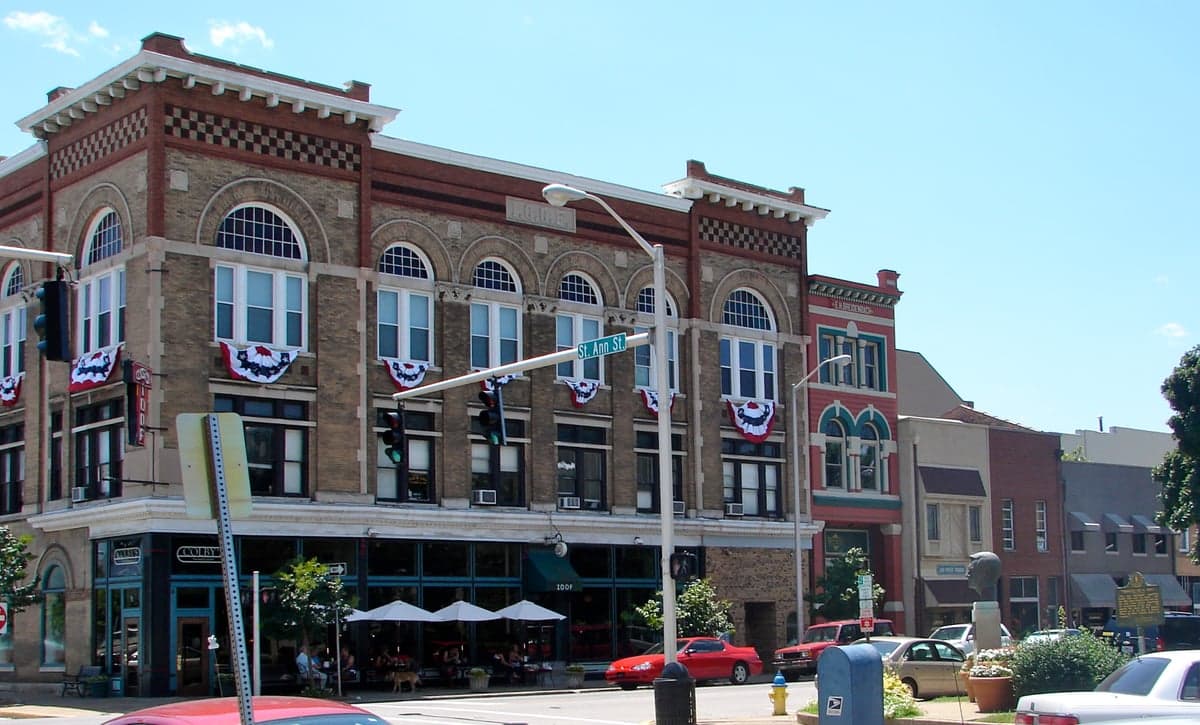
Owensboro, Kentucky, is home to 60,112 residents, a population that is 80.2% white, 6.4% Black, 5.4% Hispanic, and 2.9% East/Southeast Asian, with a small Indian subcontinent community at 0.2%. The city’s character is rooted in its Ohio River location and a history of German Catholic and Protestant settlement, giving it a notably stable, family-oriented, and church-centered identity. With only 3.6% foreign-born residents and a college attainment rate of 25.4%, Owensboro remains a predominantly native-born, working-to-middle-class community where extended family ties and local traditions—like the International Bar-B-Q Festival—define daily life.
How the city was settled and grew
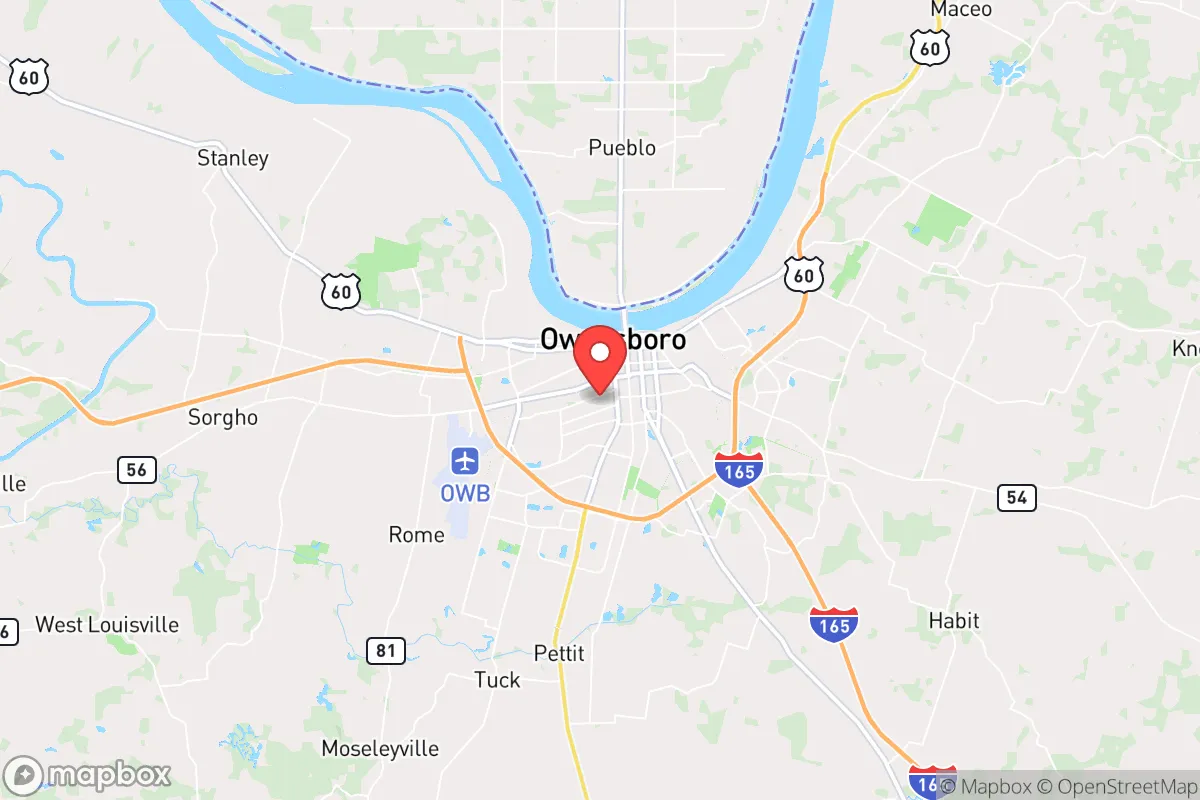
Owensboro’s population story begins with its founding in 1797 as a river landing and county seat of Daviess County. The earliest settlers were English, Scots-Irish, and German farmers drawn by fertile bottomlands and the Ohio River’s commercial potential. The first major demographic wave came in the 1840s–1860s, when German Catholic immigrants arrived in large numbers, fleeing political unrest and seeking farmland. They built the core of what is now West End, establishing St. Stephen’s Cathedral and a dense network of parishes, breweries, and tobacco warehouses. A smaller wave of Irish immigrants settled near the riverfront in what was then called “The Bottoms” (now part of downtown), working on the railroad and in the distilleries. By 1900, Owensboro was a majority-German Catholic city, with a distinct cultural identity that persists in surnames, church affiliations, and the local dialect. The Black population grew slowly after the Civil War, with African American families settling primarily in the South Side neighborhood around 9th and Frederica streets, where they built churches, schools, and a small business district. The city’s population peaked at around 60,000 in the 1960s, driven by tobacco, whiskey, and furniture manufacturing.
Modern era (post-1965)
After the 1965 Immigration and Nationality Act, Owensboro saw only modest demographic change compared to larger Kentucky cities. The foreign-born share remains low at 3.6%, with the largest post-1965 influx being East/Southeast Asian communities—primarily Vietnamese and Filipino families—who arrived as refugees and medical professionals in the 1970s–1990s. These families concentrated in the East Side near the Owensboro Health Regional Hospital and along Parrish Avenue, where several Asian grocery stores and churches now operate. The Hispanic population, now 5.4%, grew steadily from the 1990s onward, driven by agricultural and construction jobs; most settled in the West End and South Side, where Spanish-language services at Catholic parishes and a growing number of taquerias mark their presence. The Black population, at 6.4%, has remained stable but slightly declined from its 1970 peak, with many younger families moving to newer subdivisions in the Thruston-Dunn area or leaving for Louisville. Suburbanization after 1970 pulled white families into northern Daviess County and the Utica area, leaving the historic core neighborhoods—especially the West End and South Side—more diverse but also older and lower-income. The Indian subcontinent community (0.2%) is tiny and consists mostly of professionals working at Owensboro Health or Kentucky Wesleyan College, with no distinct ethnic enclave.
The future
Owensboro’s population is projected to remain stable or decline slightly over the next decade, as the native-born white population ages and out-migration of young adults to Louisville and Nashville continues. The Hispanic and East/Southeast Asian communities are growing slowly but steadily, driven by family reunification and local healthcare and manufacturing jobs. These groups are not forming isolated enclaves but are dispersing across the West End, East Side, and newer subdivisions, suggesting gradual assimilation rather than tribalization. The Black population is likely to remain flat, as Owensboro lacks the economic pull to attract significant new African American migration. The city’s low foreign-born share (3.6%) and high native-born rate mean it will remain a culturally homogeneous place compared to national averages, though the Hispanic and Asian communities will continue to add modest diversity. The biggest demographic shift may be internal: the continued hollowing out of older neighborhoods like the West End and South Side as younger families move to the outskirts, leaving a core that is older, poorer, and more diverse.
For a newcomer, Owensboro offers a stable, family-oriented community where church, school, and extended family networks dominate social life. The population is not rapidly diversifying or homogenizing but slowly aging and suburbanizing. The city’s future is one of gentle decline in overall numbers, with a modest increase in Hispanic and Asian shares, but without the dramatic demographic churn seen in larger metros. It is a place where roots run deep, and moving in means integrating into an established, predominantly white, German-Catholic-influenced social fabric.

* Values derived from national, state, county, city and local statistics and may differ in a specific area. Last updated: 2026-04-21T10:47:14.000Z
Narrative content on this page is AI-generated and may contain mistakes. Verify any details that matter before acting on them.
ReloMaps may earn a commission from affiliate links at no extra cost to you.

