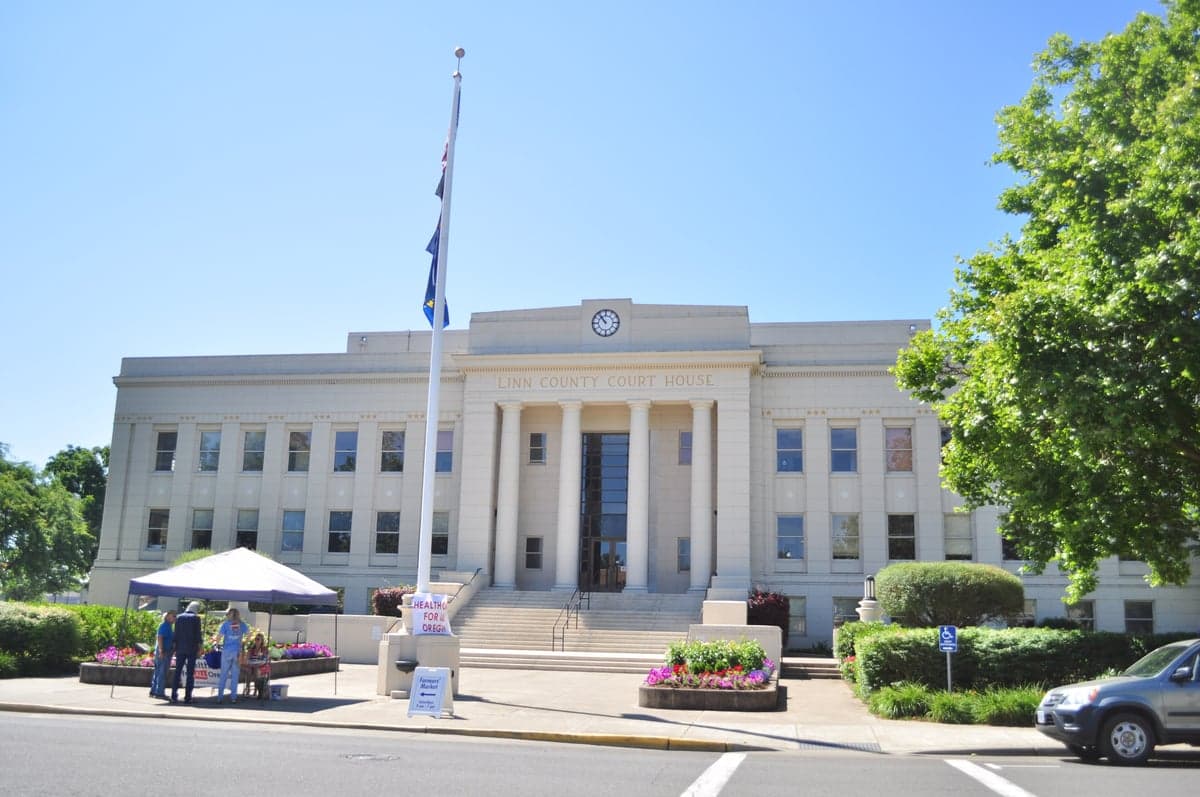
Photo: Wikipedia
Demographics of Linn County
Affluence Level in Linn County
A middle-class area roughly in line with national averages across income, home values, education, and employment.
People of Linn County
Linn County, Oregon, is home to 129,794 residents who are overwhelmingly white (82.2%) and native-born, with a foreign-born population of just 2.4% — one of the lowest in the Willamette Valley. The county’s character is shaped by its working-class timber and agricultural roots, a modest college attainment rate of 20.8%, and a growing Hispanic community (10.3%) concentrated in the agricultural towns of the South Santiam River valley. Distinctive identity markers include a strong sense of local independence, a deep connection to outdoor recreation in the Cascade foothills, and a population that is notably less diverse and less urban than neighboring Benton or Lane counties.
Settlement & growth (pre-1960)
The original inhabitants of Linn County were the Kalapuya people, who lived in seasonal villages along the Willamette, Santiam, and Calapooia rivers for thousands of years. Their population was decimated by introduced diseases and displacement following the arrival of Euro-American fur trappers in the 1810s and 1820s. By the time the Oregon Trail began delivering permanent settlers in the 1840s, the Kalapuya had been largely removed to the Grand Ronde Reservation, and the valley floor was open for homesteading.
The first major wave of American settlers arrived between 1845 and 1860, overwhelmingly from the Midwest — specifically Missouri, Iowa, Illinois, and Indiana. These were families of Scots-Irish, English, and German descent who came via the Oregon Trail seeking free land under the Donation Land Claim Act of 1850. They founded the county’s earliest towns: Albany (1848), Brownsville (1846), Lebanon (1847), and Harrisburg (1846). These settlers were farmers, millers, and merchants who established a wheat-and-lumber economy that would define the region for a century.
A second, smaller wave of European immigration arrived between 1870 and 1900, drawn by railroad construction and the expansion of the timber industry. German and Swiss families settled in the Sweet Home area and along the South Santiam River, where they worked in sawmills and established dairy farms. A distinct community of Finnish immigrants also settled near Scio and Mill City, drawn by the logging camps and the familiar conifer forests. These groups remained culturally distinct for a generation but largely assimilated into the broader white Protestant population by the 1920s.
The Dust Bowl and Great Depression brought a third wave: white migrants from Oklahoma, Arkansas, and Texas who arrived between 1935 and 1950. These "Okies" and "Arkies" settled in the timber towns of Sweet Home, Mill City, and Lyons, where they found work in the booming post-war lumber mills. Their cultural influence — a blend of Southern evangelical Protestantism, country music, and a fierce work ethic — remains visible in the county’s rural communities today. By 1960, Linn County was 98% white, with a small Japanese American community in the Albany area that had been forcibly interned during World War II and only partially returned.
Modern era (post-1965)
The 1965 Hart-Cellar Act had a minimal direct impact on Linn County. Unlike Portland or Salem, the county did not attract significant post-1965 immigration from Asia, Africa, or Latin America. The foreign-born population today is just 2.4%, and the East/Southeast Asian population is only 0.7% — mostly families of Japanese and Filipino descent who arrived in the 1970s and 1980s to work in the electronics and food-processing plants that replaced some of the shuttered lumber mills. A small Indian-subcontinent population (0.2%) is concentrated in Albany, employed primarily in healthcare and engineering at Samaritan Health Services and local manufacturing firms.
The most significant demographic shift since 1965 has been the growth of the Hispanic population, which rose from under 2% in 1990 to 10.3% today. This wave is almost entirely Mexican-American, driven by agricultural labor demand in the county’s berry, mint, and grass-seed farms. The Hispanic community is concentrated in Albany’s south side and in the rural towns of Tangent, Halsey, and Harrisburg, where they form a visible and growing presence in local schools and Catholic parishes. Unlike the earlier European waves, this group has maintained stronger linguistic and cultural ties, with Spanish spoken in a significant minority of households in these areas.
Domestic migration has reshaped the county in subtler ways. Since 2000, Linn County has seen steady in-migration from California’s Bay Area and Southern California, driven by housing cost differentials. These newcomers — often white, college-educated, and politically liberal — have concentrated in Albany and Lebanon, where new subdivisions have been built on former farmland. This has created a cultural tension between the older, conservative, working-class population and the newer, more progressive arrivals, visible in local school board and city council elections. The county’s college-educated share (20.8%) remains well below the state average (34%), reflecting the persistence of blue-collar employment in manufacturing, healthcare, and agriculture.
The future
Linn County is likely to continue its slow diversification, but the pace will be modest. The Hispanic population is projected to reach 15-18% by 2040, driven by natural increase and continued agricultural labor demand. This growth is concentrated in specific towns — Albany, Harrisburg, and Tangent — and is not spreading evenly across the county, creating a pattern of distinct enclaves rather than full integration. The white population is aging and declining slightly, as younger, college-educated residents leave for Portland, Corvallis, or Salem.
The East/Southeast Asian and Indian populations are likely to remain small (under 2% combined), as the county lacks the professional job base or ethnic infrastructure to attract significant new immigration. The Black population (0.3%) is essentially static. The most dynamic demographic force is domestic in-migration from California and the Portland metro area, which is slowly raising the county’s educational attainment and political diversity but also driving up housing costs in Albany and Lebanon.
Culturally, the county is tribalizing rather than homogenizing. The rural timber towns — Sweet Home, Mill City, Lyons — remain overwhelmingly white, conservative, and working-class. The agricultural towns — Harrisburg, Tangent, Halsey — are becoming more Hispanic. The urban centers — Albany and Lebanon — are becoming more mixed, both racially and politically. These three zones are growing apart in identity, with less social and economic crossover than a generation ago.
For someone moving in now, Linn County offers a choice rather than a single experience. A family settling in Albany will find a small city with growing diversity, decent schools, and a moderate political climate. A family settling in Sweet Home will find a homogeneous, conservative, outdoor-oriented community with limited economic opportunity. The county as a whole is becoming more stratified by town and by class, even as its overall population grows slowly. The next 20 years will likely see continued Hispanic growth, continued white out-migration from rural areas, and a slow but steady increase in the cultural and political divide between the county’s urban core and its hinterlands.

* Values derived from national, state, county, city and local statistics and may differ in a specific area. Last updated: 2026-06-02T03:31:09.000Z
Narrative content on this page is AI-generated and may contain mistakes. Verify any details that matter before acting on them.
ReloMaps may earn a commission from affiliate links at no extra cost to you.

