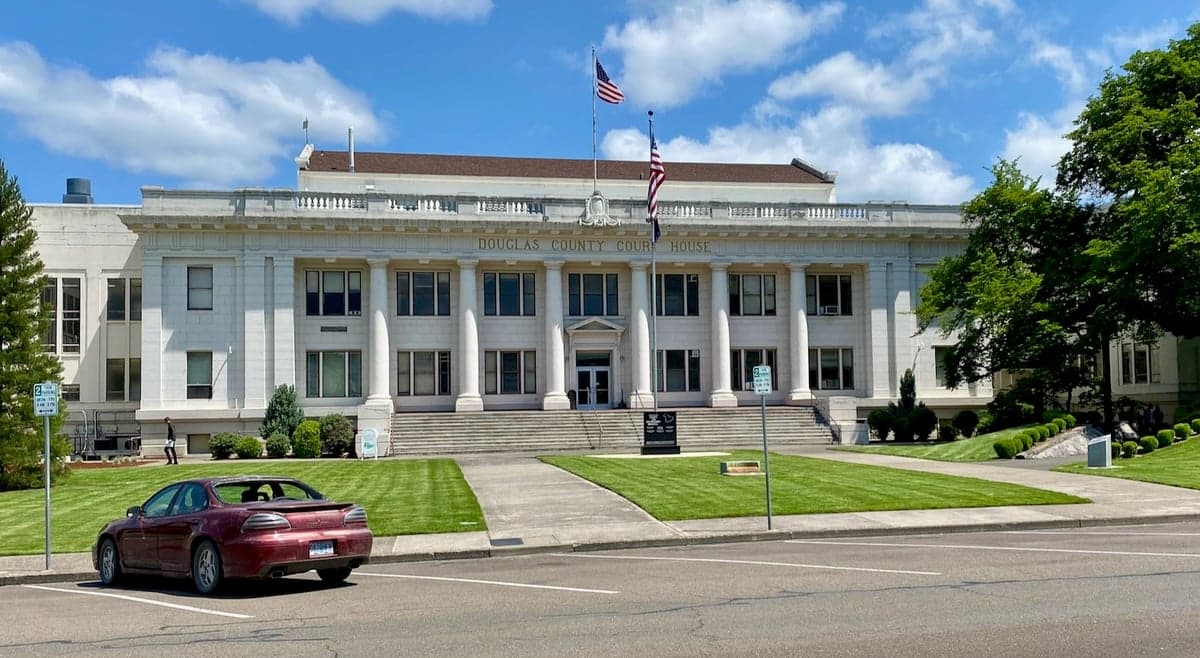
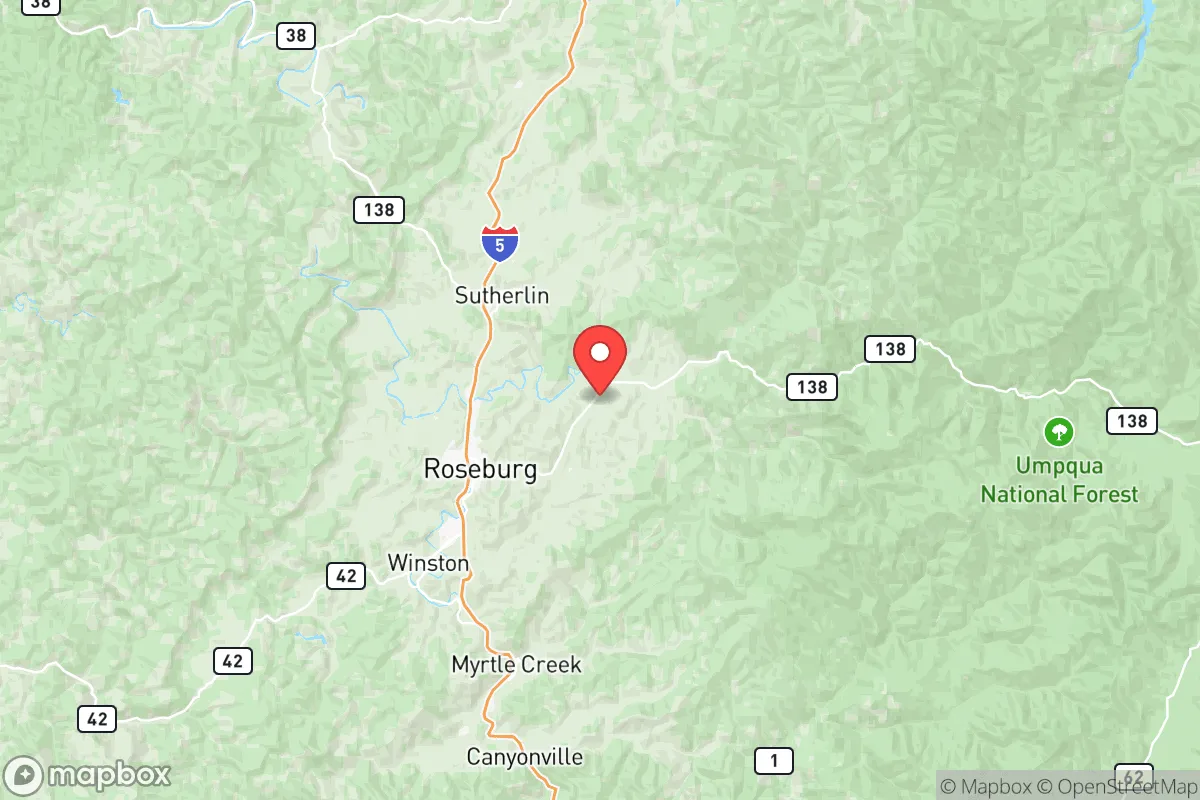
Photo: Wikipedia
Demographics of Douglas County
Affluence Level in Douglas County
A middle-class area roughly in line with national averages across income, home values, education, and employment.
People of Douglas County
The people of Douglas County, Oregon, today are overwhelmingly white, native-born, and rooted in a rural, resource-extraction heritage that has shaped the region since the mid-19th century. With a population of 111,807, the county is one of the least ethnically diverse in Oregon: 85.1% of residents identify as white alone, only 0.9% are foreign-born, and just 18.9% hold a college degree. The county’s identity is defined by its timber towns, the Umpqua River valley, and a conservative, self-reliant culture that stands in contrast to the more liberal, urbanized Willamette Valley to the north.
Settlement & growth (pre-1960)
Long before European settlement, the Umpqua and Cow Creek bands of the Upper Umpqua people lived along the Umpqua River and its tributaries, hunting, fishing, and gathering acorns and camas bulbs. The Cow Creek Band of Umpqua Tribe of Indians, federally recognized today, maintains a reservation near Canyonville and operates the Seven Feathers Casino Resort, a major employer in the southern part of the county. The first Euro-Americans to enter the area were fur trappers and traders of the Hudson’s Bay Company in the 1820s, but they established no permanent settlements.
Permanent American settlement began in earnest after the Donation Land Claim Act of 1850, which drew white settlers—mostly from the Midwest and Upper South—into the Umpqua Valley. The discovery of gold in the 1850s at Jacksonville (just south of the county line) and in the Bohemia Mining District near Cottage Grove brought a rush of prospectors, but the real economic engine was timber. By the 1880s, the Oregon & California Railroad reached Roseburg, the county seat, opening the region’s vast old-growth forests to national markets. Sawmills sprang up in Winston, Drain, Glide, and Myrtle Creek, drawing waves of workers from the Midwest, Scandinavia, and the Appalachian coal country. These were overwhelmingly white, Protestant, and rural—people who valued hard work, independence, and a distrust of distant government.
The 1930s Dust Bowl and Great Depression pushed a small number of displaced farmers from Oklahoma and Arkansas into the county, but the population remained remarkably stable in its ethnic composition. The post-World War II housing boom supercharged the timber industry, and Douglas County’s population grew from 54,000 in 1950 to 72,000 in 1960, almost entirely through domestic migration from other western states. Roseburg became a regional hub for logging and lumber, while smaller towns like Riddle and Sutherlin grew as mill towns. The county’s population was, by 1960, nearly 98% white, with a tiny Japanese American community (mostly displaced from the coast during wartime internment) and a scattering of Native families on the Cow Creek reservation.
Modern era (post-1965)
The 1965 Hart-Cellar Act, which opened immigration to Asia and Latin America, had almost no effect on Douglas County. The county’s foreign-born population today is just 0.9%, compared to 10% statewide. The few immigrants who have arrived since 1965 are primarily Hispanic—mostly from Mexico and Central America—drawn by agricultural work in the Umpqua Valley’s vineyards, nurseries, and grass-seed farms. Today, 6.4% of the county’s population is Hispanic, up from roughly 2% in 1990. These families are concentrated in Winston and the unincorporated areas around Green and Lookingglass, where they work in farming and food processing. There is no visible Asian or Indian enclave: East/Southeast Asian residents make up 0.8% of the population, and Indian-subcontinent residents just 0.1%, mostly professionals in healthcare at Mercy Medical Center in Roseburg.
The defining demographic shift of the modern era has been domestic out-migration, not immigration. The collapse of the Pacific Northwest timber industry in the 1980s and 1990s—driven by federal logging restrictions, the spotted owl controversy, and mill closures—cost Douglas County thousands of jobs. The population actually declined from 100,000 in 1990 to 99,000 in 2000, as young families left for Bend, Portland, or out of state. Those who stayed are older, whiter, and more rooted: the median age is 45.6, well above the Oregon median of 39.9. The county has seen a modest influx of retirees from California and the Willamette Valley, drawn by lower housing costs and a slower pace of life, particularly in Roseburg and Winston. This has slightly increased the share of college-educated residents (now 18.9%), but the county remains one of the least educated in Oregon.
The future
Douglas County’s population is projected to grow slowly, reaching roughly 115,000 by 2035, driven almost entirely by natural increase (births minus deaths) and continued domestic in-migration of retirees and remote workers seeking affordable land. The Hispanic share is expected to rise to 8-9% as agricultural families grow, but the county will remain overwhelmingly white and native-born. The Asian and Indian populations will likely remain negligible, as there are no large employers or ethnic enclaves to attract them. The biggest demographic wild card is the potential for a new economic driver: the county is actively courting data centers and light manufacturing, and the expansion of the Seven Feathers Casino in Canyonville continues to draw visitors and some new residents. However, without a major shift in the local economy, the county will continue to age, with a growing share of residents over 65 and a shrinking base of young families.
For someone moving in now, Douglas County offers a stable, culturally homogeneous, and deeply conservative community where the pace of change is slow and the landscape is still dominated by forests and farms. It is not a place of demographic transformation or urban energy—it is a place where the past remains visible in the mill towns, the church steeples, and the family names that have been on the land for five generations. If you are seeking a diverse, fast-growing, or cosmopolitan environment, this is not the county for you. But if you value quiet, affordability, and a community where most people share your background and values, Douglas County remains one of the most unchanged corners of the Pacific Northwest.

* Values derived from national, state, county, city and local statistics and may differ in a specific area. Last updated: 2026-07-30T07:31:56.000Z
Narrative content on this page is AI-generated and may contain mistakes. Verify any details that matter before acting on them.
ReloMaps may earn a commission from affiliate links at no extra cost to you.

