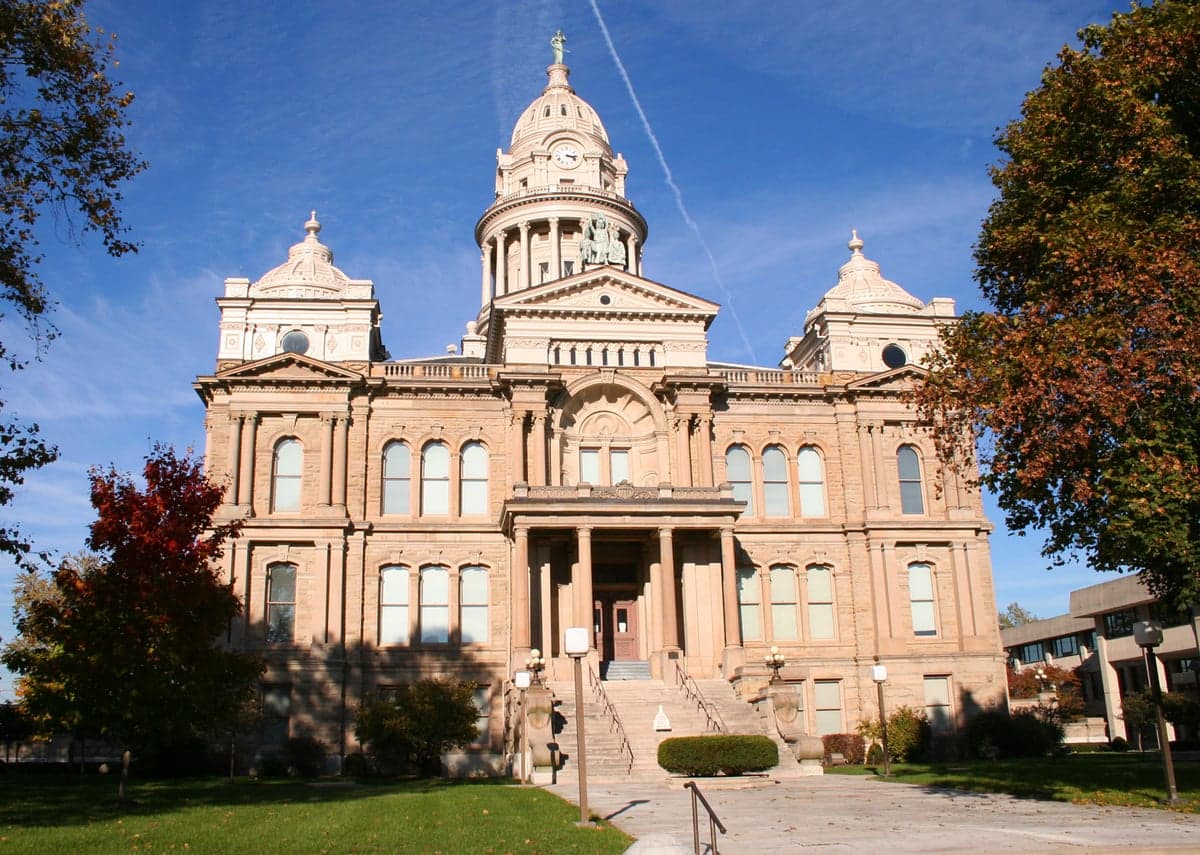
Photo: Wikipedia
Demographics of Miami County
Affluence Level in Miami County
A middle-class area roughly in line with national averages across income, home values, education, and employment.
People of Miami County
Miami County, Ohio, is a predominantly white, rural-suburban county of 109,549 residents where 90.5% of the population identifies as white alone, and the foreign-born share sits at just 1.1% — well below the national average. The county’s identity is rooted in its agricultural and industrial heritage, with a strong sense of local community, conservative political leanings, and a population that has remained remarkably stable in its ethnic composition for decades. Residents are concentrated in the county seat of Troy, the manufacturing hub of Piqua, and the smaller towns of Tipp City, Covington, West Milton, and Bradford, each retaining a distinct small-town character.
Settlement & growth (pre-1960)
Before European settlement, the Miami County area was home to the Shawnee and Miami Native American nations, who used the Great Miami River as a transportation and trade corridor. The region was part of the Ohio Country, contested by the French and British during the 18th century, but no permanent European settlements existed until after the American Revolution. The 1795 Treaty of Greenville opened the area to American settlers, and the first wave of pioneers — primarily of English, Scots-Irish, and German descent — arrived in the early 1800s, drawn by the promise of fertile farmland along the river valleys.
The county was formally established in 1807, and the earliest settlements grew around mills and trading posts. Troy, founded in 1807, became the county seat and a center for grain and livestock. Piqua, settled in 1807 as well, grew rapidly after the Miami and Erie Canal reached it in 1837, turning it into a major shipping point for agricultural goods and later a manufacturing town for textile and iron production. Tipp City, originally named Tippecanoe, was platted in 1840 and benefited from the canal and later the railroad. Covington (founded 1816) and West Milton (1817) developed as farming communities, while Bradford (1865) grew around the railroad junction.
The second major wave came with German immigration in the 1840s-1860s. German farmers and craftsmen settled throughout the county, particularly in the rural townships around Pleasant Hill and Laura, where they established Catholic and Lutheran churches that remain community anchors. Unlike some parts of Ohio, Miami County saw very little immigration from Southern or Eastern Europe; the population remained overwhelmingly of German and British Isles ancestry through the 19th and early 20th centuries.
The industrial boom of the late 19th and early 20th centuries brought a modest influx of workers to Piqua and Troy, where factories produced stoves, farm equipment, and later automotive parts. The Great Migration of African Americans from the South largely bypassed Miami County — the Black population in 1950 was under 1%. The Dust Bowl and Appalachian migration of the 1930s-1950s brought some white families from Kentucky and West Virginia, but the county’s population grew slowly and steadily, reaching about 60,000 by 1950.
Modern era (post-1965)
The 1965 Hart-Cellar Act had a minimal impact on Miami County. Unlike major metropolitan areas, the county did not attract significant numbers of new immigrants from Asia, Latin America, or Africa. The foreign-born population today is just 1.1%, and the county’s racial composition has shifted only slightly since 1970. The Hispanic population, at 2.1%, is the fastest-growing minority group, with most families working in agriculture or manufacturing, and they are dispersed across the county rather than concentrated in a single enclave. The Black population remains small at 2.0%, with the largest numbers in Piqua and Troy. East and Southeast Asian residents (1.3%) are primarily professionals employed by regional manufacturers like Hobart Brothers in Troy or Whirlpool in nearby Greenville. The Indian-subcontinent population (0.4%) is mostly composed of medical professionals working at Upper Valley Medical Center in Troy.
The most significant demographic shift since 1965 has been domestic: suburbanization and the decline of small family farms. The construction of Interstate 75 in the 1960s transformed the county, making Troy and Tipp City attractive bedroom communities for workers commuting to Dayton (20 miles south) and even Cincinnati (60 miles south). New subdivisions sprouted around Troy and Tipp City, drawing middle-class families from Montgomery County and beyond. Meanwhile, Piqua and Covington experienced population stagnation as manufacturing jobs consolidated or moved overseas. The county’s population grew from 84,000 in 1970 to 109,549 in 2024, a modest 30% increase over 54 years, driven almost entirely by white domestic migration from other parts of Ohio and the Midwest.
The college-educated share of the population is 24.9%, below the national average of 33%, reflecting the county’s strong blue-collar manufacturing base. However, the presence of Edison State Community College in Piqua and Hobart Institute of Welding Technology in Troy provides technical training that supports local industry.
The future
Miami County is projected to remain predominantly white and non-diverse for the foreseeable future. The county’s population growth rate has slowed to less than 1% annually, and the median age (41.5) is slightly above the national average. Younger residents often leave for college or jobs in larger cities, and the county is not a destination for international migration. The Hispanic population may grow slowly as agricultural and manufacturing sectors continue to attract some workers, but it is unlikely to exceed 5% by 2040. The East/Southeast Asian and Indian populations will remain small and tied to specific professional roles.
The most notable trend is the continued suburbanization of the I-75 corridor. Tipp City and southern Troy are likely to see the most new housing development, attracting families seeking lower taxes and larger lots than in Dayton. Piqua and Covington will likely see stable or slightly declining populations as older residents age out and younger families choose newer subdivisions. The county’s cultural identity — rooted in agricultural fairs, church communities, and high school sports — will persist, with little pressure from demographic change to alter it.
For someone moving in now, Miami County offers a stable, safe, and culturally homogeneous environment where community ties are strong and the pace of life is slow. The trade-off is limited diversity, a modestly educated workforce, and a reliance on manufacturing and agriculture that may face long-term economic headwinds. The county is not becoming more diverse or cosmopolitan; it is doubling down on its existing character as a white, middle-American, conservative-leaning region where newcomers are expected to fit in rather than change the culture.

* Values derived from national, state, county, city and local statistics and may differ in a specific area. Last updated: 2026-08-19T02:46:19.000Z
Narrative content on this page is AI-generated and may contain mistakes. Verify any details that matter before acting on them.
ReloMaps may earn a commission from affiliate links at no extra cost to you.

