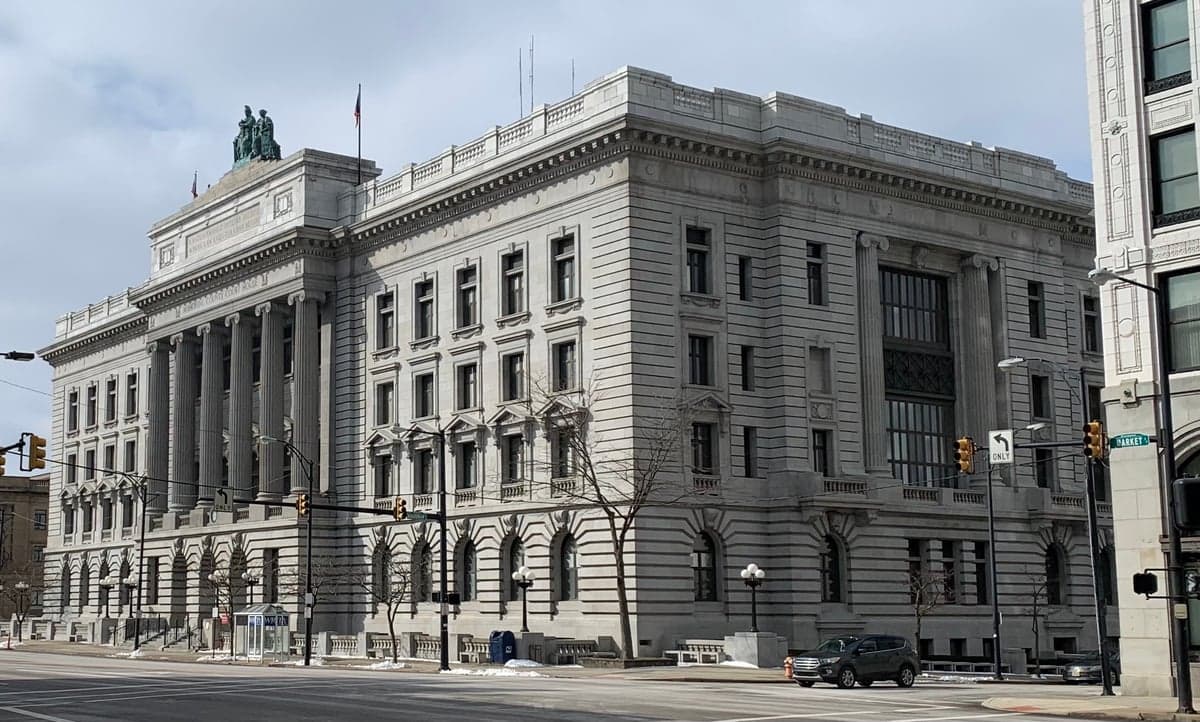
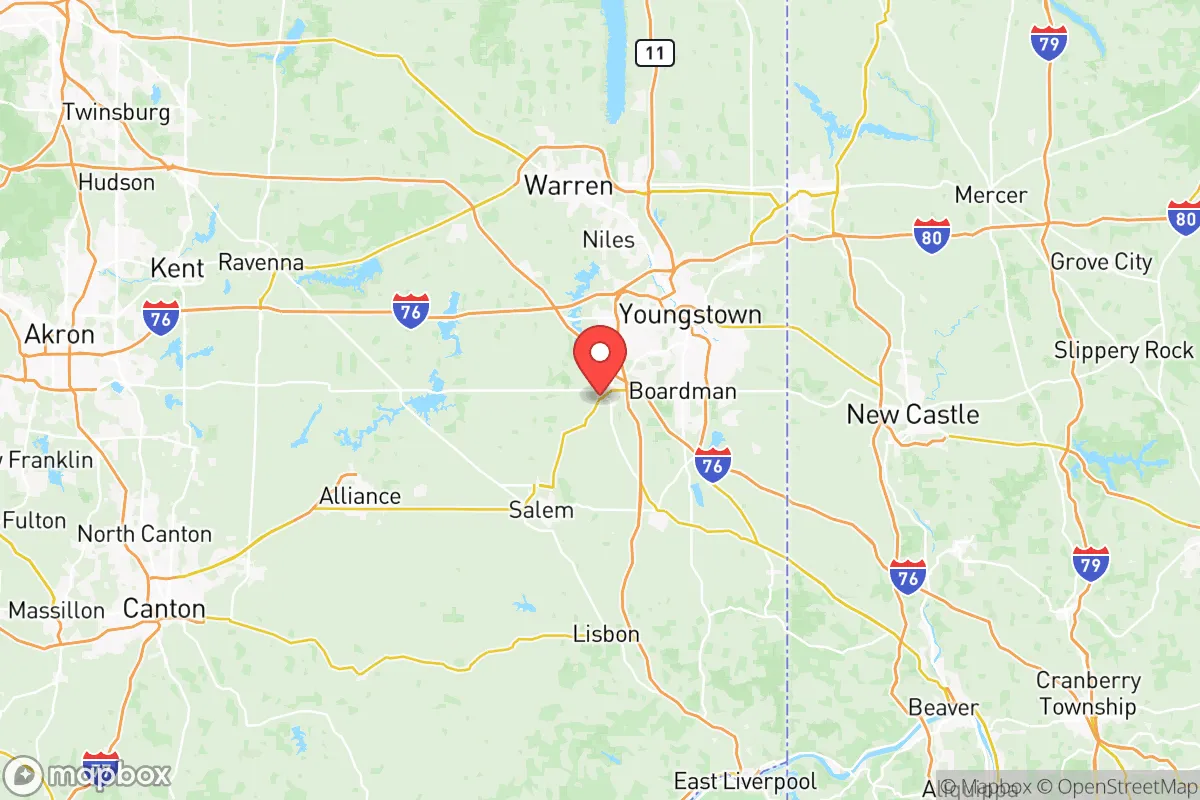
Photo: Wikipedia
Demographics of Mahoning County
Affluence Level in Mahoning County
A below-average socioeconomic profile. Incomes, home values, and educational attainment trail the U.S., with higher poverty and unemployment.
People of Mahoning County
Mahoning County’s 227,063 residents today form a predominantly white (74.3%) and native-born (99.0% U.S.-born) population, concentrated in the urban core of Youngstown and its surrounding suburbs like Boardman, Canfield, and Austintown. The county’s identity remains shaped by its industrial past—a once-booming steel corridor that drew waves of European immigrants and Black migrants from the South—now grappling with decades of population decline and economic restructuring. With a college attainment rate of just 26.4%, the population is older, more rooted, and less diverse than the national average, though Hispanic (6.5%) and Black (13.8%) communities are growing modestly. This is a region where the legacy of heavy industry still defines the social fabric, even as the mills have largely gone silent.
Settlement & growth (pre-1960)
Before European settlement, the area that became Mahoning County was part of the Western Reserve, claimed by Connecticut and inhabited by the Seneca and other Iroquoian-speaking nations, who used the Mahoning River valley for hunting and seasonal camps. The first permanent white settlers arrived in the late 1790s, mostly Scots-Irish and English farmers from Pennsylvania and New England, drawn by the fertile bottomlands and the promise of cheap land in the Connecticut Western Reserve. They established small farming communities like Canfield (founded 1798) and Poland (settled 1798), which remain today as affluent, historic villages.
The county’s demographic character shifted dramatically after 1850, when the discovery of coal and iron ore in the region sparked the rise of the iron and steel industry. The Mahoning River became an industrial corridor, and Youngstown—incorporated as a city in 1867—emerged as the epicenter. The first major immigrant wave was Irish, arriving in the 1840s and 1850s to dig canals and lay railroad tracks, settling in Youngstown’s Brier Hill neighborhood. Germans followed in the 1850s-1870s, establishing farms and breweries in Berlin Center and North Lima, while also forming a working-class enclave in Youngstown’s Smoky Hollow district.
The steel boom of the 1880s-1920s brought the largest waves: Italians, who concentrated in Youngstown’s Hazelton and Brier Hill neighborhoods; Eastern European Jews, who built a tight-knit community around Elm Street in Youngstown; and Poles, Slovaks, and Hungarians, who settled in the Struthers and Campbell mill towns. By 1920, over 40% of Mahoning County’s population was foreign-born, one of the highest rates in Ohio. The Great Migration of Black Americans from the South began during World War I and accelerated through the 1940s, as steel mills recruited Black workers to replace striking white laborers. Black families settled primarily in Youngstown’s South Side and Idora neighborhoods, forming a distinct community that would grow to 13.8% of the county’s population by 2020.
The post-World War II period saw suburbanization begin in earnest. The 1950s and early 1960s brought a wave of Appalachian whites from Kentucky and West Virginia, drawn by high-paying steel jobs. They settled in Boardman and Austintown, which transformed from farmland into sprawling bedroom communities. By 1960, Mahoning County’s population peaked at 303,424, with Youngstown itself housing over 166,000 residents.
Modern era (post-1965)
The 1965 Hart-Cellar Act had minimal direct impact on Mahoning County, as the region’s industrial decline began almost simultaneously. The steel industry collapsed in the 1970s and 1980s, triggering a massive out-migration of white working-class families to the Sun Belt and to surrounding rural counties. Youngstown’s population fell from 166,000 in 1960 to just 60,000 by 2020. The foreign-born share dropped to 1.0%—among the lowest of any U.S. county—as the immigrant-heavy neighborhoods of the early 20th century aged and their descendants left.
Domestic migration reshaped the county more than immigration. The Black population, which had been concentrated in Youngstown’s South Side, began spreading to inner-ring suburbs like Campbell and Struthers in the 1990s and 2000s, though segregation remains high. The Hispanic population grew from negligible levels in 1980 to 6.5% by 2020, driven primarily by Puerto Rican migration (U.S. citizens, not immigrants) and a smaller number of Mexican-origin families settling in Youngstown’s West Side and in Boardman. The East/Southeast Asian population remains tiny at 0.3%, concentrated among a few dozen families in Canfield and Boardman, mostly professionals in healthcare and engineering. The Indian-subcontinent population (0.6%) is slightly larger, with families drawn to medical residencies at Mercy Health and the Northeast Ohio Medical University, settling in Canfield and Poland.
Suburbanization continued through the 2000s, with Canfield and Boardman absorbing most of the county’s remaining middle-class families, while Youngstown itself became increasingly poor and Black. The county’s population fell by 12% between 2000 and 2020, a decline that has only recently begun to stabilize.
The future
Mahoning County’s population is projected to continue a slow decline, falling to roughly 210,000 by 2040, according to state forecasts. The white population is aging rapidly—the median age is 43, well above the national average—and natural decrease (more deaths than births) is now the norm. The Black and Hispanic populations are younger and growing slowly through higher birth rates, but not fast enough to offset white losses. The foreign-born share is likely to remain below 2% for the foreseeable future, as the county lacks the job growth and ethnic networks that attract immigrants to larger Ohio cities like Columbus or Cleveland.
The county is not tribalizing into distinct enclaves so much as consolidating into a two-tier system: affluent, largely white suburbs (Canfield, Poland, Boardman) and a poorer, increasingly minority urban core (Youngstown, Campbell, Struthers). The small Hispanic and Black middle class is slowly integrating into the suburbs, but the county remains one of the most residentially segregated in Ohio. In-migration is minimal—mostly retirees returning from Florida and a trickle of remote workers from coastal cities—and is being absorbed into the existing cultural identity rather than transforming it.
For a conservative-leaning individual or family considering relocation, Mahoning County offers a low-cost, low-crime (outside Youngstown proper), and culturally traditional environment, but with a shrinking tax base and limited economic dynamism. The population is becoming older, whiter in the suburbs, and more polarized between a stable professional class and a struggling working class. The next 20 years will likely see continued consolidation of services into Boardman and Canfield, while Youngstown’s population stabilizes at a smaller, poorer, and more diverse level. This is a region that has already undergone its demographic transformation—the question is not who will come, but who will stay.

* Values derived from national, state, county, city and local statistics and may differ in a specific area. Last updated: 2026-06-01T17:00:41.000Z
Narrative content on this page is AI-generated and may contain mistakes. Verify any details that matter before acting on them.
ReloMaps may earn a commission from affiliate links at no extra cost to you.

