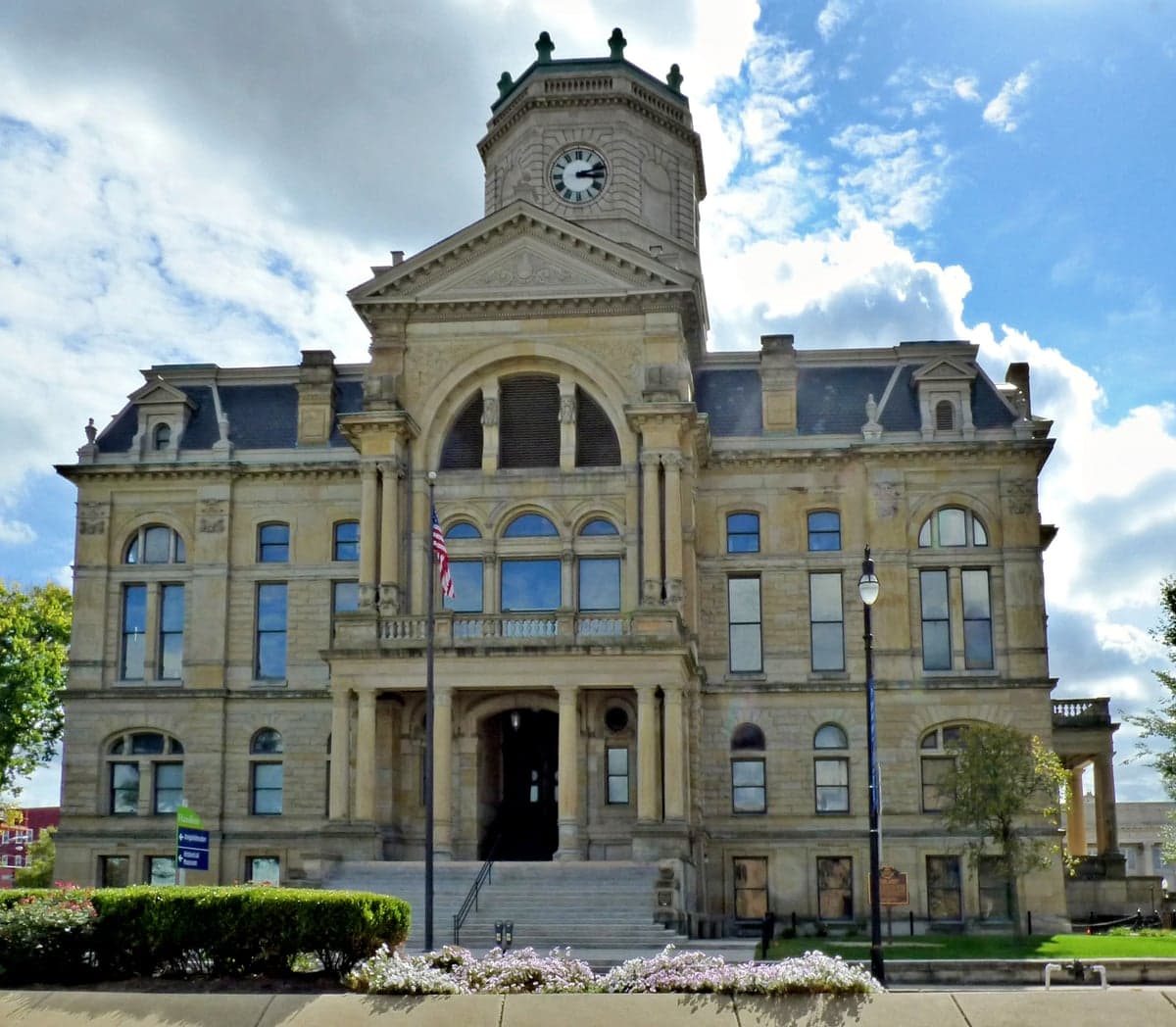
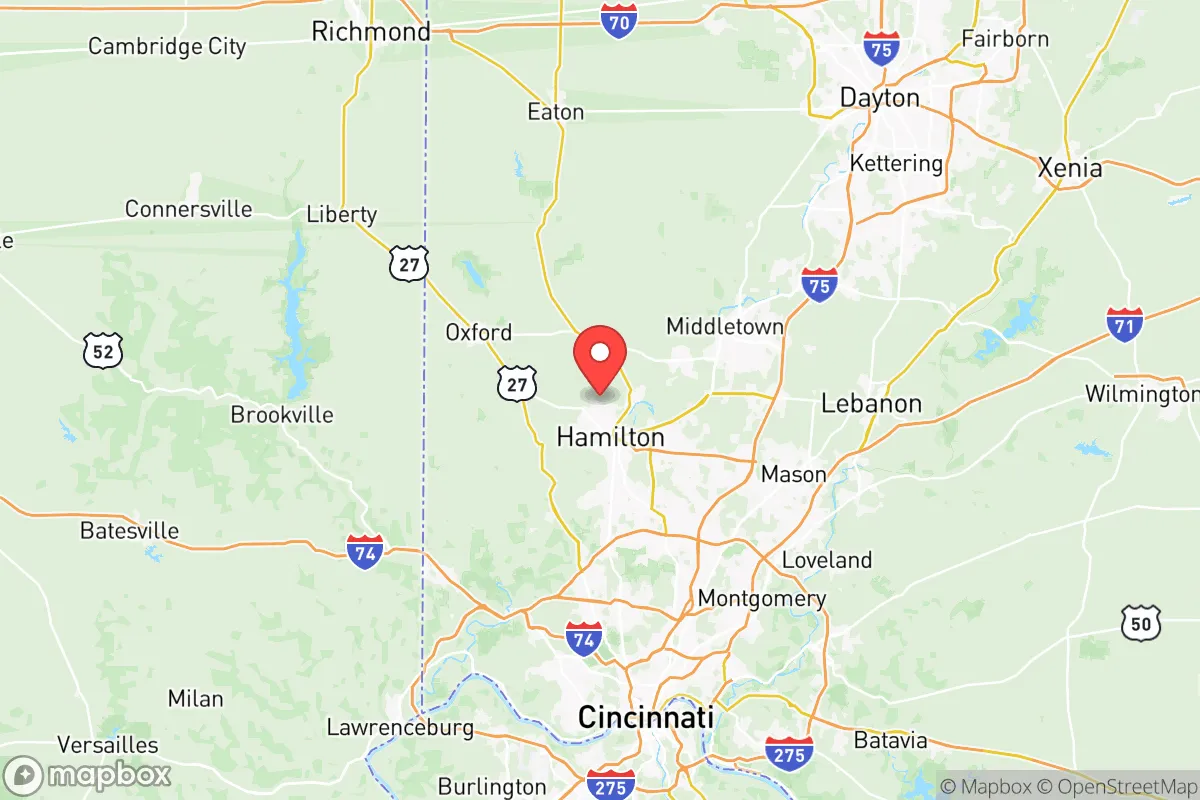
Photo: Wikipedia
Political ClimatePolitical Climate in Butler County
Showing district-level results — no local-only data available.
Local Political AnalysisPolitical Analysis of Butler County
Butler County has been a reliably Republican stronghold for decades, and if anything, it's gotten redder in recent election cycles. With a Cook Partisan Voting Index of R+12, the county votes about 12 points more Republican than the national average, placing it firmly in the deep-red camp. This isn’t just a fluke of one election — Donald Trump carried the county by roughly 21 points in both 2016 and 2020, a margin that actually widened slightly from 2012. The county's politics have shifted in lockstep with the broader Cincinnati suburbs, moving right as the state of Ohio itself trends a little less red overall at R+5.
How it compares to Ohio
The state of Ohio, with its R+5 PVI, is considered a lean-Republican state that still contains battleground dynamics — think Columbus, Cleveland, and their inner-ring suburbs. Butler County, by contrast, holds no such suspense. The R+12 designation places it closer to strongly red territory, alongside neighboring Warren County (R+18), while the state’s blue islands remain over an hour away. That difference matters: in Ohio, statewide races are competitive and hinge on the I-71 corridor; in Butler County, the primary election is often the more contested race, and general elections have a predictable outcome. The county’s politics are closely aligned with the Miami University corridor in Oxford and the western Cincinnati exurbs — places like West Chester and Liberty Township — which have gone from swingy to reliably red over the last 15 years.
What this means for residents
For conservative residents, Butler County offers a comfortable environment where local governance aligns with their values. The county commission is solidly Republican, and issues like gun rights, low taxes, and restrictions on abortion access are reflected in local policy. Conservative families often cite the school districts — Lakota, Fairfield, and Mason — as a draw, with active parent groups and a generally traditionalist culture. For liberal residents, life is more about carving out niches. The city of Oxford, home to Miami University, stands out as a significant blue dot. In 2020, Oxford precincts voted for Biden by nearly 30 points, a stark contrast to the rural and exurban precincts in the county’s north and east, such as those in Hanover Township or the village of Somerville, where Trump won by 40 to 50 points. There are also a few swing pockets, particularly in the older parts of Middletown and Hamilton, where working-class voters have shown more willingness to split tickets, though those areas have also trended red in recent presidential cycles. Liberal residents will find a smaller, more self-selecting community here but can also access the broader Cincinnati progressive scene within a 20-30 minute drive.
The real cultural distinction in Butler County compared to the rest of Ohio is its proximity to the Cincinnati metro while maintaining a distinctly exurban and rural feel, especially as you head north toward Germantown and Gratis. The county has avoided the sort of deep urban vs. rural polarization seen in places like Cuyahoga County. Instead, you get a spectrum: the solidly red exurbs, the reliably blue college town, and a shrinking middle in the post-industrial cities. Over the next decade, I see the red edges staying strong as the county’s growth pushes outward, but Oxford will remain its own universe. A conservative family moving to West Chester will feel right at home. A liberal family considering a move should look at Oxford first, but they won’t feel out of place in Hamilton’s historic districts either — just don’t expect the politics to be in your favor at the county level.

State Political ClimatePolitical Climate in Ohio
State Political AnalysisPolitical Environment in the State
Ohio has shifted from a classic presidential bellwether to a solidly Republican-leaning state, sporting a Cook PVI of R+5 after twice backing Donald Trump by eight points in 2016 and 2020. The dominant coalition now pairs culturally conservative rural and small-town voters with enough blue-collar exurbs and outer suburbs to offset the shrinking Democratic strongholds in the big cities. Over the past 20 years, the state has lurched rightward more than almost any other in the Midwest, driven by Appalachian realignment, union defections, and a GOP legislature that has locked in conservative policies on everything from abortion to union rights.
Urban vs. rural divide
The state's political map is a stark tri-color split. The urban cores of Cleveland, Columbus, and Cincinnati vote deep blue and grow more diverse each census cycle, but their surrounding counties have flipped hard red. Lake County, east of Cleveland, voted Democratic for decades and went +15 for Biden before swinging back to a toss-up in 2024 — a shift driven by working-class voters who feel the national Democratic brand no longer speaks to them. The I-71 corridor from Cincinnati to Columbus to Cleveland is the epicenter of the blue vote, anchored by Ohio State University in Columbus and the Metroparks suburbs of Cleveland's Cuyahoga County. Meanwhile, the state's second-tier cities — Dayton, Akron, and Toledo — are now pure swing cities, each shedding population and watching their surrounding exurbs turn GOP. The entire southeastern Appalachian quadrant, from Steubenville down to Portsmouth, has become as reliably red as any county in West Virginia, fueled by coal heritage, gun culture, and resentment of state environmental policy.
Policy environment
Ohio's policy environment reflects a GOP supermajority that's been in control of the legislature since 2011, consistently overriding vetoes from Governor Mike DeWine. The state income tax has been cut from a top rate of about 5.3% down to 3.5% and is on a glide path toward elimination. Corporate taxes are low, and Ohio has a "right to work" feel despite formally remaining a union state — the 2011 collective bargaining law (SB 5) was repealed by voters, but public sector union power has eroded through attrition and pension changes. On education, the state uses a universal school voucher system (the EdChoice program) that any family below 450% of the federal poverty line can tap for private school costs; over 50,000 students now use vouchers, making it one of the nation's largest programs.
Recent policy direction
Since 2020 Ohio has moved decisively right on most liberty-related issues. On gun and self-defense law, it became a permitless carry state in 2022 (HB 227) — any law-abiding adult 21 or over can carry a concealed handgun without a license or training, and "stand your ground" and castle doctrine protections are codified in statute. The NRA rates Ohio's gun laws among the most permissive in the Midwest. On parental and education rights, the legislature passed a "Parents' Bill of Rights" in 2023 requiring schools to notify parents of curricular changes and get written consent before teaching anything related to sexuality or gender, and 2021's HB 322 banned transgender girls from girls' school sports. On abortion and bodily autonomy, a 2022 six-week "heartbeat" ban went into effect after Dobbs, but a November 2023 statewide ballot measure (Issue 1) codified abortion access up to fetal viability into the Ohio Constitution, overturning the ban — a rare example of voters rebuking the legislature. On surveillance and privacy, the state has no broad consumer privacy law comparable to California or Virginia, but it did ban government-mandated vaccine passports in 2021. Voting and ballot access got tighter in 2023 with HB 458, which reduced the mail-in ballot application window, tightened ID requirements to a valid state or federal ID, and cut drop box hours. Early voting remains but is shorter than in pre-Trump years.
Civil unrest & political movements
Ohio has long been a battleground for high-profile protest movements. The 2020 protests over George Floyd's death in Minneapolis escalated into the most intense civil unrest since the 1960s, particularly in Columbus where the Statehouse grounds were ringed with National Guard for weeks, and in Cincinnati where clashes with police led to dozens of arrests. Right-wing activism remains organized through county-level "Election Integrity" groups that monitor drop boxes and poll sites, particularly in the Columbus suburbs of Delaware County and Warren County, which were ground zero for post-2020 "stop the steal" rallies. Immigration politics are less visible here than in border states, but the 2023 "Troop of the Ohio State Highway Patrol" sent 70 troopers to Texas as part of Governor Abbott's border operation — a symbolic move that played well in conservative media. There is no sanctuary city movement in Ohio; even Cleveland, the most liberal city, doesn't advertise sanctuary policies, though it has a "Welcoming City" ordinance limiting police cooperation with ICE on low-level arrests. Election integrity controversies have faded since 2022, when Secretary of State Frank LaRose (a Republican) purged 150,000 inactive voter registrations but also expanded online registration — a compromise that satisfied few on either side.
Projection
Over the next decade, expect Ohio to become more Republican, not less, despite the 2023 abortion ballot win for progressives. The suburbs around Cleveland and Columbus are slowly liberalizing (Delaware County went from +22 Trump in 2016 to +11 in 2024), but the rural and exurban exodus from the Democratic party is faster. In-migration from California and New York is not significant here — Ohio has net domestic out-migration to states like Texas and Florida, meaning the people moving in tend to be older retirees who lean right. The 2020 census cost Ohio a House seat, and the 2030 census may cost another as the population stagnates and ages. The biggest wild card is Columbus, which is growing younger and more diverse than the rest of the state; if it reaches the critical mass of a deep-blue city like Nashville, it could shift a couple of statehouse seats. But the legislature's GOP supermajority is likely safe through at least 2030 due to gerrymandered maps that are currently locked in through 2032.
The bottom line for a new resident: if you're conservative, Ohio is already one of the most comfortable states in the Midwest — low taxes, permissive gun laws, a school choice system that works, and a cultural environment that respects Second Amendment and religious liberty viewpoints. If you're progressive, you'll find strong community in the urban cores, particularly in Columbus's Short North and Cleveland's Ohio City neighborhoods, but you'll be fighting against a GOP supermajority that shows no signs of loosening its grip. Both sides would agree on one thing: Ohio's days as a swing state are over. The future is R+5 and trending toward R+8 by 2030, even if a single-issue ballot measure like Issue 1 can still flip state policy on a one-off basis. The politics here feel like they've settled into a long-term equilibrium, and the demographic trends only reinforce it.
* Values derived from national, state, county, city and local statistics and may differ in a specific area. Last updated: 2026-09-13T23:29:12.000Z
Narrative content on this page is AI-generated and may contain mistakes. Verify any details that matter before acting on them.
ReloMaps may earn a commission from affiliate links at no extra cost to you.

