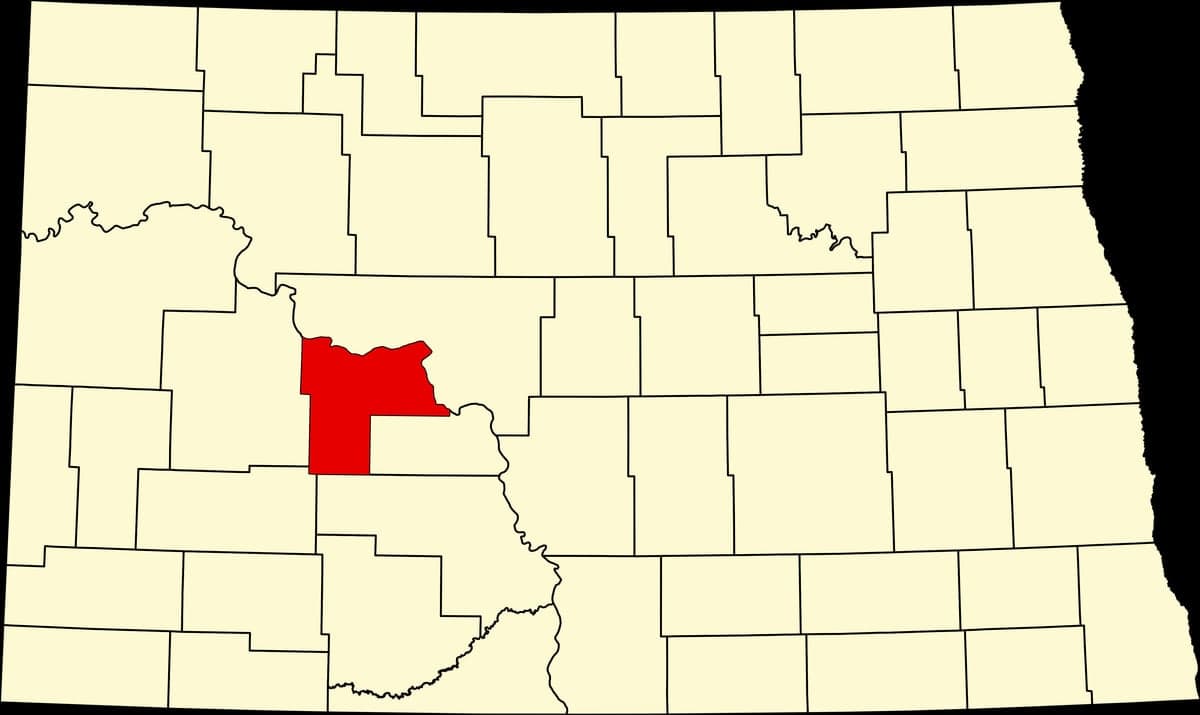
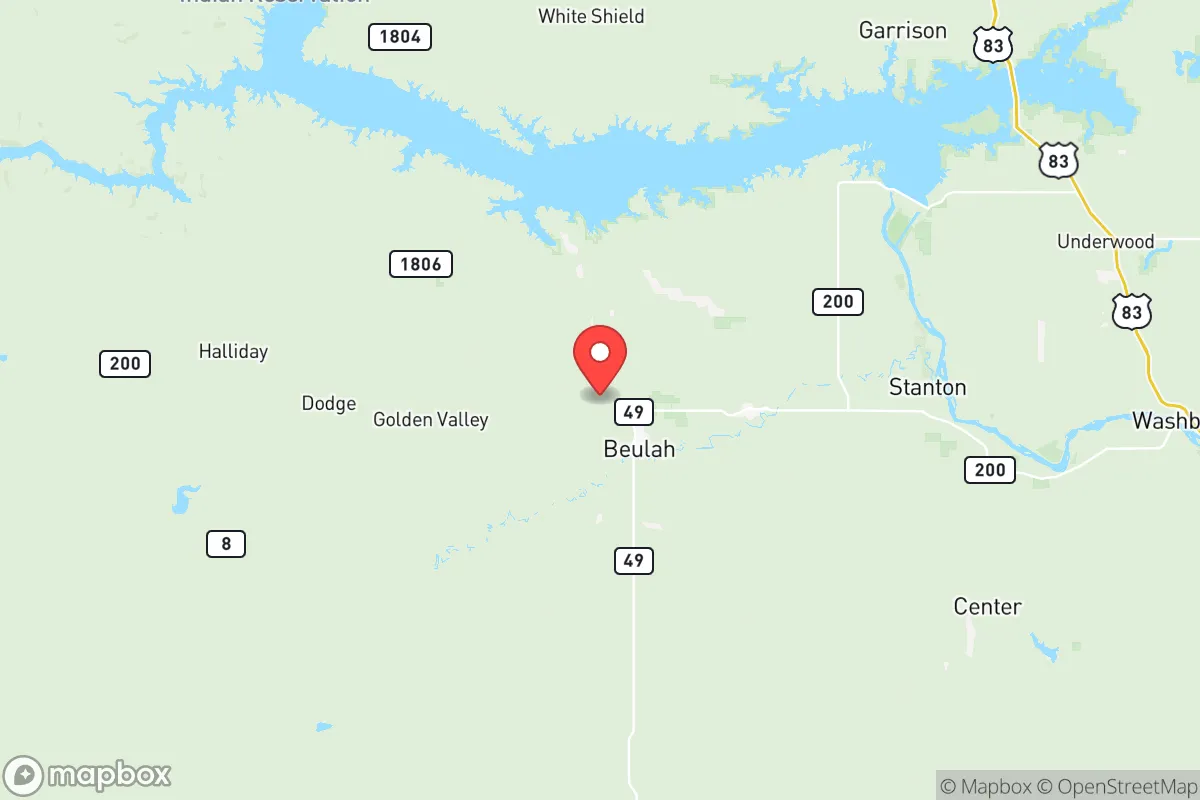
Photo: Wikipedia
Demographics of Mercer County
Affluence Level in Mercer County
A middle-class area roughly in line with national averages across income, home values, education, and employment.
People of Mercer County
Mercer County, North Dakota, is a sparsely populated rural county of 8,341 residents, characterized by its overwhelmingly white (90.5%) and native-born (99.6% U.S.-born) population. The county’s identity is rooted in its agricultural and energy-producing heritage, with a culture that remains deeply tied to the land, local churches, and small-town civic life. With a low college attainment rate of 22.6% and a minuscule foreign-born share of 0.4%, Mercer County is one of the most ethnically homogeneous and culturally stable counties in the state, a place where generational continuity is the norm rather than the exception.
Settlement & growth (pre-1960)
Before European settlement, the area that is now Mercer County was part of the traditional territory of the Mandan and Hidatsa peoples, who lived in fortified earth-lodge villages along the Missouri River. The county’s location along the Missouri River corridor made it a crossroads for fur traders and explorers in the early 19th century, but permanent non-Native settlement did not begin until the 1870s and 1880s, following the creation of the Fort Berthold Indian Reservation to the north and the opening of the region to homesteading under the Homestead Act of 1862.
The first major wave of settlers were German-Russian immigrants, who began arriving in the 1880s and 1890s. These were ethnic Germans who had lived for generations in the Volga River region of Russia, where they had maintained their language, religion, and farming traditions. They were drawn to the Great Plains by the promise of cheap land and the freedom to practice their Lutheran and Catholic faiths without interference. They founded the towns of Hazen (1882) and Beulah (1883), which became the county’s primary population centers. The German-Russian influence remains the dominant cultural thread in Mercer County today, visible in local church denominations, family names, and community festivals.
A smaller but significant wave of Norwegian and Swedish immigrants arrived in the same period, settling in the northern and eastern parts of the county, particularly around Stanton, the county seat, and the rural areas near Zap. These Scandinavian settlers were primarily Lutherans and brought with them a tradition of cooperative grain farming and strong civic participation. By 1910, the county’s population had reached roughly 5,000, with the economy almost entirely dependent on wheat and livestock farming.
The discovery of lignite coal in the early 20th century brought a modest industrial shift. The town of Beulah became a center for coal mining and, later, electricity generation. The construction of the Garrison Dam on the Missouri River (completed in 1953) created Lake Sakakawea and brought a wave of construction workers and engineers to the region, though the dam’s primary impact on Mercer County was the displacement of farmland and the creation of a recreational economy. The population peaked at around 10,000 in the 1950s before beginning a slow decline as agricultural consolidation reduced the number of family farms.
Modern era (post-1965)
The post-1965 period in Mercer County has been defined not by immigration-driven diversification, but by domestic out-migration and energy-driven booms. The 1965 Hart-Cellar Act, which transformed immigration patterns in most of the United States, had virtually no effect on Mercer County. The foreign-born population today stands at just 0.4%, and the county’s racial composition has remained overwhelmingly white (90.5%) for decades. The small Hispanic population (2.7%) and even smaller Black (0.6%) and East/Southeast Asian (0.4%) populations are largely the result of temporary workers in the energy sector, not permanent settlement.
The major demographic story of the modern era has been the Bakken oil boom, which began in earnest around 2008. While the core of the boom was in counties to the west (McKenzie, Dunn, Williams), Mercer County experienced a spillover effect. The towns of Beulah and Hazen saw an influx of workers from other parts of North Dakota and from out of state, particularly from Texas, Oklahoma, and the Rocky Mountain states. This brought a temporary increase in population and a noticeable shift in the local economy, with housing prices rising and new businesses opening. However, the boom was cyclical, and population growth has since leveled off. The county’s population in 2020 was 8,341, roughly the same as it was in 1990.
Suburbanization has been minimal. There are no suburbs in the conventional sense; instead, the county’s population is concentrated in its four incorporated towns: Beulah (pop. ~3,000), Hazen (pop. ~2,400), Stanton (pop. ~1,200), and Zap (pop. ~200). The rural areas between these towns have seen a steady decline in population as family farms have been consolidated into larger operations. The county’s young people continue to leave for college and urban jobs in Bismarck, Fargo, and Minneapolis, contributing to an aging population profile.
The future
Mercer County is likely to remain one of the most demographically stable counties in North Dakota over the next 10-20 years. The foreign-born population is expected to remain negligible, as there are no major industries or institutions attracting immigrants. The county’s white share may decline slightly, from 90.5% to perhaps 85-88%, as the small Hispanic and Native American populations grow through natural increase, but the county will remain overwhelmingly white and native-born.
The biggest demographic wildcard is the energy sector. If lignite coal and natural gas prices remain strong, the towns of Beulah and Hazen may see modest population growth as workers and their families move in. If the energy sector declines, the county will likely resume its long-term trend of slow population loss, with the remaining population concentrating in the three largest towns while the most rural areas continue to depopulate. The county’s cultural identity — German-Russian, Lutheran, agricultural, and conservative — is unlikely to change significantly, as there are no large-scale forces pushing toward diversification.
For someone moving in now, Mercer County offers a stable, safe, and culturally cohesive environment where neighbors know each other and community institutions are strong. The trade-off is limited economic opportunity outside of energy and agriculture, a low level of ethnic and cultural diversity, and a population that is aging and slowly shrinking. It is a place for those seeking continuity and community, not for those seeking rapid change or cosmopolitan variety.

* Values derived from national, state, county, city and local statistics and may differ in a specific area. Last updated: 2026-08-24T21:35:47.000Z
Narrative content on this page is AI-generated and may contain mistakes. Verify any details that matter before acting on them.
ReloMaps may earn a commission from affiliate links at no extra cost to you.

