
Photo: Wikipedia
Strategic Assessment of Wayne County
Meaningful friction. Expect exposure to either population pressure, blast zones, or natural disaster risk. Consider buying a retreat property.
What does the Strategic Assessment tell us?
Our Strategic Assessment grades tactical survivability of an area. Major population centers, military targets, fallout zones, natural disasters, and border exposure all drive risk — lower exposure means a more defensible position in a crisis.
This is heavily inspired by Joel Skousen's Strategic Relocation book. Highly recommended you checkout the book ($)What does this tell us?
Our Strategic Assessment grades tactical survivability of an area. Major population centers, military targets, fallout zones, natural disasters, and border exposure all drive risk — lower exposure means a more defensible position in a crisis.
This is heavily inspired by Joel Skousen's Strategic Relocation book. Highly recommended you checkout the book ($)Strategic Pillars

Key Distances
Strategic Assessment Analysis
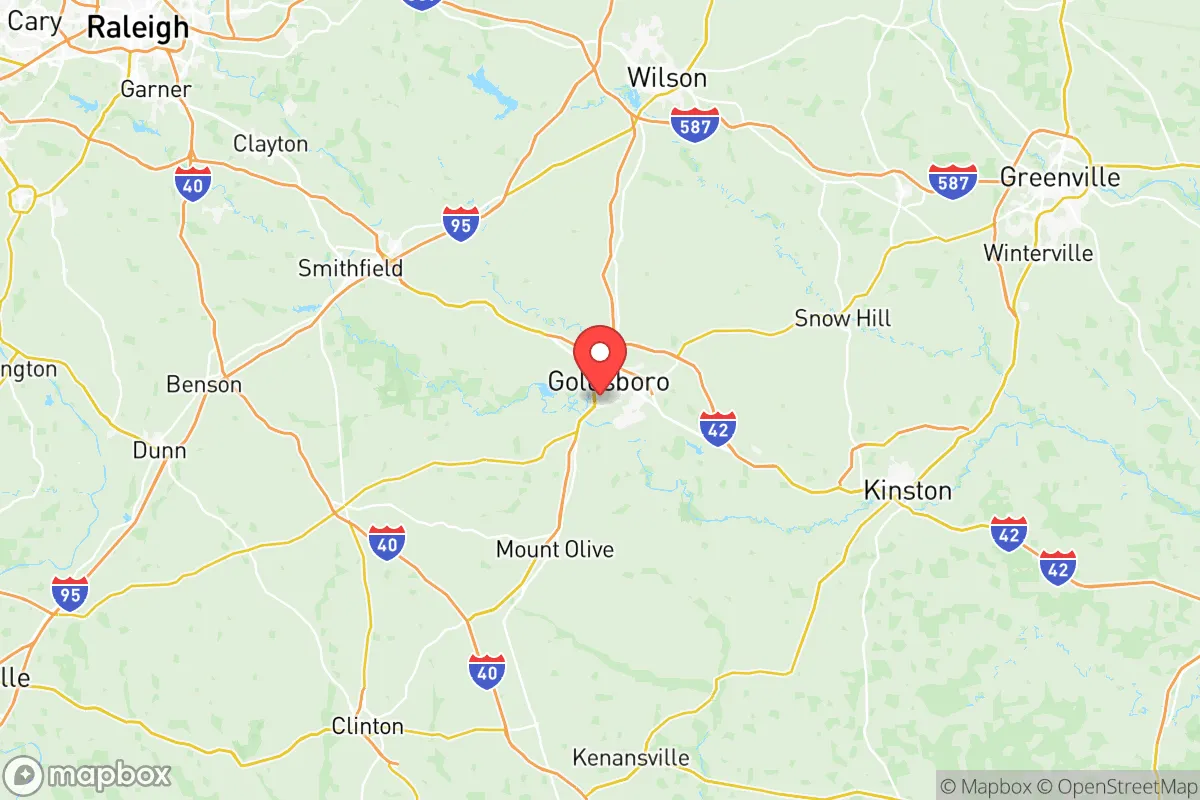
Wayne County, anchored by the city of Goldsboro, presents a mixed strategic picture for the relocation-minded reader focused on resilience and self-sufficiency. Its position in eastern North Carolina offers a blend of agricultural self-reliance and access to coastal resources, but it also sits within a corridor of significant military and industrial infrastructure that could become a liability in a major disruption. For a family or individual weighing long-term preparedness, the county's advantages in food production and water availability are counterbalanced by its proximity to Seymour Johnson Air Force Base and the vulnerabilities of the I-95 and I-40 logistics corridor.
Geographic position and natural advantages for self-sufficiency
Wayne County's geography is defined by the Neuse River basin and the relatively flat, fertile Coastal Plain. This terrain is a genuine asset for anyone interested in small-scale farming or homesteading: the growing season stretches from late March to early November, and the sandy loam soils are well-suited for row crops, orchards, and pasture. The county is part of North Carolina's "Black Belt" of rich agricultural land, with Goldsboro historically a tobacco and cotton hub that has diversified into soybeans, corn, and swine production. For a relocator, this means local food sources are abundant—farmers' markets, roadside stands, and direct-from-farm meat and produce are common. The Neuse River and its tributaries, including the Little River, provide a reliable surface water source, though groundwater from the surficial aquifer is generally accessible for private wells at depths of 30 to 100 feet in most rural areas. The county's elevation, averaging around 130 feet above sea level, offers a modest but meaningful buffer against storm surge from the coast, which is roughly 60 miles southeast. This inland position also means the area is less exposed to the direct impacts of hurricanes than coastal counties, though it still experiences tropical storm-force winds and heavy rainfall from these systems.
Risks, exposures, and proximity to fallout-relevant landmarks
The most significant strategic liability in Wayne County is Seymour Johnson Air Force Base, located just east of Goldsboro. This is a major active-duty installation housing the 4th Fighter Wing and the F-15E Strike Eagle fleet. In a conflict scenario involving strategic strikes, this base is a high-value target. The base's footprint and its associated munitions storage areas create a concentric risk zone that extends several miles outward. Additionally, the county sits within the broader eastern North Carolina military complex, which includes Camp Lejeune (Marine Corps) to the south and Fort Liberty (Army) to the west. While not directly adjacent, the transportation corridors linking these bases—primarily I-40 and US-70—would be choke points in any evacuation or logistics disruption. The county also has a number of industrial sites worth noting: the Goldsboro Municipal Airport industrial park and several large-scale poultry and pork processing plants (such as the Butterball facility in nearby Mount Olive) that, while not nuclear or chemical targets, represent potential points of congestion or hazard in a crisis. On the natural hazard side, the county is in a moderate-risk zone for tornadoes, and the flat terrain can lead to localized flooding along the Neuse River after prolonged rain. The risk of a major earthquake is negligible, but the region is susceptible to ice storms that can knock out power for days.
Practical resilience for a relocator: food, water, energy, and defensibility
For someone serious about self-sufficiency, Wayne County offers a solid baseline. Food security is the strongest pillar: the agricultural base means that even in a supply chain disruption, local food production would likely continue. The county has multiple feed and seed stores, livestock auction barns, and a cooperative extension office that provides practical resources for small-scale farming. Water access is also favorable for a rural property. A drilled well with a submersible pump is the standard, and the water quality from the surficial aquifer is generally good, though testing for nitrates from agricultural runoff is advisable. The county does not have a municipal water system covering all rural areas, so a well is a necessity for most homesteads. Energy resilience is more of a challenge. The local grid is served by Duke Energy Progress, and outages from storms are common. Solar potential is moderate—the region gets about 4.5 peak sun hours per day on average—so a grid-tied solar system with battery backup is feasible but will require a generator for extended cloudy periods. Wood heating is a practical option, as the county has abundant timberland and firewood is readily available. Defensibility is a mixed bag. The terrain is flat and open in many areas, which reduces natural concealment, but the rural parts of the county offer good standoff distance from neighbors. The county seat, Goldsboro, has a population of roughly 35,000, and the overall county population is around 125,000, which means the rural areas are not densely populated. The biggest defensive concern is the proximity to the base and the potential for displaced populations from the coast or from Raleigh (about 50 miles northwest) to flow through the county along the major highways in a crisis.
The overall strategic picture for Wayne County is one of moderate resilience with a specific, non-negotiable risk. For a relocator who values agricultural self-reliance, abundant water, and a lower cost of land compared to the Piedmont or the coast, the county offers genuine advantages. The climate is forgiving for year-round food production, and the local economy is grounded in tangible goods rather than speculative services. However, the presence of Seymour Johnson Air Force Base is a hard fact that cannot be ignored—it is a target, and its location near Goldsboro means that any major conflict involving strategic strikes would directly affect the area. For a family willing to accept that risk in exchange for the benefits of a productive, rural environment with strong community ties and practical resources, Wayne County is a defensible choice. For those seeking a location with zero exposure to military or industrial targets, this is not the place. The key is to choose a property well away from the base, the major highways, and the industrial zones, and to invest in independent water and power systems that can weather the region's natural hazards.

* Values derived from national, state, county, city and local statistics and may differ in a specific area. Last updated: 2026-06-11T18:20:02.000Z
Narrative content on this page is AI-generated and may contain mistakes. Verify any details that matter before acting on them.
ReloMaps may earn a commission from affiliate links at no extra cost to you.

