Photo: Wikipedia
Demographics of North Bennington, VT
Affluence Level in North Bennington, VT
A middle-class area roughly in line with national averages across income, home values, education, and employment.
People of North Bennington, VT
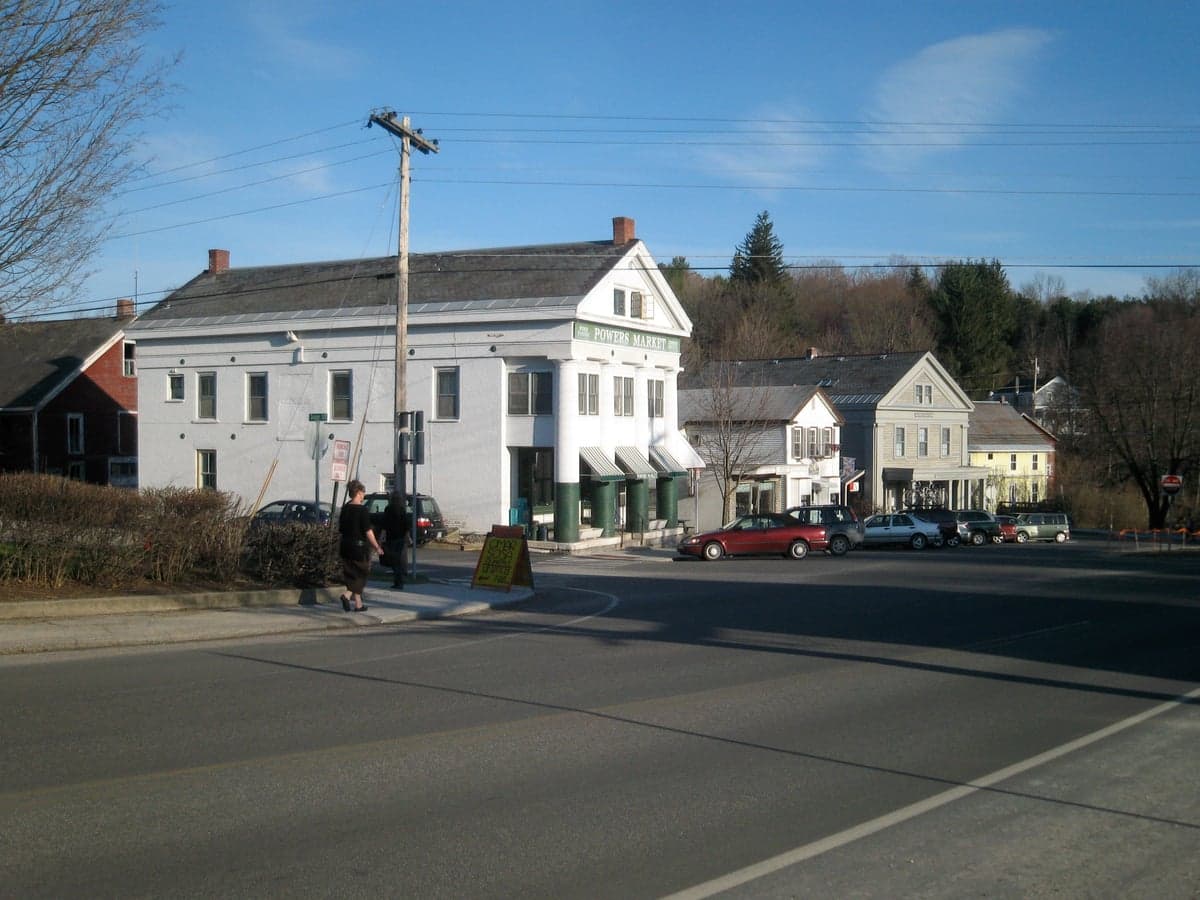
North Bennington, Vermont, is a small, historic village of 1,342 residents that feels more like a tight-knit college town than a typical rural hamlet. Its population is notably older and more educated than the state average, with 41.0% holding a college degree, and it remains overwhelmingly white at 86.5%. The village’s character is defined by its deep Yankee roots, a significant East/Southeast Asian community (4.7%), and a palpable sense of place anchored by the Bennington College campus. This is a place where the past is present, and the population is slowly diversifying while retaining a distinctly New England identity.
How the city was settled and grew
North Bennington’s original population was drawn by the same forces that built much of southern Vermont: fertile river valleys and water power. Chartered in 1749, the town of Bennington was settled primarily by English colonists from Connecticut and Massachusetts after the French and Indian War. These were Congregationalist farmers and millers who established the village’s first neighborhoods along the Walloomsac River. The Historic District around the Four Corners, with its white clapboard houses and the iconic North Bennington Railroad Station, was the original commercial and civic core built by these early families. The arrival of the railroad in the 1850s and the rise of the Bennington Pottery and paper mills brought a second wave: Irish and French-Canadian laborers who settled in the Mill District along the river, building modest worker cottages that still stand today. These groups formed the backbone of the village’s working class through the early 20th century, with the French-Canadian community remaining a distinct cultural presence in neighborhoods like West Street and River Road.
Modern era (post-1965)
The most transformative event for North Bennington’s modern population was the founding of Bennington College in 1932, but its post-1965 impact was profound. The college attracted a steady stream of faculty, artists, and intellectuals from across the country, many of whom settled in the College Hill neighborhood and the surrounding historic homes. This influx raised the village’s educational attainment dramatically and gave it a distinctly liberal, cosmopolitan flavor. The post-1965 immigration reforms had a modest but visible effect: the East/Southeast Asian community (4.7%) is the largest minority group today, concentrated among faculty families and professionals associated with the college and regional hospitals. These households are primarily located in the Park Street and Main Street areas, near the campus. The Hispanic population (1.6%) and Black population (1.3%) are small but present, largely employed in service roles at the college and local businesses. The Indian subcontinent population is effectively zero (0.0%), reflecting the village’s lack of the tech or medical sectors that draw that group to larger Vermont towns. The foreign-born share (5.2%) is slightly above the Vermont average, driven almost entirely by the college-connected Asian community.
The future
North Bennington’s population trajectory is one of slow, selective diversification within a stable, aging base. The village is not homogenizing into a generic suburb; rather, it is tribalizing into two distinct enclaves: the long-established Yankee and French-Canadian families in the Mill District and West Street, and the newer, college-affiliated professionals in College Hill and the Historic District. The East/Southeast Asian community appears to be plateauing, as it is tied to a specific institutional employer (the college) rather than a broader economic draw. The Hispanic and Black populations are growing very slowly, primarily through service-sector employment. The next 10-20 years will likely see continued aging of the white population, with younger families priced out by high housing costs and limited inventory. The village’s future depends on whether it can attract younger, working-age residents—particularly in trades and small business—to offset the demographic decline. Without a major economic catalyst, North Bennington will remain a small, educated, and slowly diversifying village where the college and its orbit define the social and demographic landscape.
For a conservative-leaning individual or family considering a move, North Bennington offers a stable, safe, and historically rooted community with a strong sense of place. The population is not growing rapidly, and the cultural and political atmosphere is heavily influenced by the college, which may be a consideration. The village is becoming a quieter, more expensive, and more educated version of its former self—a place where tradition and academia coexist, but where the working-class roots of the Mill District are increasingly a memory. If you value deep history, walkable streets, and a community that knows its own story, North Bennington is a compelling choice, but it is not a place of rapid demographic change or economic dynamism.

* Values derived from national, state, county, city and local statistics and may differ in a specific area. Last updated: 2026-04-30T03:08:52.000Z
Narrative content on this page is AI-generated and may contain mistakes. Verify any details that matter before acting on them.
ReloMaps may earn a commission from affiliate links at no extra cost to you.

