 Popular
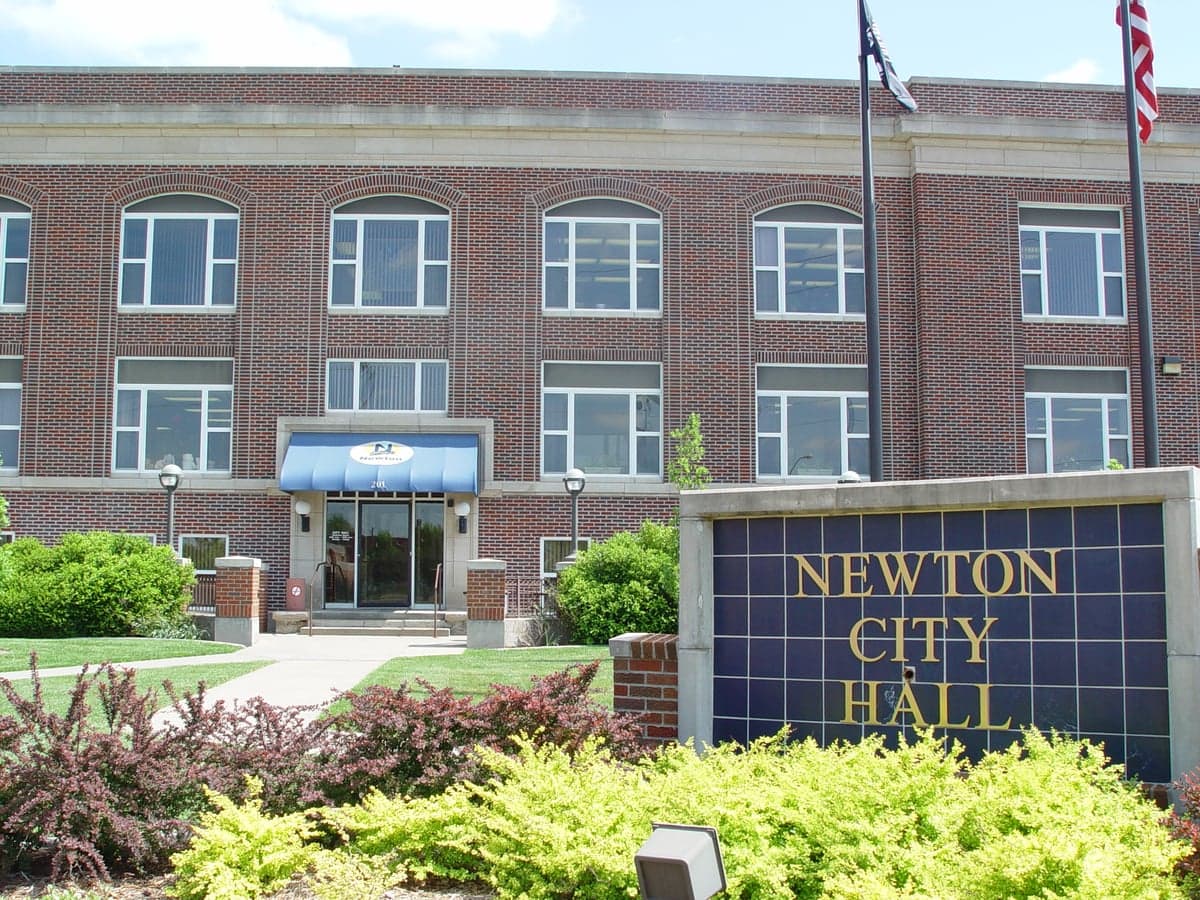
Photo: Wikipedia
Demographics of Newton, KS
Affluence Level in Newton, KS
A middle-class area roughly in line with national averages across income, home values, education, and employment.
People of Newton, KS
The people of Newton, Kansas, today number 18,443, forming a community that is predominantly white (73.9%) with a significant Hispanic minority (19.5%) and a very small foreign-born population of just 1.6%. The city’s character is shaped by its deep Mennonite roots, a historic railroad and manufacturing economy, and a notably low college attainment rate of 29.5%, which is below the national average. Distinctive identity markers include a strong sense of local tradition, a working-class ethos tied to the rail and manufacturing sectors, and a growing Hispanic presence that is reshaping the city’s cultural and residential landscape.
How the city was settled and grew
Newton was founded in 1871 as a planned stop on the Atchison, Topeka and Santa Fe Railway, which drew the first major wave of settlers: railroad workers, merchants, and land speculators. The city’s original population was overwhelmingly white, with a significant number of German-speaking Mennonite families who arrived in the 1870s and 1880s, fleeing religious persecution in Russia and seeking farmland. These Mennonites, known for their agricultural expertise and hard red winter wheat, settled primarily in the North Newton area, which remains a distinct, quieter residential district with strong ties to Bethel College, a Mennonite liberal arts school. A second wave came with the discovery of oil in the nearby El Dorado field around 1915, bringing roughnecks and laborers who filled modest homes in the Old Town district near the railroad tracks. By the mid-20th century, Newton’s population was stable, white, and largely Protestant, with a small African American community concentrated in the East Side neighborhood, historically near the rail yards where many worked as porters and laborers.
Modern era (post-1965)
After the 1965 Hart-Cellar Act, Newton saw only a modest uptick in immigration, unlike larger Kansas cities. The foreign-born share remains very low at 1.6%, and the Asian (East/Southeast Asian) population is negligible at 0.1%, with no measurable Indian-subcontinent population. The most significant demographic shift since the 1970s has been the growth of the Hispanic population, now 19.5%, driven by domestic in-migration from Texas and the Southwest, as well as some direct immigration from Mexico. These families initially settled in the South Side neighborhood, near the rail lines and industrial zones, where affordable housing and proximity to meatpacking and manufacturing jobs (such as at the former Excel plant) provided a foothold. Over the past two decades, Hispanic residents have also moved into the West Side district, a post-war suburban area of single-family homes, creating a more integrated but still economically distinct enclave. The white population, while still the majority at 73.9%, has aged and declined slightly, as younger families often leave for larger job markets in Wichita (25 miles south) or Kansas City.
The future
Newton’s population is heading toward a gradual diversification, with the Hispanic share likely to continue rising as younger families replace an aging white cohort. The city is not tribalizing into stark enclaves—Hispanic and white residents increasingly share neighborhoods like the College Hill area near Bethel College—but economic divides persist, with Hispanic households concentrated in lower-cost housing near the rail corridor. The immigrant community is plateauing rather than surging, given the low foreign-born share, but the domestic Hispanic population is growing through natural increase. The next 10-20 years will likely see Newton become a majority-minority city if current trends hold, though the pace is slow. The low college attainment rate (29.5%) suggests limited in-migration of highly educated professionals, meaning the city will retain its working-class character. For a conservative-leaning mover, this means a stable, family-oriented community with a growing Hispanic presence that is assimilating into local institutions like churches and schools, rather than forming isolated ethnic blocks.
Newton is becoming a more diverse, still predominantly working-class city where traditional values and a slow-growth economy define daily life. For someone moving in now, the city offers a low-cost, safe environment with a clear sense of place, but limited economic dynamism and a population that is gradually shifting from its historic white Mennonite base to a more Hispanic-influenced future.

* Values derived from national, state, county, city and local statistics and may differ in a specific area. Last updated: 2026-04-30T13:17:12.000Z
Narrative content on this page is AI-generated and may contain mistakes. Verify any details that matter before acting on them.
ReloMaps may earn a commission from affiliate links at no extra cost to you.

