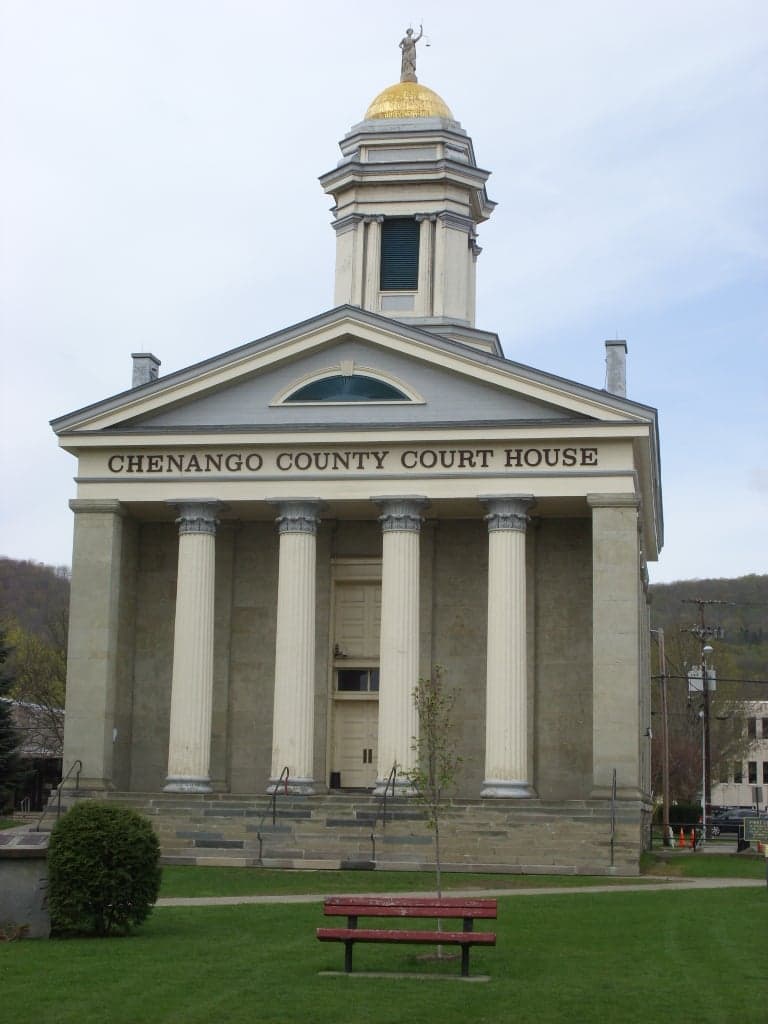
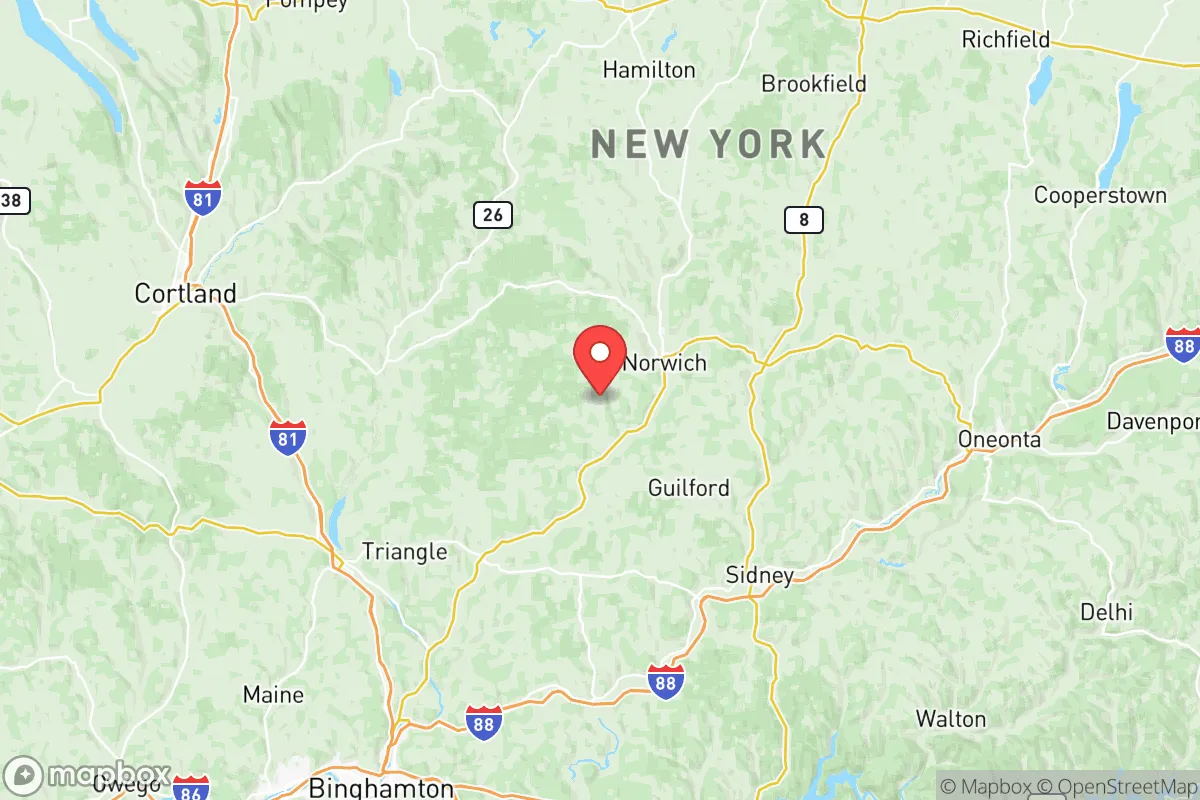
Photo: Wikipedia
Demographics of Chenango County
Affluence Level in Chenango County
A below-average socioeconomic profile. Incomes, home values, and educational attainment trail the U.S., with higher poverty and unemployment.
People of Chenango County
Today, Chenango County is home to roughly 46,685 residents, making it one of New York’s more sparsely populated counties with a density of just 42 people per square mile. The population is overwhelmingly white (92.9%) and native-born (only 1.2% foreign-born), with a strong rural character defined by small villages, dairy farms, and a deeply rooted sense of local independence. Distinctive markers include a higher-than-average share of residents working in manufacturing, healthcare, and agriculture, alongside a pronounced lack of racial or ethnic diversity that sets it apart from the state’s urban and suburban corridors.
Settlement & growth (pre-1960)
The land that became Chenango County was originally the territory of the Oneida Nation, one of the five nations of the Iroquois Confederacy. The Oneida maintained villages and hunting grounds along the Chenango River and its tributaries, including sites near present-day Norwich and Greene. French and British fur traders passed through in the 17th and 18th centuries, but no permanent European settlement occurred until after the American Revolution. In 1788, New York State extinguished Oneida claims through the Treaty of Fort Stanwix, opening the region to Euro-American settlers.
The first major wave of settlers arrived between 1790 and 1820, overwhelmingly from New England—primarily Connecticut, Massachusetts, and Vermont. These Yankees were drawn by the promise of cheap, fertile land in the Chenango Valley, advertised by land speculators and state land grants. They founded the county’s core villages: Norwich (settled 1788, incorporated 1793), Oxford (1790), Sherburne (1792), and Greene (1795). These communities were laid out around central greens and meetinghouses, reflecting their New England origins. The Chenango Canal, completed in 1837, linked the county to the Erie Canal system and spurred a second wave of growth, bringing Irish laborers who dug the canal and later settled in Bainbridge and Oxford.
By the mid-19th century, dairy farming and hop cultivation dominated the economy, attracting a smaller but notable influx of German and Polish immigrants, who worked as farmhands and in creameries. These groups concentrated in the towns of Plymouth and New Berlin, where German Lutheran and Polish Catholic churches were established. The county’s population peaked at around 45,000 in 1880, then declined as the hop industry collapsed due to blight and competition from the West Coast. The 20th century brought little new immigration; the county remained overwhelmingly white and native-born, with a small African American population (mostly domestic workers and railroad laborers) concentrated in Norwich. The post-World War II era saw no major suburban boom—Chenango County lacked the interstate highways and job growth that transformed other regions—and its population hovered around 40,000 through the 1950s and 1960s.
Modern era (post-1965)
The 1965 Hart-Cellar Act had virtually no effect on Chenango County. The foreign-born population today is just 1.2%, and the county’s racial composition has barely shifted since the 1970s. Unlike much of the United States, Chenango did not experience significant immigration from Latin America, Asia, or the Indian subcontinent. The small Hispanic population (2.4%) is mostly of Puerto Rican or Mexican origin, concentrated in Norwich and Sherburne, where they work in manufacturing and food processing. East and Southeast Asian communities (0.3%) are almost entirely absent, and the Indian-subcontinent population (0.2%) is negligible, limited to a handful of professionals at the county’s largest employer, the NBT Bank headquarters in Norwich.
Domestic migration has been the dominant demographic force since 1965, but it has been a net outflow rather than an inflow. Young adults have left for college and jobs in the Albany-Schenectady-Troy metro area, Binghamton, and Syracuse, while retirees have moved to warmer climates. The county’s population declined from 51,768 in 1970 to 46,685 in 2020. Suburbanization has been minimal; the only modest growth has occurred in the village of Norwich and along the NY-12 corridor, where a few subdivisions have been built for commuters working in Broome County. The African American population remains tiny (0.5%), mostly in Norwich and Oxford, and has not grown appreciably since the Great Migration ended in the 1970s.
The county’s cultural identity has remained remarkably stable. It is politically conservative by New York standards—Chenango County voted for Donald Trump by a 30-point margin in 2020—and its residents value self-reliance, hunting, and outdoor recreation. The lack of diversity is not a recent trend but a continuation of a pattern that has held for over a century. The only notable modern shift has been a small influx of white retirees from downstate New York and New Jersey, drawn by low property taxes and rural quiet, particularly around South New Berlin and Pitcher.
The future
Chenango County’s population is projected to continue its slow decline, falling to roughly 44,000 by 2040, according to Cornell University’s Program on Applied Demographics. The county is aging—the median age is 44.6, well above the national average—and the birth rate is below replacement. Diversity is unlikely to increase significantly; the foreign-born share may rise slightly as a few immigrant workers fill labor gaps in dairy farming and food processing, but these numbers will remain small. The Hispanic population may grow to 4-5% by 2040, driven by natural increase and limited migration, but the county will remain overwhelmingly white.
New communities are not forming; instead, the population is dispersing as young people leave and older residents age in place. The villages of Greene and Bainbridge are losing population fastest, while Norwich is holding steady due to its role as the county seat and employment hub. The cultural identity is likely to become more entrenched, with conservative politics and rural traditions persisting. There is no sign of the kind of rapid suburbanization or immigration that has reshaped other parts of New York.
For someone moving in now, Chenango County offers a stable, safe, and deeply traditional rural environment—but one that is shrinking and aging. The lack of diversity and limited economic opportunity mean it is best suited for those seeking low-cost, low-hassle living and a community where neighbors have known each other for generations. It is not a place of demographic transformation, but of continuity.

* Values derived from national, state, county, city and local statistics and may differ in a specific area. Last updated: 2026-10-05T03:00:48.000Z
Narrative content on this page is AI-generated and may contain mistakes. Verify any details that matter before acting on them.
ReloMaps may earn a commission from affiliate links at no extra cost to you.

