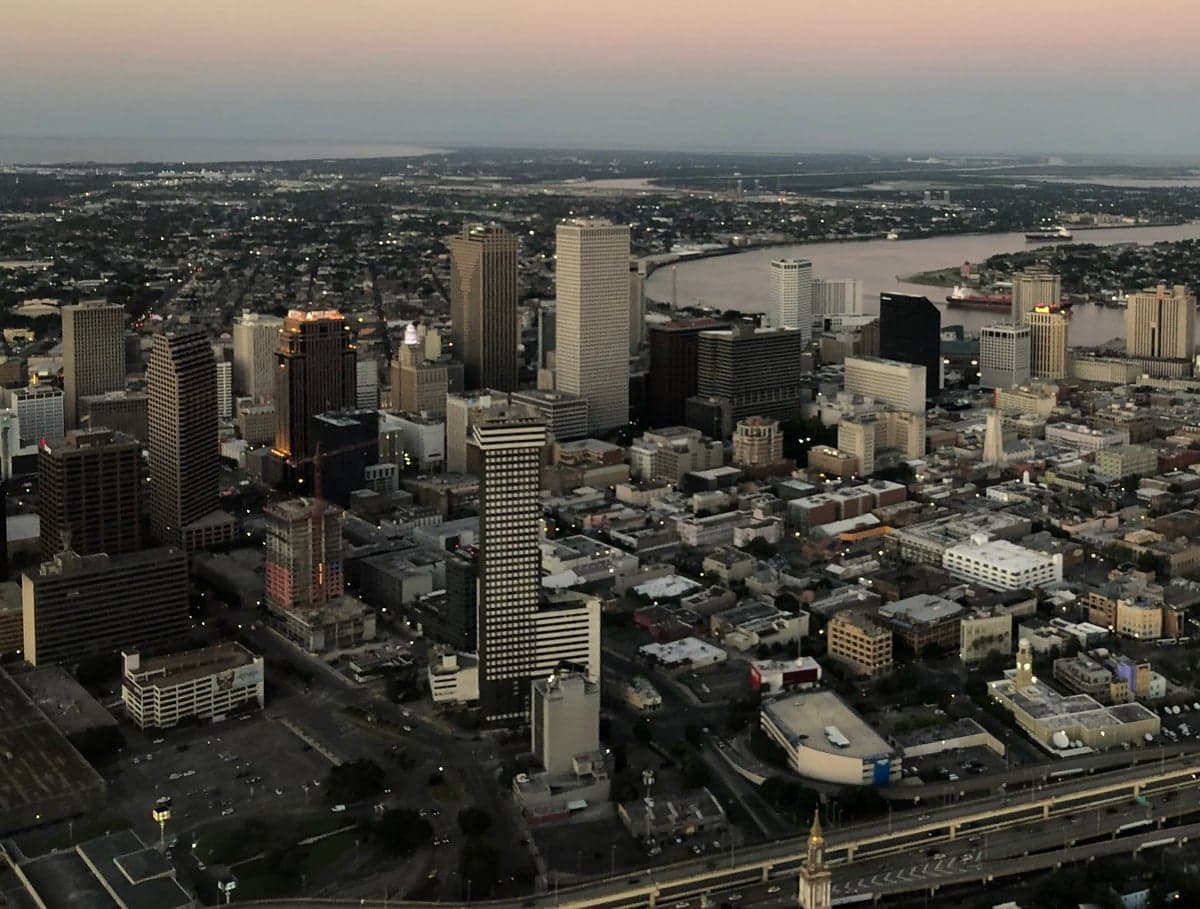
Photo: Wikipedia
Personal Sovereignty in New Orleans, LA
Strong independent fundamentals that actively favor personal liberty and low regulation.
What does Personal Sovereignty tell us?
Personal Sovereignty measures your capacity for self-reliance and independence with minimal government friction. Higher scores mean fewer barriers between you and the way you want to live... but it assumes you have the space you need and good neighbors.
What does this tell us?
Personal Sovereignty measures your capacity for self-reliance and independence with minimal government friction. Higher scores mean fewer barriers between you and the way you want to live... but it assumes you have the space you need and good neighbors.
State Policy
Energy independence: Net exporter (280% of energy produced in-state)
Personal Liberty
Homesteading

Personal Liberty Analysis
New Orleans presents a deeply conflicted environment for personal sovereignty. While Louisiana’s state-level legal framework offers some of the strongest protections in the South for gun rights and property defense, the city of New Orleans itself operates under a dense web of local ordinances, high taxation, and a political culture that often prioritizes collective mandates over individual autonomy. For a survivalist or prepper evaluating this area, the calculus is stark: you get a powerful legal shield for self-defense and a relatively low cost of land, but you must navigate a city government that actively restricts personal choice in areas from medical mandates to property use. The net result is a sovereignty profile that is far stronger than coastal blue states but significantly weaker than rural parishes just an hour north.
Tax burden and regulatory posture: How much of your income and freedom does the government take?
Louisiana’s state-level tax posture is a mixed bag for those seeking to minimize government extraction. The state has a flat income tax rate of 3% as of 2025, down from a previously graduated system, which is a genuine win for high earners and those who view progressive taxation as a form of coercion. However, the state sales tax is among the highest in the nation, averaging 9.55% in Orleans Parish when you combine state, local, and city levies. This means every major purchase—from a generator to bulk ammo—is heavily taxed. Property taxes are surprisingly low, with an effective rate around 0.55% of assessed value, which is a major plus for landowners. But the regulatory posture in New Orleans itself is hostile to self-reliance. The city has a notoriously complex permitting system for any structural modification, including fences, sheds, or solar panel installations. Building codes are enforced aggressively, and the city’s historic district commissions can veto exterior changes on a whim. For a prepper wanting to reinforce a home or install off-grid infrastructure, this is a direct infringement on property rights. The city also imposes a 1.75% hotel/motel tax and has a history of aggressive business licensing, making any side hustle or home-based enterprise a bureaucratic headache. Compared to neighboring St. Tammany Parish, where regulations are far looser, New Orleans feels like a regulatory choke point.
Self-defense and gun law specifics: Can you legally protect your home and family without government permission?
On self-defense, Louisiana is a constitutional carry state, meaning no permit is required to carry a concealed firearm for anyone legally allowed to possess one. This is a bedrock sovereignty protection. New Orleans cannot override this state preemption, so the city’s attempts to create its own gun restrictions have been repeatedly struck down in court. Stand Your Ground laws are fully in effect, with no duty to retreat in any place you have a legal right to be. Castle Doctrine protections are robust: if someone forcibly enters your home or vehicle, you are legally presumed to have a reasonable fear of death or great bodily harm, justifying lethal force. This is critical for a prepper mindset—the law is on your side if you must defend your supplies or family. However, the practical reality in New Orleans is that the city’s police force is understaffed and response times are notoriously slow, often exceeding 30 minutes for non-life-threatening calls. This means the legal right to self-defense is not just a right but a practical necessity. The city also has a high rate of illegal gun possession and violent crime, which creates a volatile environment where the legal carrying of firearms is common but the risk of encountering an armed criminal is elevated. There are no magazine capacity restrictions or "assault weapon" bans at the state or local level, so you can legally own standard AR-15s and high-capacity magazines. For a survivalist, the legal framework is ideal; the enforcement environment is the weak link.
Self-reliance and homesteading viability: Lot sizes, zoning, and off-grid feasibility
New Orleans’ urban geography is a major obstacle to self-reliance. The typical lot size in the city is a narrow 30 to 40 feet wide by 100 to 120 feet deep, often with zero side setbacks. This makes any serious homesteading—raising chickens, keeping goats, or growing a substantial garden—nearly impossible within city limits. Zoning is restrictive: the city’s Comprehensive Zoning Ordinance (CZO) limits livestock to a few hens (no roosters) on lots over 5,000 square feet, and even then, neighbors can complain about noise or smell. Off-grid feasibility is extremely low due to the city’s reliance on a centralized drainage and sewer system. The ground is mostly clay and silt, making septic systems difficult and expensive. Rainwater collection is technically legal but limited by the city’s stormwater management rules, and solar panels require a structural permit and approval from the Historic District Landmarks Commission if you’re in a designated historic area—which covers much of the city. For a prepper wanting to be fully independent, the city is a trap. The viable alternative is to buy land in the surrounding parishes—St. Bernard, Plaquemines, or St. Tammany—where lot sizes of 1 to 5 acres are common and zoning is far more permissive. In those areas, you can legally install a well, septic, solar, and even a backup generator without city interference. The trade-off is a longer commute to New Orleans for work or supplies, but for sovereignty, it’s the only rational choice.
Personal liberties: Parental rights, medical autonomy, speech, and property
Louisiana has been a battleground for personal liberties, with mixed results. On parental rights, the state passed the Parents’ Bill of Rights in 2024, which explicitly affirms that parents have the fundamental right to direct the upbringing, education, and healthcare of their children. This means you can opt your child out of any school curriculum or medical treatment you find objectionable, including vaccine mandates or gender-related instruction. The state also has a strong school choice program, including vouchers and charter schools, giving parents real alternatives to the underperforming Orleans Parish School Board. On medical autonomy, Louisiana was one of the few states to pass a law in 2023 prohibiting the enforcement of federal vaccine mandates for private employers, and it has no state-level mask or lockdown mandates. However, the city of New Orleans itself imposed its own mask and vaccine mandates during the pandemic, and the current city council is considered progressive on public health issues. Free speech is protected under the state constitution, which has a broader protection for political speech than the First Amendment, but the city has a history of cracking down on "disinformation" and has a hate speech ordinance that some view as chilling. Property rights are strong on paper—Louisiana is a "title theory" state, meaning you hold clear title to your land—but the city’s use of eminent domain for development projects has been controversial. The state also has a strong homestead exemption, protecting up to $35,000 of your home’s value from creditors, which is a meaningful shield for a prepper trying to protect assets.
Overall, New Orleans offers a paradoxical sovereignty profile. The state-level legal framework is among the most protective in the South for gun rights, parental control, and tax structure. But the city itself is a high-tax, high-regulation environment that actively undermines self-reliance through zoning, permitting, and public health overreach. For a single individual or family with a survivalist mindset, the smart play is to live outside the city limits—in a parish like St. Tammany or Washington—while maintaining a legal and business presence in New Orleans for work or commerce. That gives you the best of both worlds: strong state-level protections and the ability to live a self-sufficient life without city interference. Compared to cities like Portland or Denver, New Orleans is a sovereignty win. Compared to rural Montana or Texas, it’s a compromise you make for culture and opportunity. The key is knowing where the lines are drawn and not letting the city’s bureaucracy encroach on your fundamental rights.

* Values derived from national, state, county, city and local statistics and may differ in a specific area. Last updated: 2026-04-22T12:55:34.000Z
Narrative content on this page is AI-generated and may contain mistakes. Verify any details that matter before acting on them.
ReloMaps may earn a commission from affiliate links at no extra cost to you.

