Photo: Wikipedia
Demographics of New Orleans, LA
Affluence Level in New Orleans, LA
A middle-class area roughly in line with national averages across income, home values, education, and employment.
People of New Orleans, LA
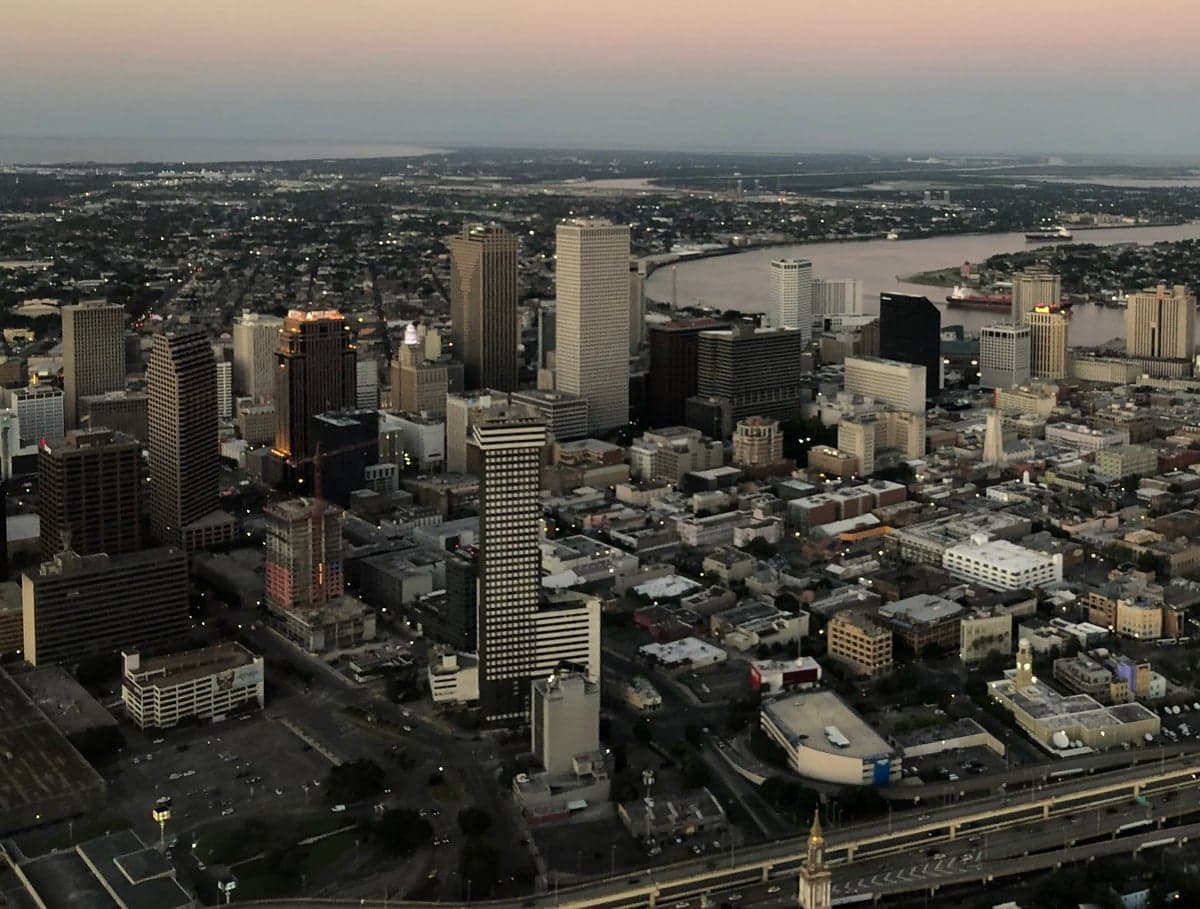
The people of New Orleans today number 376,035, making it one of the most densely populated major cities in the South, yet its character is defined less by size than by a layered, often turbulent human history. The city is majority Black (54.7%), with a white population of 30.1% and a growing Hispanic share of 7.9%. Its identity remains deeply tied to its port, its music, and its distinct neighborhood cultures, though the population has shrunk by roughly 20% since Hurricane Katrina, reshaping who lives where and why.
How the city was settled and grew
Founded by the French in 1718, New Orleans was a strategic port on the Mississippi River, drawing a mix of French colonists, enslaved Africans, and later, Spanish administrators after 1763. The early population was a forced and voluntary blend: French and Spanish Creoles, enslaved people from West and Central Africa, and free people of color who built a unique tri-racial society. The French Quarter (Vieux Carré) was the original settlement, while Faubourg Tremé, just north of the Quarter, became the heart of the free Black and Creole community in the 19th century. The Louisiana Purchase in 1803 brought a wave of Anglo-American settlers, who clustered in the Garden District and Uptown, creating a sharp divide between the French-speaking Creole downtown and the English-speaking American uptown. By the mid-1800s, Irish and German immigrants arrived in large numbers, settling in the Irish Channel and along the riverfront, working the docks and building the city's infrastructure. The 20th century saw a Great Migration of Black Americans from rural Louisiana and Mississippi into neighborhoods like Central City and the Seventh Ward, solidifying the city's Black majority by the 1970s.
Modern era (post-1965)
The 1965 Immigration and Nationality Act opened doors for new arrivals, but New Orleans—unlike Houston or Atlanta—did not see a massive influx of immigrants. The foreign-born population today is just 3.3%, far below the national average. The most notable post-1965 group is Vietnamese refugees, who arrived after the fall of Saigon in 1975 and settled in New Orleans East and Versailles, building a tight-knit community around the Mary Queen of Vietnam Church. This East/Southeast Asian community now accounts for 2.3% of the city's population. Meanwhile, the city's white population, which had been shrinking for decades, saw a modest post-Katrina rebound as new residents—often younger, college-educated professionals—moved into Bywater, Marigny, and parts of Mid-City, driving up the college-educated share to 42.0%. The Hispanic population, at 7.9%, has grown steadily since the 1990s, drawn by construction and service jobs, with concentrations in Kenner (just outside city limits) and the West Bank. The Indian subcontinent population remains tiny at 0.4%, with no single dominant neighborhood.
The future
The population is slowly stabilizing after Katrina, but the city is not returning to its pre-2005 demographics. The Black population, while still the majority, has declined in absolute numbers, while the white and Hispanic shares have increased. The city is becoming more educated and more expensive, pushing lower-income residents—disproportionately Black—further into suburbs like New Orleans East or across the lake to Slidell. The Vietnamese community in New Orleans East is aging, with younger generations often moving to Houston or the West Coast for opportunity. Hispanic growth is likely to continue, driven by labor demand in construction and hospitality, but the city's low foreign-born share suggests it will remain an outlier among major U.S. cities. The next 10-20 years will likely see a more polarized city: a wealthy, white, and college-educated core in the historic neighborhoods, and a poorer, more diverse periphery.
For someone moving in now, New Orleans is a city of stark contrasts—vibrant and historic, but also shrinking and economically stratified. The population is becoming whiter and more affluent in the tourist-friendly core, while the Black majority that defined the city for generations is dispersing to the suburbs. It is not a homogenizing city, but one where enclaves are hardening along lines of class and race, and where the future depends on whether the city can retain its diverse working class amid rising costs.

* Values derived from national, state, county, city and local statistics and may differ in a specific area. Last updated: 2026-04-22T12:55:34.000Z
Narrative content on this page is AI-generated and may contain mistakes. Verify any details that matter before acting on them.
ReloMaps may earn a commission from affiliate links at no extra cost to you.

