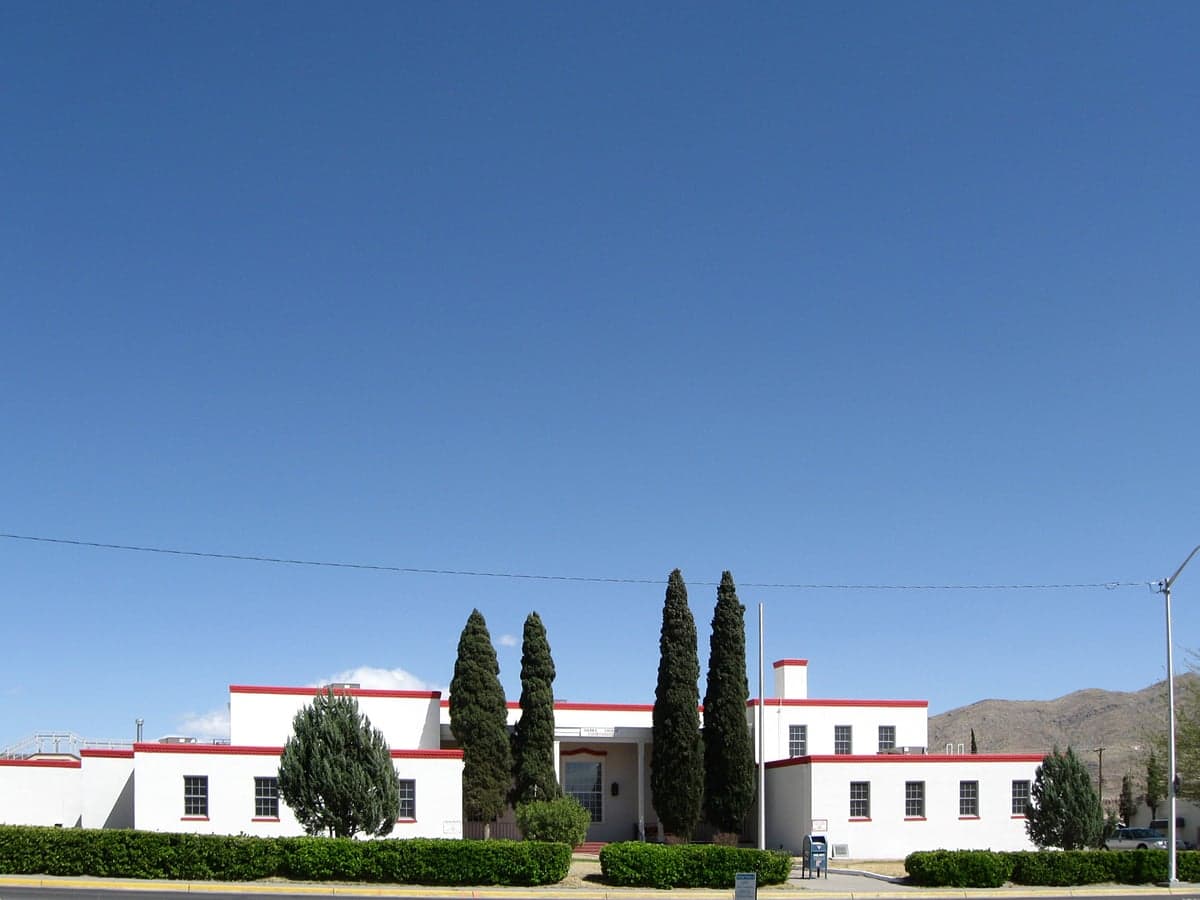
Photo: Wikipedia
Political ClimatePolitical Climate in Sierra County
Showing district-level results — no local-only data available.
Local Political AnalysisPolitical Analysis of Sierra County
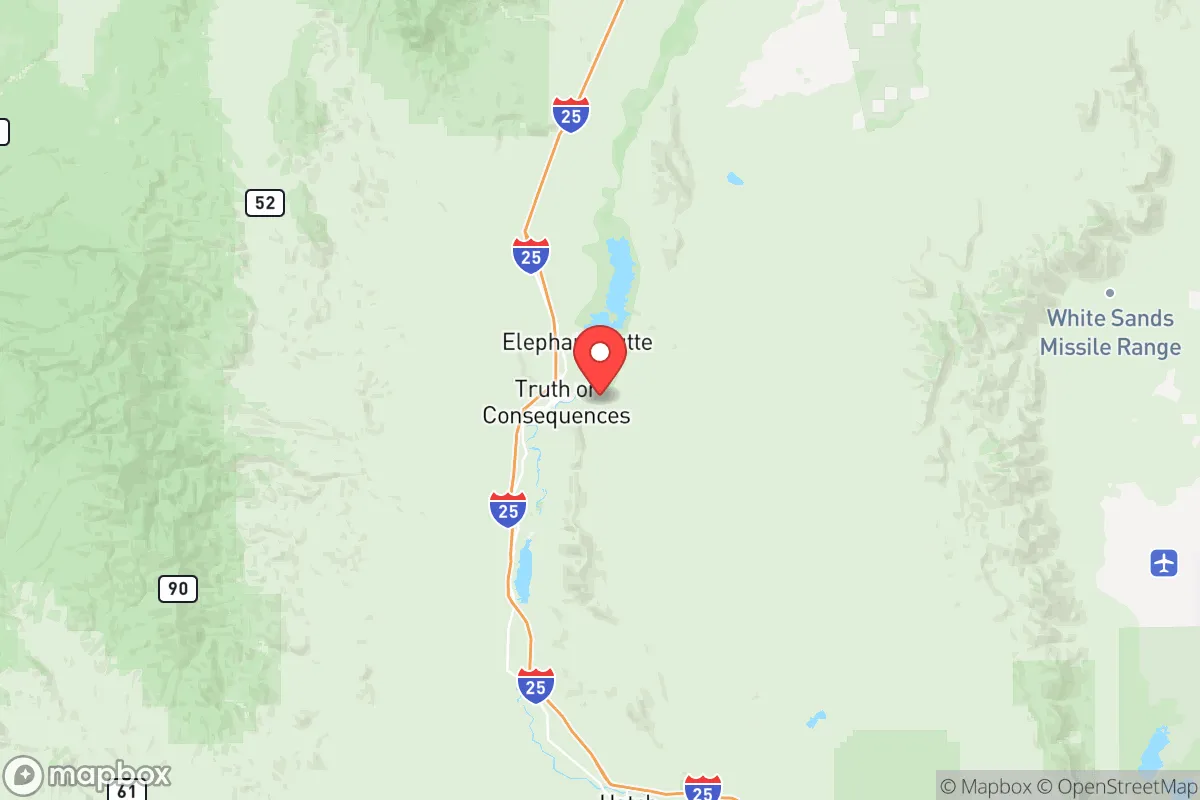
Sierra County is a genuine political battleground, carrying a Cook Partisan Voting Index of EVEN, which makes it one of the few truly competitive counties in a state that leans Democratic by D+3. Over the past decade, the county has shifted rightward in presidential races, with the rural precincts around Truth or Consequences and the Gila National Forest pulling the county toward the GOP, while the town of Truth or Consequences itself and the smaller community of Williamsburg provide a reliable Democratic base. The swing precincts are the ones just outside city limits—places like the area around Elephant Butte Lake and the northern reaches of the county near the Socorro County line—where independent and moderate voters decide elections by margins of 50 to 100 votes.
How it compares
Compared to New Mexico as a whole, Sierra County is notably more conservative, but not in a uniform way. The state's D+3 lean is driven by the heavily Democratic strongholds of Santa Fe, Albuquerque's Bernalillo County, and the tribal lands in the northwest. Sierra County, by contrast, has no major urban center; its largest town, Truth or Consequences, is a quirky mix of aging hippies, retired military, and working-class families, which creates a unique political blend. In the 2024 election, the county voted for Donald Trump by a narrow margin, while the state overall went for Joe Biden. The difference is starkest on cultural issues: Sierra County's voters are more skeptical of gun control and less enthusiastic about renewable energy mandates than the state average, though they strongly support public lands access and water rights—issues that cut across party lines.
What this means for residents
For conservative residents, the county's EVEN rating means their votes genuinely matter—unlike in deep-blue counties where they might feel drowned out. Local elections for county commission and sheriff are often decided by single-digit margins, and the Republican Party maintains a strong ground game in the rural precincts. For liberal residents, the picture is more mixed: they can reliably win the city council seats in Truth or Consequences and Williamsburg, but they face an uphill battle in county-wide races. The practical effect is that policy tends to be moderate and pragmatic. The county government avoids the culture-war fights that dominate state politics in Santa Fe, focusing instead on infrastructure, water management, and economic development around the hot springs and the lake. Both sides agree that the biggest local issue is the aging population and the need to attract younger families and businesses.
Culturally, Sierra County stands apart from the rest of New Mexico in its fierce independence. There is a strong libertarian streak here—people don't like being told what to do by either Santa Fe or Washington. The hot springs in Truth or Consequences draw a countercultural crowd that coexists uneasily but peacefully with the ranching and hunting culture of the outlying areas. You'll see "Don't Tread on Me" flags next to "Keep Public Lands Public" signs. The county's political identity is less about party labels and more about a shared skepticism of outside control, which is why it remains a true swing county in a state that otherwise leans blue. For anyone moving here, the key takeaway is that your vote will count, your voice will be heard, and you'll need to get used to having neighbors who disagree with you on almost everything except the value of the land itself.

State Political ClimatePolitical Climate in New Mexico
State Political AnalysisPolitical Environment in the State
New Mexico has a solid Democratic lean at the state level, with a Cook PVI of D+3, but that number masks a deeply divided political landscape that has shifted rightward over the past decade. The state’s dominant coalition is a mix of urban liberals, Native American voters, and a significant Hispanic working-class base, but the margin of victory for Democrats has narrowed in recent cycles—Hillary Clinton won by 8 points in 2016, Joe Biden by 11 in 2020, and Kamala Harris by just 6 in 2024. For a conservative relocator, the reality is more nuanced than the label suggests: you’ll find deep-red counties where conservative values dominate daily life, but state policy is firmly controlled by a progressive majority in Santa Fe.
Urban vs. rural divide
The political map of New Mexico is a textbook case of urban-rural polarization. The Democratic stronghold is Albuquerque (Bernalillo County), which casts roughly a third of the state’s votes and leans heavily blue—Biden won it by 25 points in 2020. Santa Fe (Santa Fe County) is even more liberal, with margins exceeding 40 points, driven by a high concentration of government workers, artists, and retirees from out of state. Las Cruces (Doña Ana County) is a swingier urban center, trending blue but with a sizable conservative Hispanic population that has shifted right in recent elections—Trump improved his margin there by 5 points from 2020 to 2024. The rural expanse tells a different story: Lea County (oil country near the Texas border) voted +48 for Trump in 2024, while Chaves County (Roswell) and San Juan County (Farmington) are reliably red by 30+ points. The eastern plains—Curry, Roosevelt, and Quay counties—are culturally and politically indistinguishable from West Texas, with strong conservative majorities. The north-central mountains (Taos, Mora, Rio Arriba) are deep blue, driven by a mix of Hispanic progressives and out-of-state transplants. What this means for a conservative resident: your vote in state elections is largely symbolic outside of a few swing districts, but your local government in most rural areas will reflect your values.
Policy environment
New Mexico’s state-level policy is consistently progressive, shaped by a Democratic trifecta that has held the governorship and both legislative chambers since 2019. The tax structure is moderately progressive: a graduated income tax with rates from 1.7% to 5.9%, no state-level estate tax, and a gross receipts tax (GRT) that functions like a sales tax but applies to services, averaging around 7-8% statewide but hitting 9% in some cities like Santa Fe. Property taxes are among the lowest in the nation—typically 0.5-0.8% of assessed value—thanks to a 1970s constitutional amendment that caps annual increases. Education policy is a flashpoint: the state has a universal school choice program (the Educational Choice Act of 2023) that provides up to $8,000 per student for private school tuition, homeschooling materials, or tutoring—a rare conservative win in a blue state. Healthcare is dominated by Medicaid expansion (covering about 40% of residents) and a state-run health insurance exchange, but private options are limited in rural areas. Election laws are among the most accessible in the country: same-day voter registration, no-excuse absentee voting, and automatic voter registration at the DMV. For a conservative, the policy environment is a mixed bag—low property taxes and school choice are attractive, but the high GRT and progressive income tax can feel burdensome.
Recent policy direction
The last five years have seen a sharp leftward shift in several key areas. On gun and self-defense law, New Mexico passed a red-flag law (the Extreme Risk Firearm Protection Order Act) in 2020, and in 2023 banned carrying firearms in public buildings and near polling places. A 2024 law raised the minimum age to purchase a semiautomatic rifle from 18 to 21. However, the state remains a shall-issue concealed carry state with no permit required for open carry. On parental and education rights, the 2023 school choice law was a major win for conservatives, but the state also mandates LGBTQ-inclusive curriculum and prohibits school boards from banning books based on content. On speech and privacy, New Mexico has no state-level shield law for journalists, but a 2024 privacy law (the New Mexico Data Privacy Act) gives residents the right to opt out of data collection by companies. On medical and bodily autonomy, the state has codified abortion rights into law (the Reproductive and Gender Affirmation Health Care Act of 2023), with no gestational limits and no parental notification requirement for minors—a stark contrast to neighboring Texas. On property rights, the state has no statewide rent control, but Albuquerque and Santa Fe have local ordinances limiting rent increases. On taxation, the 2024 legislative session saw a small income tax cut (reducing the top rate from 5.9% to 5.8%) and an expansion of the child tax credit to $600 per child. On voting and ballot access, the 2021 Voter Action Act made same-day registration permanent and expanded early voting. For a conservative relocator, the net direction is clearly leftward on social issues, with a few bright spots on school choice and property taxes.
Civil unrest & political movements
New Mexico has a history of low-grade political tension rather than explosive unrest. The most visible flashpoint in recent years has been immigration politics: the state is a sanctuary state (since 2019), with state law prohibiting local law enforcement from cooperating with federal immigration authorities except in limited circumstances. This has led to periodic standoffs between the governor and rural sheriffs, particularly in Otero County (Alamogordo) and Lea County, where sheriffs have publicly refused to comply. In 2023, Governor Michelle Lujan Grisham declared a public health emergency over gun violence in Albuquerque, drawing lawsuits from gun rights groups and criticism from rural county commissions. The New Mexico Civil Guard, a right-wing militia group, has been active in border-area protests, particularly in Sunland Park and Columbus, but remains a fringe presence. On the left, the Mountain West Progressive Caucus has pushed for rent control and a state public bank, but has not gained traction. Election integrity controversies have been muted compared to other states—New Mexico uses paper ballots with mandatory audits, and no major fraud allegations have surfaced since 2020. For a new resident, the political temperature is warm but not boiling; you’ll see occasional protests in Santa Fe and Albuquerque, but daily life in most of the state is politically quiet.
Projection
Over the next 5-10 years, New Mexico’s political trajectory is likely to remain leftward at the state level, but with a narrowing margin. The key demographic shift is in-migration from Texas and California: between 2020 and 2025, net migration added roughly 50,000 new residents, with most settling in Albuquerque, Santa Fe, and Las Cruces. These newcomers tend to be more liberal than native-born New Mexicans, particularly on social issues. However, the Hispanic working-class vote—about 50% of the electorate—is slowly trending right, especially in rural areas and the oil patch. The 2024 election saw Trump win 44% of the Hispanic vote statewide, up from 38% in 2020. This could make the state competitive in presidential elections within a decade—think Nevada or Arizona circa 2016. The state’s oil and gas industry (the Permian Basin in Lea and Eddy counties) will continue to anchor conservative influence, but the state’s reliance on federal spending (about 30% of the budget) means that a Republican-controlled Congress could create fiscal pressure. For a conservative moving in now, expect the state to remain blue but with a growing conservative minority that could flip a few legislative seats and make the governor’s race competitive by 2030.
For a conservative relocator, the bottom line is that New Mexico offers a low-cost, low-property-tax environment with genuine school choice, but you’ll be living under a state government that is actively moving left on guns, abortion, and immigration. If you’re willing to accept that trade-off—and to live in a rural county where your local government reflects your values—the state can be a good fit. If you want a state where your vote consistently wins, look to Texas or Arizona. But if you value low taxes, open space, and a slower pace of life, New Mexico’s political contradictions might be a price worth paying.
* Values derived from national, state, county, city and local statistics and may differ in a specific area. Last updated: 2026-07-10T04:16:39.000Z
Narrative content on this page is AI-generated and may contain mistakes. Verify any details that matter before acting on them.
ReloMaps may earn a commission from affiliate links at no extra cost to you.

