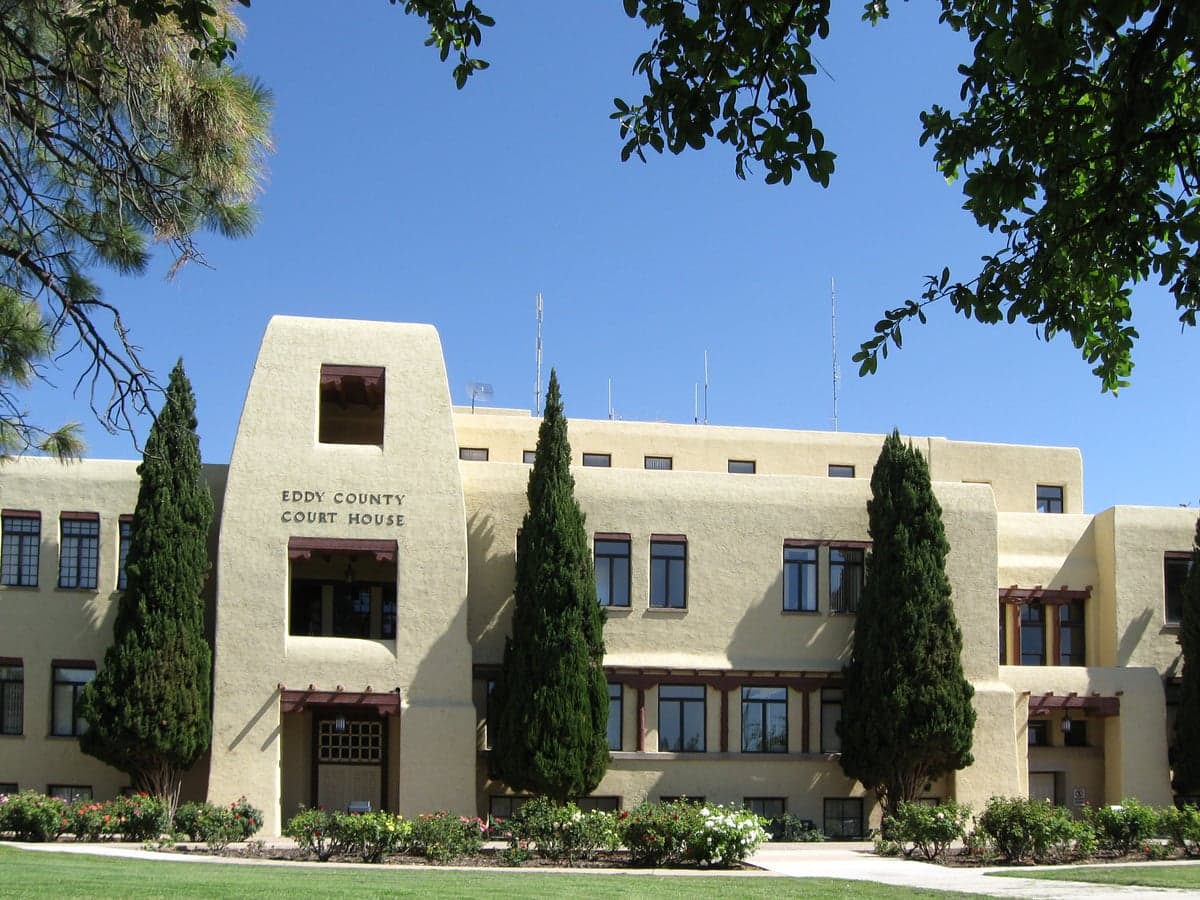
Photo: Wikipedia
Demographics of Eddy County
Affluence Level in Eddy County
A middle-class area roughly in line with national averages across income, home values, education, and employment.
People of Eddy County
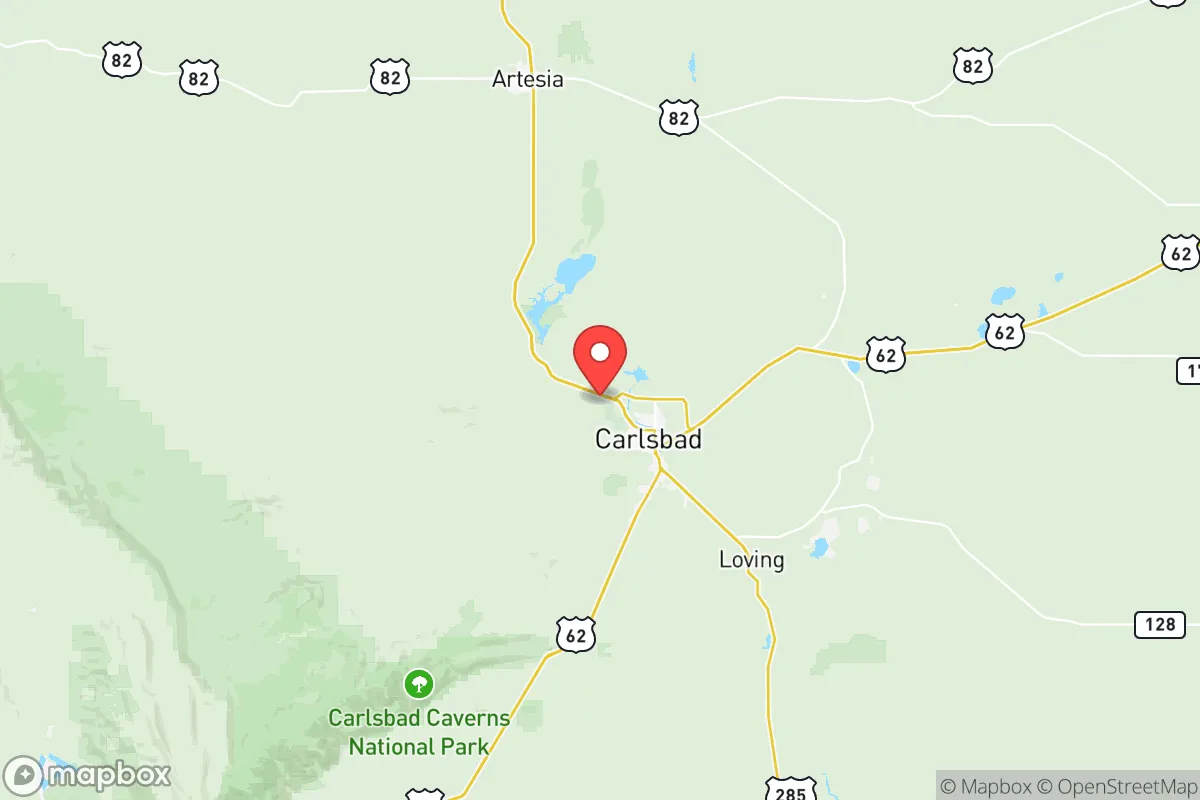
The people of Eddy County, New Mexico, today form a predominantly Hispanic and white community of 61,114 residents, characterized by a strong working-class identity rooted in the energy and agriculture sectors. With a foreign-born population of just 4.2%, the county is less diverse than the national average, and its 19.8% college-educated rate reflects a workforce oriented toward trades and industry rather than white-collar professions. The population is concentrated in the county seat of Carlsbad, with smaller clusters in Artesia, Loving, and the unincorporated community of Malaga, giving the area a small-town, family-oriented character where oil and gas booms and busts have shaped local identity for generations.
Settlement & growth (pre-1960)
Before American settlement, the land that is now Eddy County was inhabited by the Mescalero Apache, who roamed the Pecos River valley and the surrounding plains. Spanish explorers and missionaries passed through as early as the 16th century, but permanent European colonization was sparse due to the arid climate and Apache resistance. The region remained a remote frontier outpost of New Spain and later Mexico until the 1848 Treaty of Guadalupe Hidalgo ceded it to the United States.
American settlement began in earnest after the Civil War, driven by the expansion of cattle ranching along the Pecos River. The first major wave of Anglo settlers arrived in the 1870s and 1880s, primarily from Texas and the southern plains. These were ranchers and cowboys—many of Scots-Irish and English descent—who established large cattle operations. The founding of Carlsbad (originally named Eddy) in 1888 as a railroad stop on the Pecos Valley Railway marked the county's first real town. The railroad brought a second wave: merchants, skilled tradesmen, and farmers, many of German and Czech heritage, who saw opportunity in the newly irrigated lands along the river.
The discovery of potash deposits in the 1920s and 1930s transformed the county's economy and population. Potash mining, essential for fertilizer, drew a diverse workforce of Anglo and Hispanic laborers from across the Southwest. The town of Carlsbad boomed, and smaller mining camps like Malaga and Otis sprang up. During the Dust Bowl of the 1930s, a significant number of displaced farmers from Oklahoma and Texas—the "Okies"—moved into the county, seeking work in the mines and on ranches. This wave reinforced the county's conservative, rural character. By 1950, the population had reached roughly 40,000, with a demographic makeup that was roughly two-thirds Anglo and one-third Hispanic, reflecting the historic Spanish-speaking population of the region as well as newer arrivals.
Modern era (post-1965)
The 1965 Hart-Cellar Act had a minimal direct impact on Eddy County, as the area did not attract the large-scale immigration seen in coastal cities. The foreign-born share remains low at 4.2%, and the small immigrant population is primarily composed of Mexican nationals working in agriculture and oilfield services. Instead, the major demographic shift since 1965 has been driven by domestic migration tied to the energy industry. The oil booms of the 1970s and again in the 2010s (the Permian Basin boom) brought a new wave of workers from Texas, Oklahoma, and Louisiana—many of them white and Hispanic—into Carlsbad and Artesia. These booms created a transient population of roughnecks and engineers, but also a permanent base of families who settled in subdivisions on the outskirts of Carlsbad.
Suburbanization has been modest compared to major Sun Belt metros. The most notable growth has occurred in the Carlsbad North area and along the Highway 285 corridor toward Artesia, where new housing developments have been built to accommodate oilfield workers. The Hispanic population has grown steadily, rising from roughly 40% in 1980 to 50.9% today, driven by higher birth rates and continued migration from rural Mexico and Texas border towns. The white population has declined in relative share, now at 43.7%, as younger Anglos have left for college and urban jobs. The Black population remains tiny at 1.2%, concentrated in Carlsbad, while East and Southeast Asian communities (0.5%) and Indian-subcontinent residents (0.1%) are negligible, mostly comprising a few professionals in the mining and energy sectors.
The future
Eddy County's population is projected to grow slowly, driven by the cyclical nature of the oil and gas industry. The county is becoming slightly more Hispanic, as younger white residents continue to out-migrate to larger cities for education and employment, while Hispanic families tend to stay and have higher birth rates. The foreign-born share is unlikely to rise significantly, as the county lacks the urban amenities and service-sector jobs that attract new immigrants. The population is also aging, with a median age of 35.7, as younger workers leave during bust cycles. New residential development is concentrated in Carlsbad's northern fringe and in Artesia, where oilfield housing is being built. The cultural identity of the county is evolving from a historically Anglo-dominated ranching and mining community to a more Hispanic-majority working-class area, though the conservative political and social character remains stable. The next 10-20 years will likely see a continuation of these trends: slow growth, a rising Hispanic share, and a population that remains tethered to the boom-and-bust cycle of energy extraction.
For someone moving in now, Eddy County offers a low-cost, family-oriented environment with strong community ties, but with limited economic diversity and a population that is becoming increasingly Hispanic and working-class. The county's future is tied to the price of oil and potash, and its demographic trajectory points toward a more homogeneous Hispanic-majority community, with little of the cosmopolitan diversity found in larger New Mexico cities like Albuquerque or Santa Fe.

* Values derived from national, state, county, city and local statistics and may differ in a specific area. Last updated: 2026-06-11T03:51:53.000Z
Narrative content on this page is AI-generated and may contain mistakes. Verify any details that matter before acting on them.
ReloMaps may earn a commission from affiliate links at no extra cost to you.

