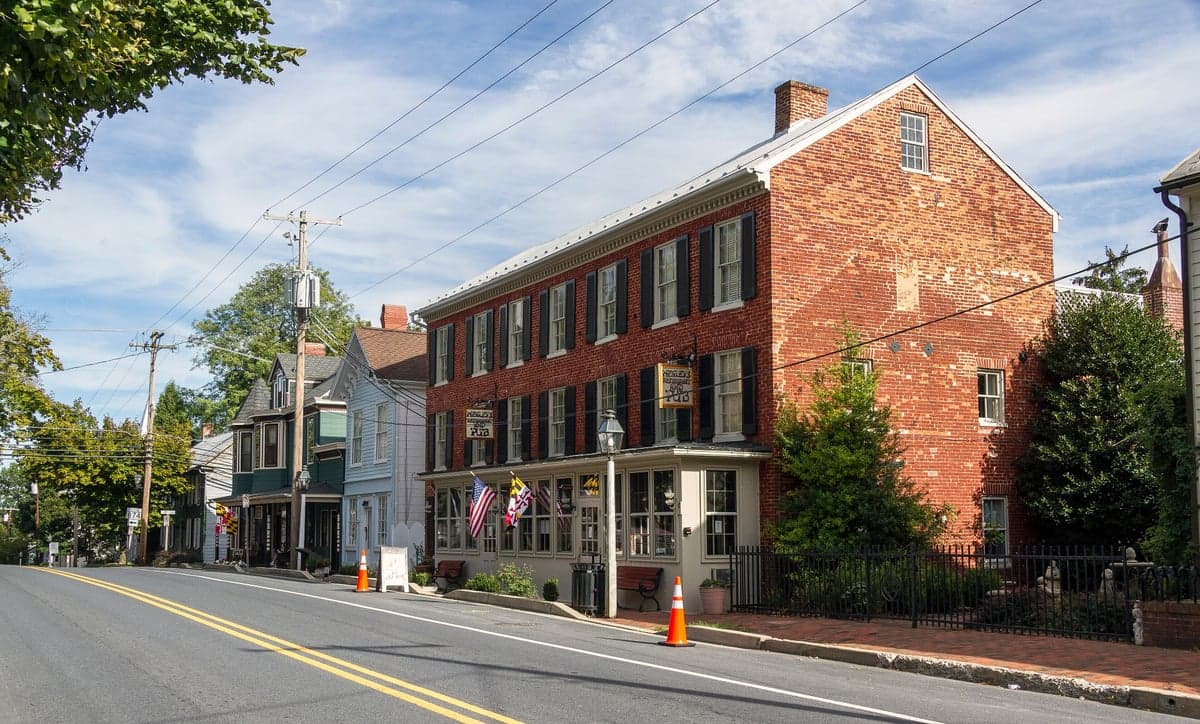
Photo: Wikipedia
Political ClimatePolitical Climate in New Market, MD
District shown is the primary district for this city’s centroid. Cities may span multiple districts.
Local Political AnalysisPolitical Analysis of New Market, MD
New Market, Maryland, sits in a political sweet spot that’s noticeably more moderate than the rest of the state. While Maryland as a whole carries a Cook PVI of D+17—making it one of the most reliably Democratic states in the country—New Market’s own PVI is D+3, a much tighter lean. That three-point Democratic advantage means this town is genuinely competitive; in a strong Republican year, it could easily flip. Locals will tell you that wasn’t always the case. Twenty years ago, this was a reliably red corner of Frederick County, but the steady influx of commuters from D.C. and Baltimore has shifted the ground beneath it. The trajectory is clear: New Market is trending left, but at a slower pace than the state average, leaving it as one of the few purple pockets in deep-blue Maryland.
How it compares
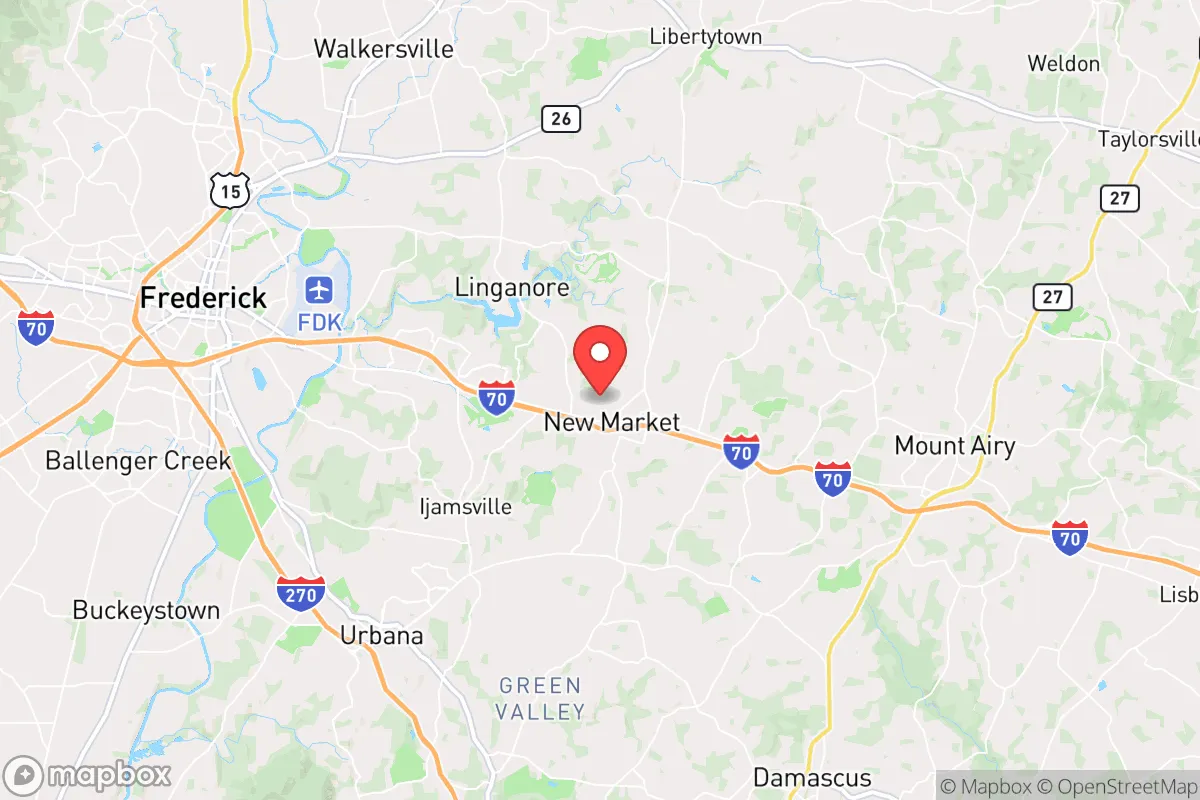
Drive ten miles north to Frederick City, and you’re in D+15 territory—solidly Democratic, with a young, diverse population and a thriving arts scene. Head south toward Mount Airy or west to Myersville, and you’ll find communities that lean more Republican, often by 5-10 points. New Market sits right in the middle, a kind of political buffer zone. The state’s D+17 overall is driven by the massive Democratic majorities in Prince George’s, Montgomery, and Baltimore City. Frederick County as a whole is D+10, so New Market’s D+3 is a real outlier—more conservative than its county, but still left of the national average. In practical terms, this means a Republican candidate for county commissioner can win here even while losing the state by 20 points. It’s a place where split-ticket voting is still common: residents might vote for a Democratic governor but a Republican sheriff, or back a progressive school board candidate while supporting a conservative town council member.
What this means for residents
For conservative residents, New Market offers a rare refuge in Maryland where their votes aren’t automatically drowned out. Local elections are genuinely contested, and Republican candidates for county office regularly win the town’s precincts. You’ll find a strong network of conservative civic groups and churches, and the annual Fourth of July parade feels more traditional than progressive. For liberal residents, the D+3 lean means they’re part of a growing coalition—newer arrivals from the D.C. suburbs tend to be younger and more left-leaning, and they’re slowly reshaping local discourse on development, schools, and environmental policy. The practical reality is that neither side gets everything it wants. Development debates are a perfect example: conservatives often push for slower growth and lower taxes, while liberals advocate for more affordable housing and transit options. The result is a cautious, incremental approach that frustrates both camps but keeps the town from swinging too far in either direction.
Culturally, New Market retains a distinct small-town identity that sets it apart from the state’s urban centers. There’s no county-level income tax surcharge here—Frederick County’s rate is 2.25%, lower than Montgomery’s 3.2%—and the town’s historic district regulations are stricter than what you’d find in most of Maryland. Gun laws are a flashpoint: while Maryland has some of the nation’s toughest firearm restrictions, enforcement in Frederick County is notably more relaxed, and New Market’s rural outskirts see regular hunting and sport shooting. The bottom line is that New Market offers a political climate that feels more like a swing state than a deep-blue stronghold. For anyone moving here, the key takeaway is that your vote will matter more than it does almost anywhere else in Maryland—and that the town’s character will continue to evolve as its demographics shift, but probably never as fast as the state as a whole.

State Political ClimatePolitical Climate in Maryland
State Political AnalysisPolitical Environment in the State
Maryland is a solidly blue state with a Cook PVI of D+17, meaning it votes about 17 points more Democratic than the national average in presidential elections. The state hasn’t voted for a Republican presidential candidate since George H.W. Bush in 1988, and Democrats hold supermajorities in both chambers of the General Assembly. However, that statewide number masks a deeply divided political geography: the Baltimore-Washington corridor, home to roughly two-thirds of the population, drives the blue lean, while the Eastern Shore, Western Maryland, and much of Southern Maryland vote reliably red. Over the last 20 years, the state has shifted leftward on social and cultural issues, even as its tax and regulatory posture has remained consistently progressive.
Urban vs. rural divide
The political map of Maryland is essentially a tale of two states. The Democratic stronghold is anchored by Montgomery County (suburban D.C.) and Prince George’s County, which together cast about a third of the state’s votes and routinely deliver 75-85% Democratic margins. Baltimore City adds another deep-blue bloc, though its population has declined by roughly 20% since 2000. The suburban ring around Baltimore—Howard County, Anne Arundel County, and parts of Baltimore County—has trended blue over the past decade, driven by professional-class voters and growing minority populations. In contrast, the rural areas are overwhelmingly Republican. Garrett County in the far west voted +40 points for Trump in 2020, and Carroll County (northwest of Baltimore) is a GOP stronghold where local offices are almost entirely Republican. The Eastern Shore counties—Worcester, Talbot, Queen Anne’s—are reliably red, though the shore’s population is growing slowly. The divide isn’t just about party registration; it’s cultural. A resident of Frederick (a fast-growing city that leans blue but is surrounded by red countryside) will experience a very different political reality than someone in Cumberland or Salisbury.
Policy environment
Maryland’s policy environment is shaped by one-party Democratic control in Annapolis, with a governor who is also a Democrat (Wes Moore, elected in 2022). The state has a progressive income tax structure with rates from 2% to 5.75%, plus local county income taxes that push the top combined rate over 8% in some jurisdictions. Property taxes are moderate but vary widely by county—Baltimore City has a high rate (over 2%), while Carroll County is under 1%. Sales tax is 6%, with no tax on groceries or prescription drugs. The regulatory environment is business-friendly in some sectors (biotech, cybersecurity) but burdensome for small businesses, with a high minimum wage ($15.00 as of 2024, indexed to inflation) and strict paid leave requirements. Education policy is centralized: the state funds K-12 through the Blueprint for Maryland’s Future, a multi-billion-dollar reform that boosts teacher pay and expands pre-K, but also mandates county-level tax increases. Healthcare is heavily regulated, with a state-run insurance exchange and strict certificate-of-need laws for hospitals. Election laws are among the most accessible in the country: no-excuse mail-in voting, same-day registration, and automatic voter registration at the DMV. Gun laws are among the strictest nationally, requiring a license to purchase a handgun, a 7-day waiting period, and a ban on “assault weapons” and high-capacity magazines.
Recent policy direction
Over the past five years, Maryland has moved decisively left on several fronts. In 2023, the legislature passed the Gun Safety Act, which bans carrying firearms in “sensitive places” like parks, hospitals, and public transit—a direct response to the Supreme Court’s Bruen decision. The law is currently being challenged in court. On education, the Blueprint for Maryland’s Future (passed 2021) dramatically increases state funding for schools, but also mandates that districts adopt “culturally responsive” curricula and expand LGBTQ+ inclusive materials. Parental rights advocates have pushed back, particularly in Frederick County and Carroll County, where school board meetings have become flashpoints over library books and transgender policies. On privacy and surveillance, Maryland passed a comprehensive data privacy law in 2024 (the Maryland Online Data Privacy Act), giving residents the right to opt out of data collection and request deletion—one of the stronger state laws nationally. Medical and bodily autonomy: Maryland codified abortion rights into state law in 2022, and in 2023 passed a law protecting providers who serve out-of-state patients. Property rights: the state has a strong “eminent domain” framework, but recent legislation has focused on affordable housing mandates, requiring counties to plan for more dense development near transit. Voting access: in 2024, the state expanded early voting to 10 days and made permanent the no-excuse mail-in ballot system adopted during COVID. For a conservative relocator, the bottom line is that Maryland’s policy direction is unambiguously progressive on guns, education, and social issues, but relatively moderate on taxes and business regulation compared to deep-blue states like California or New York.
Civil unrest & political movements
Maryland has a history of political activism that ranges from the left-wing protests in Baltimore (the 2015 Freddie Gray uprising, the 2020 George Floyd protests) to more recent conservative organizing. The “Parents’ Rights” movement has been particularly active in Carroll County and Harford County, where school board elections in 2022 saw conservative slates win seats on platforms opposing critical race theory and transgender policies. On the Eastern Shore, the “Maryland Shall Issue” gun rights group has been a persistent legal force, successfully challenging the state’s handgun licensing law in federal court. Immigration politics are a quiet but real issue: Maryland is a “sanctuary state” (by executive order since 2021), meaning state law enforcement does not cooperate with federal immigration detainers. This has caused friction in more conservative counties like Washington County, where local sheriffs have publicly opposed the policy. Election integrity controversies have been muted compared to other states, but in 2020, some Republican county officials in Garrett County and Allegany County raised concerns about mail-in ballot security. There is no serious secession or nullification movement in Maryland, though some rural residents joke about joining West Virginia. The most visible flashpoint for a new resident would likely be the annual “March for Life” in Annapolis (pro-life) and the counter-protests, which draw thousands each year.
Projection
Over the next 5-10 years, Maryland is likely to become more Democratic, not less. In-migration is heavily concentrated in the D.C. suburbs—Montgomery County and Prince George’s County are growing, while rural counties are stagnant or declining. The state’s population is becoming more diverse, younger, and more educated, all of which correlate with Democratic voting. The Republican Party in Maryland is increasingly confined to the rural west and Eastern Shore, with little hope of winning statewide office unless a moderate, business-friendly candidate emerges (like former Governor Larry Hogan, who won twice in a blue state). The policy direction will continue leftward on social issues—expect further gun restrictions, expanded transgender protections, and possibly a state-level public option for health insurance. Tax increases are likely to fund the Blueprint for education, though the state’s strong economy (driven by federal spending, biotech, and cybersecurity) can probably absorb them. For a conservative relocator, the realistic expectation is that Maryland will remain a place where you can live a comfortable life with good schools and low crime in the suburbs, but you will be voting in a state where your political views are a distinct minority, and where state policy will often run counter to your values on guns, education, and social issues.
Bottom line for a new resident: If you’re a conservative moving to Maryland, you’ll find like-minded communities in Carroll County, the Eastern Shore, or Western Maryland, but you’ll be living under a state government that is unapologetically progressive. Your property taxes will be moderate, your income taxes high, and your gun rights heavily restricted. Your children will attend schools that teach a progressive curriculum, and your local school board may be a battleground. If you’re a liberal, you’ll find the state’s policies largely aligned with your values, especially on healthcare, education, and civil rights. Either way, Maryland is a state of stark political contrasts, where your daily experience depends heavily on which county you choose to call home.
* Values derived from national, state, county, city and local statistics and may differ in a specific area. Last updated: 2026-08-26T18:52:14.000Z
Narrative content on this page is AI-generated and may contain mistakes. Verify any details that matter before acting on them.
ReloMaps may earn a commission from affiliate links at no extra cost to you.

