Photo: Wikipedia
Demographics of Passaic County
Affluence Level in Passaic County
A middle-class area roughly in line with national averages across income, home values, education, and employment.
People of Passaic County
The people of Passaic County, New Jersey, form a dense, ethnically layered population of 518,289 residents, defined by a majority-minority character where Hispanic residents make up 43.4% of the county and non-Hispanic whites account for 38.9%. The county is one of the most diverse in New Jersey, with a foreign-born population of 14.6% and significant Black (10.0%), East/Southeast Asian (1.9%), and Indian subcontinent (3.4%) communities. Its identity is shaped by a history of industrial immigration, suburban expansion, and recent waves of Latin American and South Asian arrivals, creating a patchwork of ethnic enclaves and economically varied towns from Paterson to Wayne.
Settlement & growth (pre-1960)
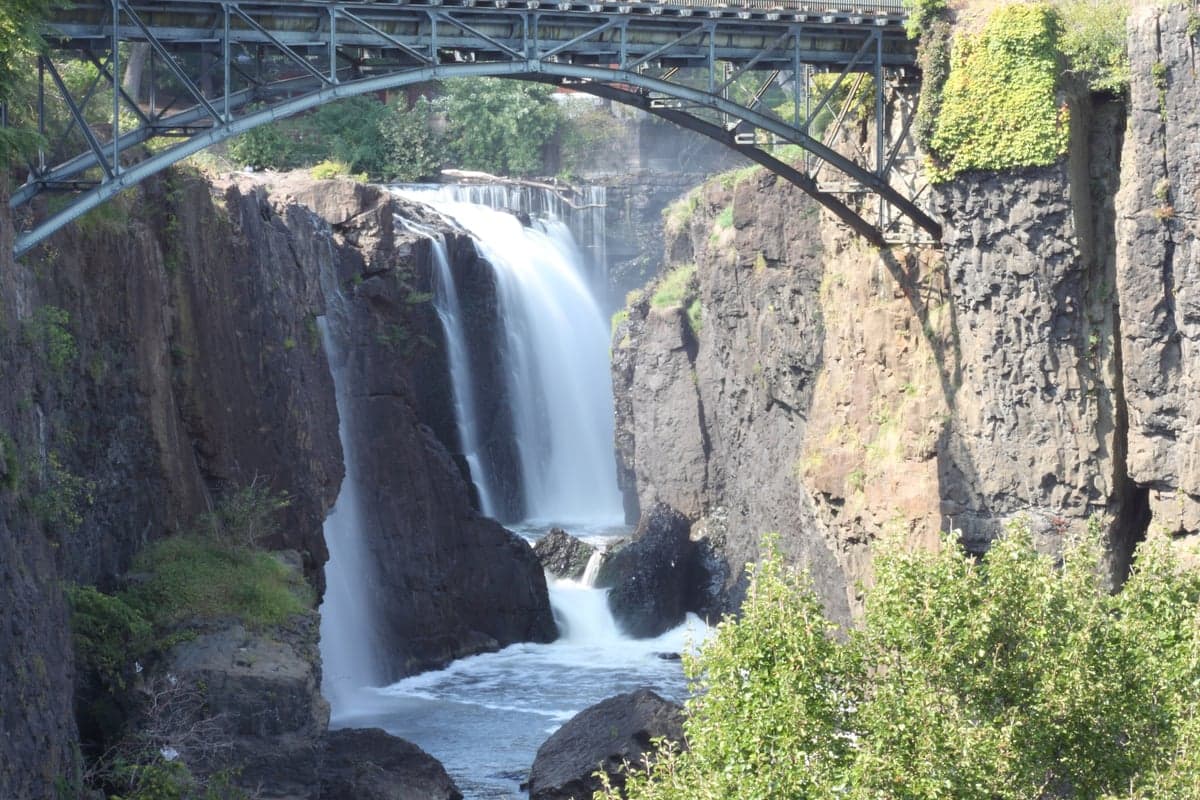
Before European colonization, the area now known as Passaic County was inhabited by the Lenape people, specifically the Munsee-speaking bands who lived along the Passaic River and the Pompton River. They maintained seasonal settlements and trade routes, with the region's waterfalls and fertile valleys supporting their way of life until Dutch and English colonists began arriving in the late 1600s. The Dutch established the first European settlements in what is now Passaic and Paterson, drawn by the water power of the Passaic River's Great Falls. By the early 1700s, English and Scots-Irish farmers moved into the northern parts of the county, founding towns like Pompton Lakes and Ringwood, where iron ore deposits spurred early mining and forging operations.
The county's population exploded after the American Revolution, driven by Alexander Hamilton's vision of Paterson as America's first planned industrial city. The Great Falls of the Passaic River powered cotton mills, locomotive works, and silk factories, attracting a massive wave of Irish immigrants in the 1830s and 1840s, who built the canals and railroads. They were followed by German immigrants in the 1850s, who settled in Paterson and Haledon, working as machinists and brewers. By the 1880s, Italian immigrants began arriving in large numbers, concentrating in Paterson's "Little Italy" neighborhoods and in Clifton, where they worked in textile mills and construction. Eastern European Jews, fleeing pogroms in Russia and Poland, arrived between 1880 and 1920, establishing a vibrant community in Paterson's Eastside and later spreading to Passaic city.
The early 20th century brought additional waves: Polish immigrants settled in Wallington and Garfield, working in the boroughs' chemical plants and dye factories. African Americans from the South began migrating north during World War I and the Great Migration, settling primarily in Paterson's 4th and 5th wards, where they found work in the silk mills and later in the city's burgeoning manufacturing sector. By 1930, Paterson was a city of 140,000, a dense industrial hub of Italians, Jews, Irish, Germans, Poles, and African Americans. The post-World War II period saw suburbanization accelerate: white ethnic families moved out of Paterson and Passaic city into developing suburbs like Wayne, Totowa, and West Milford, drawn by new highways and single-family homes. This "white flight" reshaped the county's demographics, leaving the older industrial cities increasingly non-white by the 1960s.
Modern era (post-1965)
The 1965 Hart-Cellar Immigration Act fundamentally altered Passaic County's population. The first major post-1965 wave came from the Dominican Republic and Puerto Rico, with Dominicans settling heavily in Paterson and Passaic city, where they replaced departing white ethnic populations in aging housing stock. By 1990, the Hispanic share of Paterson's population had risen to over 40%, and it now stands at 43.4% countywide. Colombian, Peruvian, and Ecuadorian immigrants followed in the 1980s and 1990s, creating distinct enclaves in Clifton and Prospect Park. The Hispanic population is not monolithic: Dominicans dominate Paterson's southern neighborhoods, while Peruvians and Colombians are more concentrated in Clifton and Passaic city, each maintaining separate churches, bodegas, and social clubs.
Simultaneously, the Indian subcontinent community grew rapidly after 1990, driven by IT and healthcare professionals. Woodland Park (formerly West Paterson) and Little Falls became hubs for Indian families, with Indian-owned businesses, temples, and cultural centers emerging along Route 46. The Indian population now stands at 3.4% of the county, with a visible concentration in the northern suburbs. East/Southeast Asian communities, primarily Chinese and Filipino, settled in Wayne and Montclair (the latter just over the Essex County line), drawn by good schools and professional job opportunities. The Black population, 10.0% of the county, remains concentrated in Paterson, but has also spread to Clifton and Wayne as middle-class families sought better housing and schools.
Domestic migration has been a countervailing force. Since 2000, some native-born white and Black residents have left Passaic County for cheaper housing in Sussex County, Pennsylvania, or the South, while the county has absorbed immigrants from Latin America and Asia. Suburbanization continues: Wayne and West Milford remain predominantly white and affluent, while Paterson and Passaic city have become majority-Hispanic and increasingly poor. The county's college-educated population is 30.3%, a figure pulled up by Wayne (where over 50% of adults hold a bachelor's degree) and pulled down by Paterson (where the figure is under 15%).
The future
Passaic County's population is trending toward a Hispanic majority, with the white share declining steadily as older generations age out and younger Hispanic families have higher birth rates. The county's foreign-born share of 14.6% is likely to remain stable or grow slightly, as immigration from Latin America continues despite federal enforcement changes. The Indian subcontinent community is growing fastest among Asian-origin groups, driven by H-1B visa holders and their families, and is likely to expand further in Woodland Park, Little Falls, and Wayne. East/Southeast Asian communities are growing more slowly, as many second-generation Chinese and Filipino families move to more affordable areas in Morris or Bergen counties.
The county is not homogenizing; instead, it is tribalizing into distinct enclaves. Paterson and Passaic city will likely become even more heavily Hispanic and poorer, while the northern and western suburbs (Wayne, West Milford, Ringwood) remain predominantly white and affluent. The Indian community is carving out a middle ground in the Route 46 corridor, creating a stable, professional enclave that is neither fully assimilated into white suburbia nor segregated in an urban ethnic neighborhood. The Black population is slowly suburbanizing, but remains a smaller share than in neighboring Essex County. Over the next 10-20 years, Passaic County will likely see continued ethnic sorting by town, with political and economic divisions hardening along municipal lines.
For someone moving in now, Passaic County offers a choice between dense, diverse, urban environments (Paterson, Passaic city) and leafy, predominantly white suburbs (Wayne, West Milford). The county's identity is becoming more Hispanic and more suburban, with the old industrial Paterson identity fading as manufacturing jobs disappear. The schools, taxes, and crime rates vary dramatically by town, making municipal selection the most important decision for a new resident. The county is not a melting pot but a mosaic of distinct communities, each with its own trajectory and character.

* Values derived from national, state, county, city and local statistics and may differ in a specific area. Last updated: 2026-05-13T01:00:13.000Z
Narrative content on this page is AI-generated and may contain mistakes. Verify any details that matter before acting on them.
ReloMaps may earn a commission from affiliate links at no extra cost to you.

