Photo: Wikipedia
Demographics of Keith County
Affluence Level in Keith County
A middle-class area roughly in line with national averages across income, home values, education, and employment.
People of Keith County
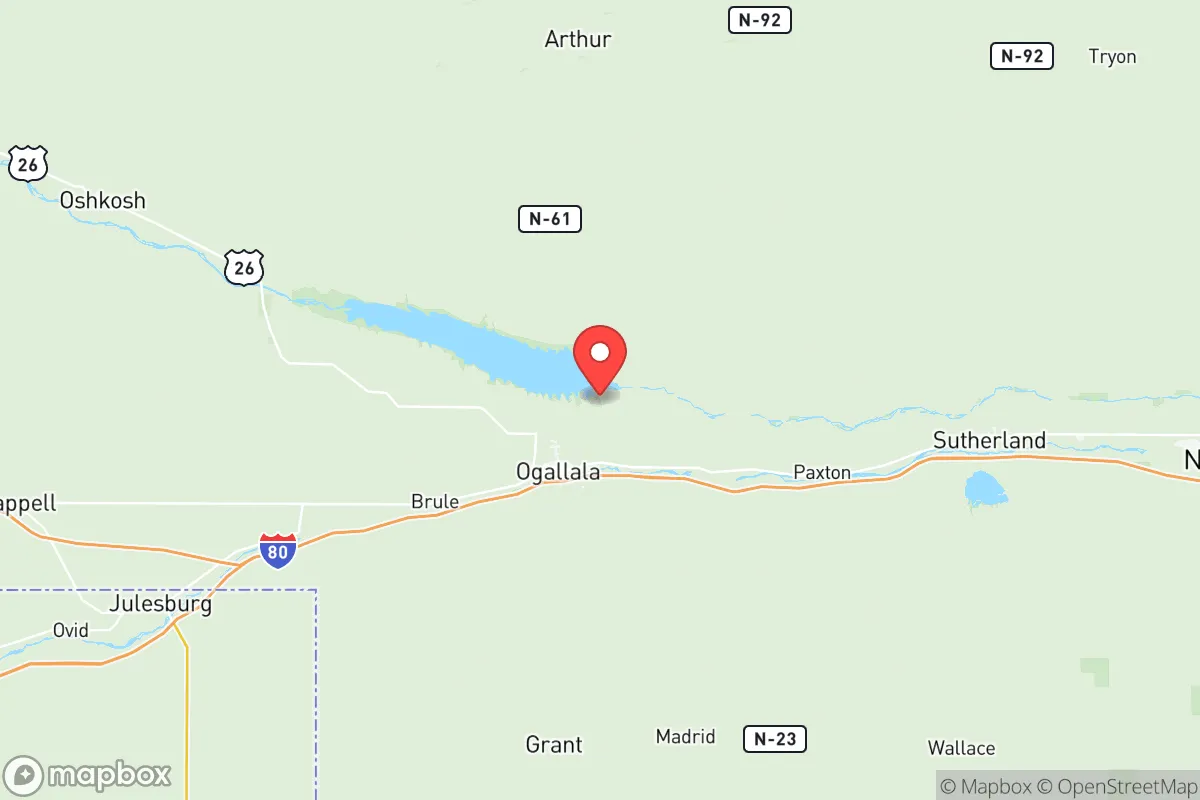
Today, Keith County, Nebraska is home to about 8,239 residents, a population that is overwhelmingly white (86.1%) and native-born (99.2% U.S.-born), with a small but notable Hispanic community (9.0%) concentrated in and around the county seat of Ogallala. The county's character is defined by its agricultural and tourism-driven economy along the South Platte River and Lake McConaughy, with a population density of just over 4 people per square mile. Distinctive identity markers include a strong ranching and farming heritage, a conservative political leaning, and a deep attachment to the area's history as a stop on the transcontinental railroad and the Oregon Trail.
Settlement & growth (pre-1960)
Before Euro-American settlement, the area now known as Keith County was part of the traditional territory of the Pawnee, Cheyenne, and Lakota peoples, who followed bison herds across the Great Plains. The South Platte River corridor served as a seasonal travel and hunting route. The first recorded non-Native presence came with fur trappers and traders in the early 1800s, but permanent settlement did not begin until after the Kansas-Nebraska Act of 1854 opened the region to homesteading.
The defining event for Keith County's population history was the arrival of the Union Pacific Railroad in the 1860s. The town of Ogallala was founded in 1868 as a railroad division point and cattle shipping center, quickly becoming a classic "cow town" where Texas cattle drives met the railhead. The first permanent settlers were a mix of Anglo-American homesteaders from the Midwest and East Coast, drawn by the promise of cheap land under the Homestead Act of 1862. Many were of English, Scots-Irish, and German ancestry, arriving in the 1870s and 1880s to establish ranches and farms along the river valley.
The town of Brule was platted in 1886 as a railroad stop, and Paxton was founded in 1885, both attracting similar populations of homesteaders and railroad workers. A small number of German-Russian immigrants, known for their wheat-farming expertise, settled in the county in the 1890s and early 1900s, particularly around the community of Keystone. These groups formed the backbone of the county's agricultural economy, with dryland farming and cattle ranching dominating through the early 20th century.
The Dust Bowl of the 1930s hit Keith County hard, causing a significant population decline as many farm families abandoned their land. The county's population peaked at around 5,000 in the 1920s, then dropped to roughly 4,000 by 1940. Recovery came slowly, aided by the construction of Kingsley Dam and the creation of Lake McConaughy in the 1940s, which brought irrigation water and a new tourism economy. The post-World War II period saw modest growth as returning veterans and their families settled in Ogallala and the surrounding area, drawn by jobs in agriculture, irrigation, and the emerging recreation industry.
Modern era (post-1965)
The 1965 Hart-Cellar Act, which dramatically reshaped U.S. immigration patterns, had a minimal direct effect on Keith County. The foreign-born population today stands at just 0.8%, far below the national average. Instead, the county's demographic story since the 1960s has been one of gradual domestic out-migration and a slow shift toward a more Hispanic population, driven by labor demand in agriculture and meatpacking.
The most significant change has been the growth of the Hispanic community, which now makes up 9.0% of the population. This population is largely of Mexican origin, with families arriving from the 1980s onward to work in cattle feedlots, dairies, and the region's agricultural processing plants. The Hispanic population is most visible in Ogallala, where a small but established community has formed around the Catholic church and local service industries. Unlike many parts of Nebraska where meatpacking plants drove large-scale Hispanic immigration, Keith County's growth has been more gradual, tied to ranching and tourism rather than industrial processing.
Meanwhile, the white population has aged and declined slightly, as younger residents have moved to larger cities like Scottsbluff, North Platte, or Denver for education and employment. The county's population has remained relatively stable at around 8,000-9,000 since the 1990s, with the Hispanic influx partially offsetting white out-migration. The Black population (1.3%) and East/Southeast Asian population (0.6%) remain very small, with no significant enclaves forming. The Indian subcontinent population is effectively zero.
Suburbanization has not occurred in the traditional sense, given the county's rural character. However, the area around Lake McConaughy has seen some second-home and retirement development, attracting seasonal residents from Colorado and other parts of Nebraska. The towns of Ogallala, Brule, and Paxton have maintained their roles as service centers for the surrounding agricultural area, with Ogallala functioning as the primary commercial and government hub.
The future
Keith County's population is projected to remain relatively stable or decline slightly over the next 10-20 years, with the Hispanic share likely continuing to grow gradually as the white population ages and younger residents leave for urban areas. The county's foreign-born population will probably remain very low, as there are no major industries or institutions attracting international immigration. The Hispanic community, while growing, is expected to remain a minority and to integrate into the existing social fabric rather than forming a distinct enclave, given the small overall numbers.
The county's cultural identity is likely to remain rooted in its ranching and agricultural heritage, with a conservative political character that reflects the broader Nebraska Panhandle. The Lake McConaughy tourism economy may attract more retirees and remote workers, potentially bringing some new residents from outside the region, but this is unlikely to dramatically alter the demographic makeup. The county will continue to face challenges of population retention, particularly among young adults, and will need to balance economic development with preserving its rural character.
For someone moving in now, Keith County offers a stable, low-density, predominantly white and native-born community with a small but growing Hispanic presence. The population is aging, but the county's strong agricultural base and recreational amenities provide a solid foundation. New residents should expect a conservative, family-oriented environment where community ties are strong and the pace of life is slow. The county is not becoming more diverse in the broad sense, but the Hispanic community is a permanent and growing part of the social landscape, particularly in Ogallala.

* Values derived from national, state, county, city and local statistics and may differ in a specific area. Last updated: 2026-07-17T17:20:55.000Z
Narrative content on this page is AI-generated and may contain mistakes. Verify any details that matter before acting on them.
ReloMaps may earn a commission from affiliate links at no extra cost to you.

