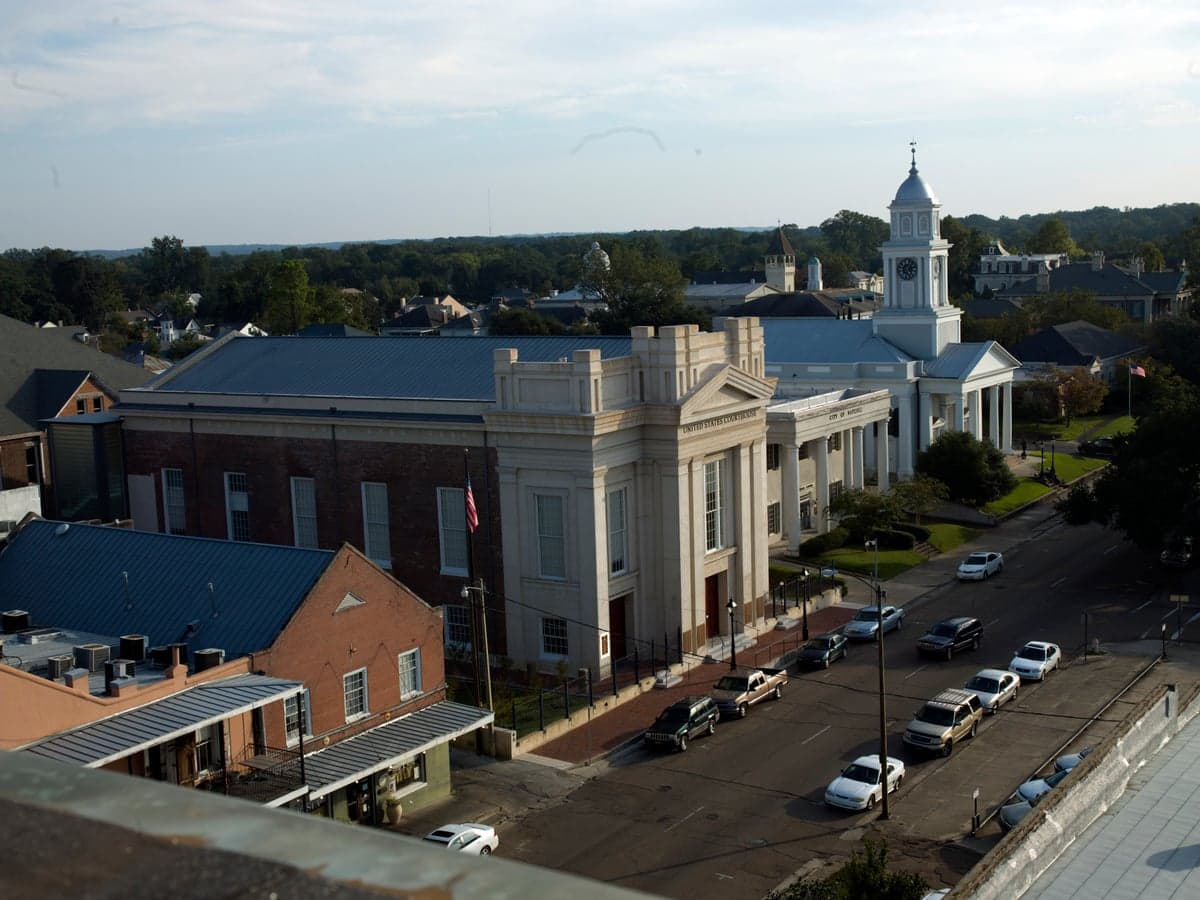
Photo: Wikipedia
Strategic Assessment of Natchez, MS
Workable tactical position. Some exposure to population density or targets, but generally defensible in a crisis.
What does the Strategic Assessment tell us?
Our Strategic Assessment grades tactical survivability of an area. Major population centers, military targets, fallout zones, natural disasters, and border exposure all drive risk — lower exposure means a more defensible position in a crisis.
This is heavily inspired by Joel Skousen's Strategic Relocation book. Highly recommended you checkout the book ($)What does this tell us?
Our Strategic Assessment grades tactical survivability of an area. Major population centers, military targets, fallout zones, natural disasters, and border exposure all drive risk — lower exposure means a more defensible position in a crisis.
This is heavily inspired by Joel Skousen's Strategic Relocation book. Highly recommended you checkout the book ($)Strategic Pillars

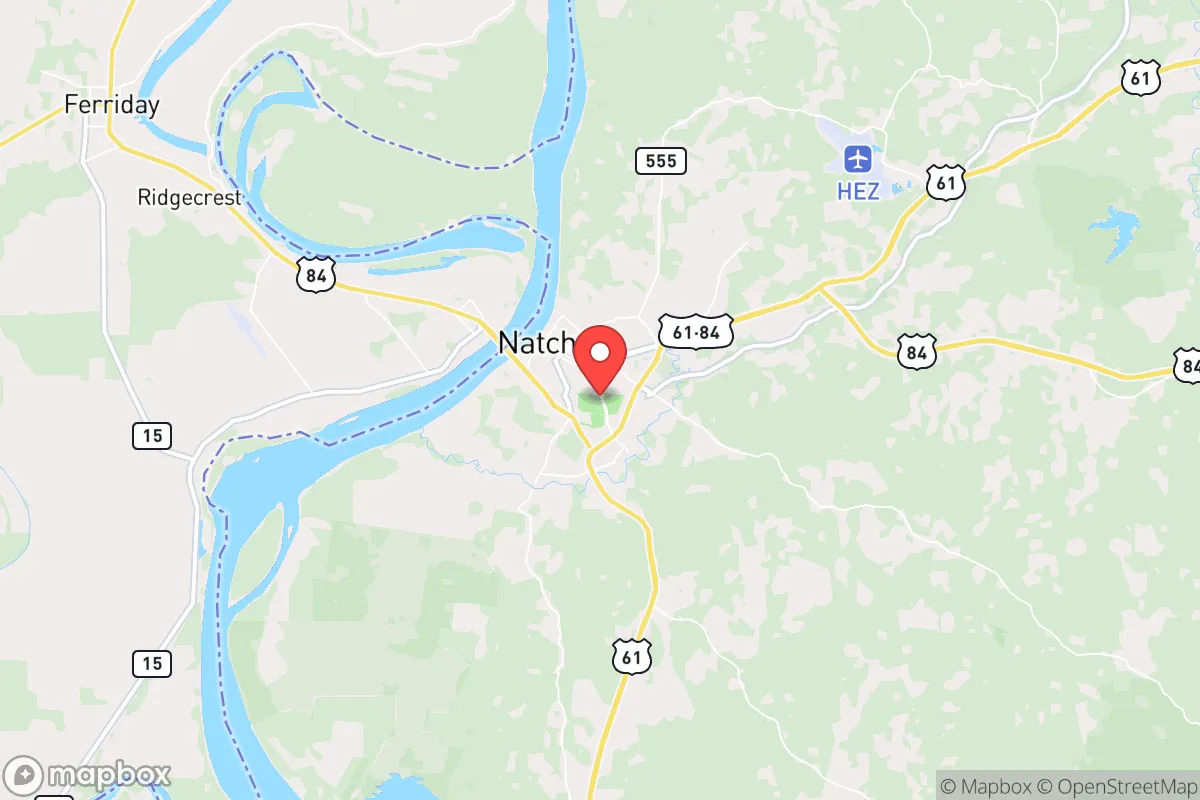
Key Distances
Regional Safe Places
Below is our recommended "safe zones" in Mississippi and the surrounding area based on our strategic heuristics. For most people, it's unrealistic to live in a “safe zone” full-time due to work, family or other personal reasons. They tend to be more rural. However, many of these areas are perfect for second homes and retreat properties that double as a vacation home or even a short-term rental.
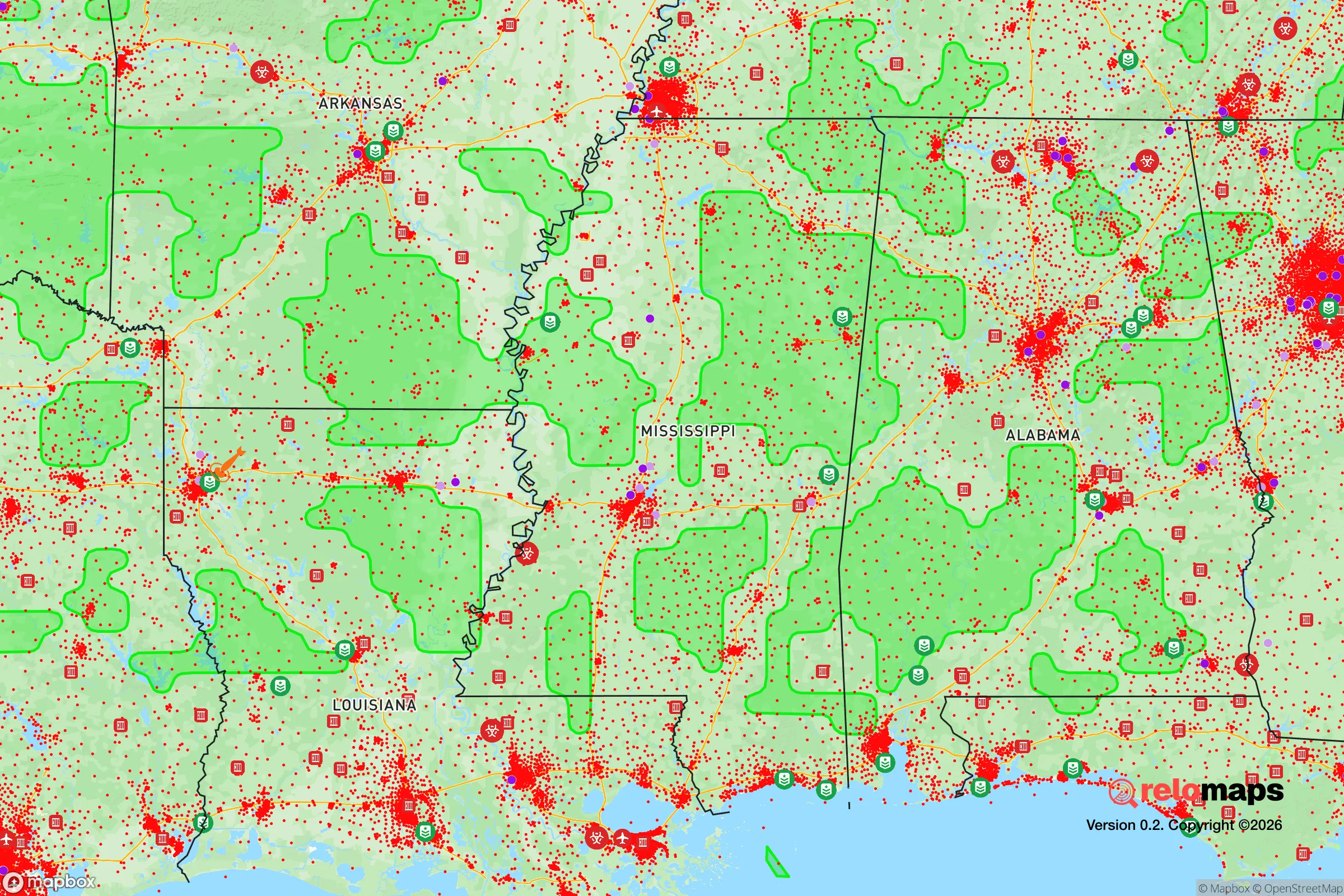
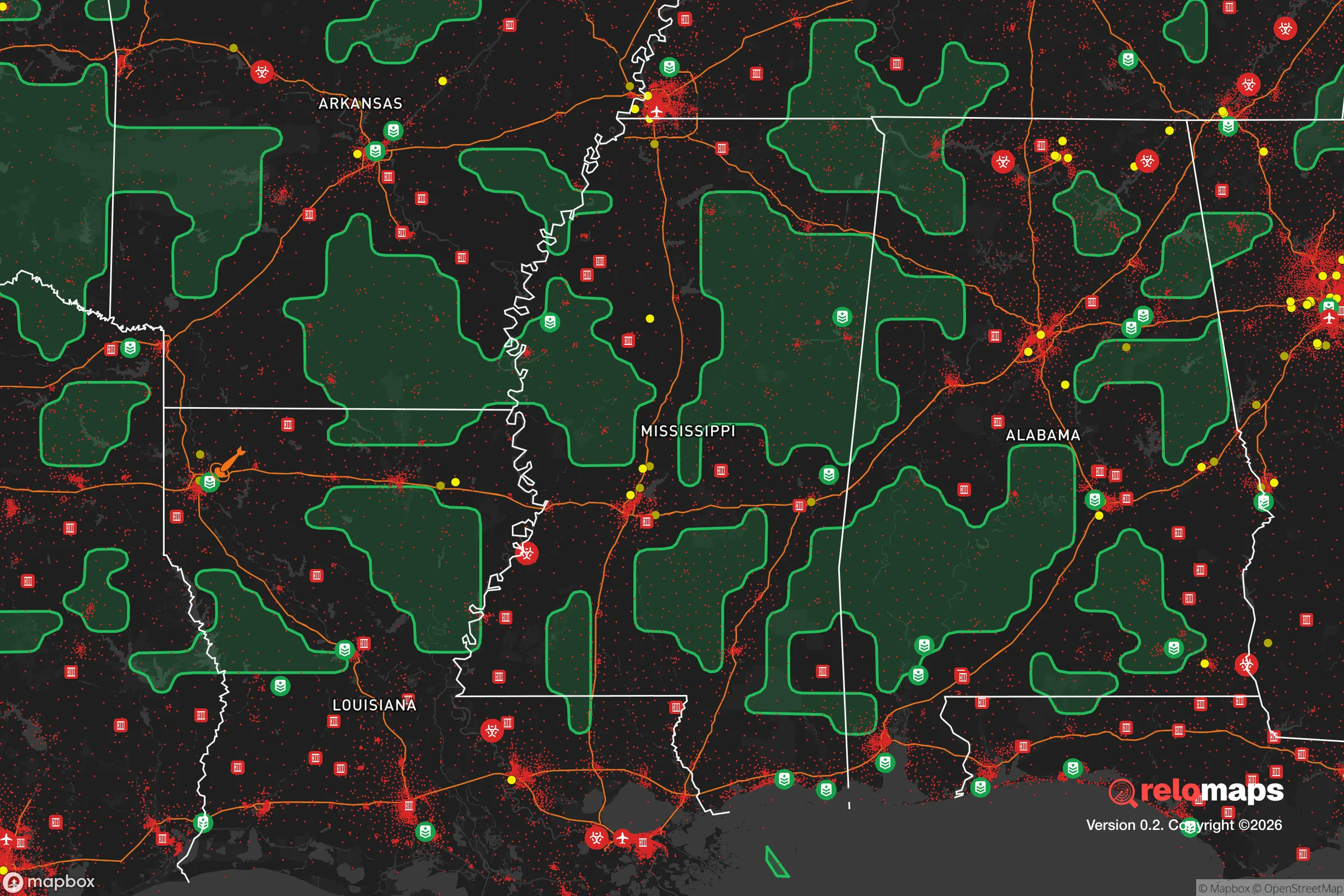


Important Note: For informational purposes only. This does not mean nothing bad ever happens in the green zones. Please use common sense. This is based on public data and modeled with AI. We tried to take a conservative approach but mistakes happen. We update this regularly as new information becomes available.
Solar Generator Recommendations
Backup power matters more here than in safer locations. We've picked three solar generators across budgets and capacity tiers — start with the budget unit if you only need a few essentials, or step up if you want to run a fridge and HVAC for days at a time.

Jackery Portable Power Station Explorer 300
Budget OptionPower on the Go: Weighing only 11 lbs, it's convenient to set up and store with book-sized foldable solar panels

BLUETTI Portable Power Station AC180
Designed for both indoor and outdoor scenarios, AC180 is highly capable as it has a robost capacity and continuous output power.

EF ECOFLOW DELTA Pro Ultra Power Station
Upgraded PickEcoFlow DELTA Pro Ultra is a whole-home energy system designed to grow with your family. Integrated with the Smart Home Panel 2, it scales to meet your evolving energy needs — keeping your home powered, intelligent, and secure through every stage of life.
We earn a commission, at no additional cost to you.
Strategic Assessment Analysis
Natchez, Mississippi, sits on the bluffs of the Mississippi River, offering a strategic mix of isolation, defensible terrain, and access to a major water artery that makes it a serious contender for a long-term relocation play. Its population hovers around 14,000, small enough to avoid the chaos of a major metro but large enough to maintain a functioning local economy and supply chain. The city’s history as a pre-Civil War trade hub means the infrastructure for self-reliance—old warehouses, river access, and a deep agricultural hinterland—is baked into the landscape. For someone thinking about resilience, Natchez isn’t a flashy choice, but it’s a grounded one.
Geographic position and natural advantages for long-term security
Natchez sits on the eastern bank of the Mississippi River, roughly 80 miles southwest of Jackson and 170 miles north of New Orleans. That river is your primary strategic asset—it’s a reliable source of water, a transport corridor for goods, and a natural barrier that complicates movement from the west. The city is built on high bluffs, which means flood risk is minimal compared to river towns downstream. The surrounding Adams County is heavily forested and agricultural, with soybeans, cotton, and cattle operations that could sustain a local food network if supply chains fracture. The climate is humid subtropical, with a growing season that runs from March to November—long enough to produce a serious garden or small farm. For a relocator, the key advantage is that Natchez is far enough from any major population center to avoid the immediate crush of a collapse event, but close enough to the river to trade or move if needed. The nearest interstate, I-55, is about 40 miles east, which keeps through-traffic away while still providing a route to Memphis or Baton Rouge for resupply.
Risks, exposures, and proximity to fallout-relevant landmarks
No place is a fortress, and Natchez has its share of vulnerabilities. The biggest exposure is the Mississippi River itself—if a major levee failure or upstream dam breach occurs, the river could become a liability rather than an asset. The city’s location on the New Madrid Seismic Zone’s southern edge means a major earthquake (think 1811-1812 scale) could cause liquefaction along the riverbanks and damage older brick buildings in the historic district. That’s a low-probability, high-consequence risk, but one worth noting. More immediate for a prepper: Natchez is about 60 miles from the Port of Baton Rouge, a major petrochemical hub with refineries and chemical plants that could become secondary targets or accident sites during unrest. The city itself has no nuclear power plants within 100 miles, but the Grand Gulf Nuclear Station is roughly 90 miles north near Port Gibson—close enough that a catastrophic failure could affect wind-borne fallout patterns, though prevailing winds tend to push east. The bigger concern is that Natchez sits on the Mississippi River, which is a natural corridor for any large-scale movement of people or military assets during a crisis. If the country fractures, the river becomes a highway for both refugees and hostile elements. The city’s small police force and county sheriff’s office (Adams County has about 30 deputies) would be overwhelmed quickly in a mass migration event. That’s not a reason to write Natchez off, but it’s a reason to plan for perimeter defense and community coordination.
Practical resilience for a relocator: food, water, energy, and defensibility
Water is the easiest win here. The Mississippi River is a massive, year-round source, but it requires treatment—boiling, filtration, or chemical purification. The city’s municipal water comes from the river, so if the grid goes down, you’re on your own. A well is the better long-term play, and the water table in Adams County is shallow enough (30-50 feet) that a hand-pump well is feasible for a small property. For food, the local agricultural base is strong. The Natchez Farmers Market operates year-round, and there are multiple U-pick farms within a 20-minute drive. Hunting is legal and common—deer, turkey, and wild hog populations are healthy in the surrounding national forests (Homochitto National Forest is 30 miles east). Fishing in the river and nearby lakes (like Lake St. John) is reliable. Energy is the weak link. Natchez is served by Entergy Mississippi, and the grid is aging. Outages from storms are common—the area gets hit by tropical remnants and severe thunderstorms regularly. Solar is viable (the region gets about 215 sunny days per year), but you’ll need battery storage because net metering policies in Mississippi are not favorable. A backup generator with a 500-gallon propane tank is the standard prepper move here. Defensibility is mixed. The historic downtown is compact and walkable, with narrow streets and brick buildings that could be barricaded, but the residential sprawl to the north and east is typical suburban—open, hard to secure. The best bet is to buy land east of the city, toward the Homochitto forest, where you get tree cover, distance from the river corridor, and access to game and timber. The local gun culture is strong—Mississippi is a constitutional carry state, and Adams County has a sheriff’s office that is generally supportive of Second Amendment rights. That’s a soft factor, but in a crisis, it matters.
The overall strategic picture for Natchez is one of moderate isolation with a solid natural resource base, tempered by exposure to the Mississippi River corridor and the fragility of small-town infrastructure. It’s not a bug-out bunker—it’s a place to build a life that can weather a slow decline or a sudden shock, provided you come in with your own water plan, energy backup, and a willingness to integrate into the local community. The conservative lean of the area (Adams County voted +18 for Trump in 2020) means you’ll find neighbors who share your skepticism of federal overreach and your interest in self-reliance. The biggest mistake a relocator could make is treating Natchez as a cheap place to hide. It’s not a hideout—it’s a working river town with real history and real risks. If you’re willing to put in the work on water, food storage, and community building, it’s one of the more defensible small cities in the Deep South. If you’re looking for a place that’s already hardened and waiting for you, keep looking. Natchez rewards preparation, not passivity.

* Values derived from national, state, county, city and local statistics and may differ in a specific area. Last updated: 2026-04-22T21:11:44.000Z
Narrative content on this page is AI-generated and may contain mistakes. Verify any details that matter before acting on them.
ReloMaps may earn a commission from affiliate links at no extra cost to you.

