

Photo: Wikipedia
Political ClimatePolitical Climate in Natchez, MS
District shown is the primary district for this city’s centroid. Cities may span multiple districts.
Local Political AnalysisPolitical Analysis of Natchez, MS
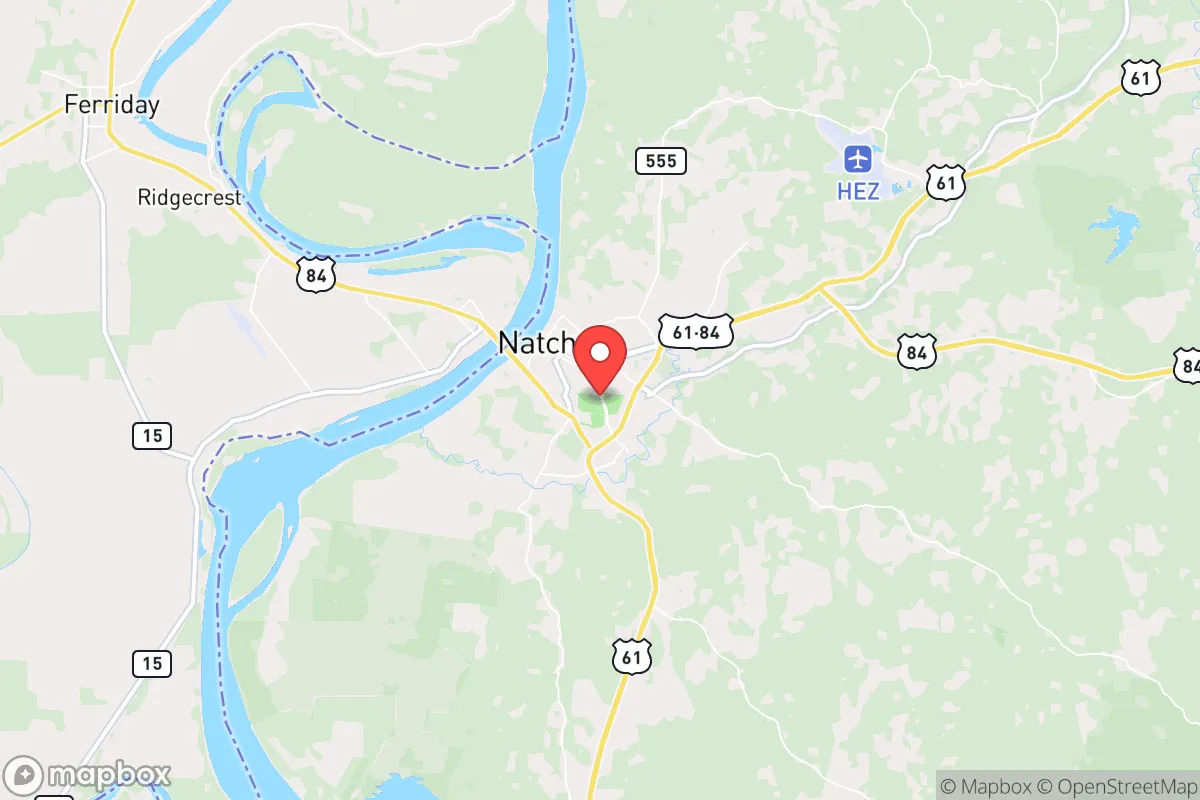
Natchez, Mississippi, leans solidly Democratic, with a Cook PVI of D+11, but that number doesn't tell the whole story of a town that's been shifting under our feet. For decades, this was a place where folks kept their politics close to the vest, where conservative values—family, church, and personal responsibility—were the unspoken rule, even if the ballot box said otherwise. Lately, though, you can feel the ground moving: more progressive energy from outside money and new transplants is pushing the old guard into a defensive crouch, and the local elections are getting a lot more interesting—and a lot more concerning for those of us who like our government small and our neighbors left alone.
How it compares
Drive 30 minutes north to Vidalia, Louisiana, and you'll find a town that votes red by a comfortable margin—folks there still wave the Gadsden flag at the county fair. Head east to Brookhaven or McComb, and you're in similar territory: rural, church-going, and suspicious of any politician who promises to "fix" things. Natchez, by contrast, has always been the odd duck—a river town with a deep history of tourism and a Black population that votes reliably Democratic. But the real tension isn't between Natchez and its neighbors; it's inside the city limits. The old-timers—both Black and white—remember when the biggest fights were over potholes and school boards. Now you've got city council meetings dominated by talk of equity audits and climate resolutions, stuff that feels imported from Jackson or even Portland. The contrast is stark: while the rest of the region is holding the line on taxes and property rights, Natchez is flirting with policies that make a man wonder if his backyard is still his own.
What this means for residents
For the average family here, the political drift means you're paying more attention to local ordinances than you used to. Property taxes have crept up as the city takes on new social programs, and there's talk of zoning changes that could tell you what you can and can't do with your land. The school board, once a sleepy affair, is now a battleground over curriculum and library books—stuff that would've been laughed out of town ten years ago. If you're a small business owner, you're watching the permitting process get longer and more expensive, with new fees tied to "sustainability" goals that sound good on paper but hit your bottom line. The silver lining? Natchez still has a strong network of civic clubs and churches that push back against the tide. The local Republican Party is small but scrappy, and the conservative-leaning voters who do show up at the polls are making their voices heard on issues like Second Amendment rights and school choice. It's not a done deal yet, but the trend line is worrying if you believe the best government is the one that stays out of your way.
Culturally, Natchez is a town of contradictions. We've got the historic homes and the annual pilgrimage that draw tourists from all over, and that tourism money keeps the lights on. But the same progressive energy that's reshaping the city council is also pushing for things like sanctuary city policies and diversity training mandates for local contractors—stuff that feels like a solution in search of a problem. The old Natchez—the one where your word was your bond and you didn't need a government program to tell you how to treat your neighbor—is still here, but it's getting harder to find. If you're thinking of moving here, come with your eyes open: the river views are unbeatable, the cost of living is low, and the people are genuinely friendly. Just be ready to keep one ear to the ground at city hall, because the political winds are shifting, and not in a direction that favors personal freedom or local control.

State Political ClimatePolitical Climate in Mississippi
State Political AnalysisPolitical Environment in the State
Mississippi is one of the most reliably conservative states in the country, with a Republican trifecta that has tightened its grip over the past two decades. The state hasn’t voted for a Democratic presidential candidate since 1976, and in 2024, Donald Trump carried it by roughly 17 points. The dominant coalition is a mix of rural white evangelicals, suburban families in the Jackson metro exurbs, and Gulf Coast retirees, all of whom have pushed the state legislature further right on taxes, guns, and cultural issues. The trajectory over the last 10-20 years has been a steady march away from the old Dixiecrat tradition toward a solid, Trump-aligned Republicanism, with the only real Democratic strongholds being the majority-Black Delta counties and a few urban pockets like Jackson and Hattiesburg.
Urban vs. rural divide
The political map of Mississippi is a stark study in contrasts. The rural Delta—places like Greenville, Clarksdale, and Yazoo City—votes overwhelmingly Democratic, often 70-80% for the party, driven by a large Black population and lingering economic struggles. Meanwhile, the suburban and exurban rings around Jackson, like Madison and Rankin counties, are deep red, routinely voting 65-75% Republican. The Gulf Coast, including Biloxi, Gulfport, and Ocean Springs, leans conservative but with a libertarian streak—military retirees and casino workers who care more about low taxes and gun rights than social crusades. The only real urban blue spot is Jackson itself, which is heavily Democratic and majority-Black, but it’s surrounded by a sea of red that controls the state legislature. The divide isn’t just racial—it’s economic. Rural white counties in the northeast, like Tishomingo and Prentiss, are solidly Republican, while the more diverse college towns like Oxford (home to Ole Miss) show a slight purple tint, especially among younger voters.
Policy environment
Mississippi’s policy environment is aggressively conservative, with a focus on low taxes and limited government. The state has a flat income tax of 4.7% that’s being phased down to 4.0% by 2026, and there’s no estate tax or inheritance tax. Sales tax is 7% on most goods, but groceries are exempt. The regulatory posture is business-friendly—Mississippi is a right-to-work state, and the legislature has repeatedly blocked Medicaid expansion under the Affordable Care Act, leaving roughly 75,000 working poor in a coverage gap. Education policy is a mixed bag: the state has school choice via charter schools and a voucher-like program for special needs students, but public school funding per pupil remains among the lowest in the nation. On election laws, Mississippi requires a photo ID to vote, and early voting is limited—no no-excuse absentee voting, though mail-in ballots are available for the elderly and disabled. The state also passed a 2023 law banning ranked-choice voting, a clear signal against progressive election reforms.
Trajectory & freedom
On the freedom front, Mississippi has been moving decisively in the direction of personal liberty, especially on gun rights and parental rights. In 2024, the legislature passed a constitutional carry law—no permit needed to carry a concealed firearm—making Mississippi one of over 25 states with permitless carry. That same year, the Mississippi Parental Rights Act was signed, giving parents explicit authority over their children’s medical decisions and education, including the right to opt out of any curriculum they find objectionable. On medical autonomy, the state has a near-total abortion ban with no exceptions for rape or incest, and a 2023 law prohibits gender-affirming care for minors, including puberty blockers and surgeries. Property rights are strong—Mississippi has no statewide zoning mandates, and most counties allow rural landowners to build without excessive permitting. The tax burden is low, but the state’s reliance on sales tax means lower-income families pay a higher percentage of their income. Overall, the trajectory is toward more freedom on cultural and economic issues, but with a heavy hand on social regulation.
Civil unrest & political movements
Mississippi has seen relatively little civil unrest compared to other states, but there are flashpoints. The most visible is the ongoing debate over the state flag—the old Confederate-themed flag was retired in 2020 after national pressure, replaced by a new design with a magnolia. That decision still rankles many conservatives, who see it as federal overreach. Immigration politics are muted—Mississippi has a small foreign-born population (about 2.5%), but the legislature passed a 2024 law requiring local law enforcement to cooperate with ICE detainer requests, a clear anti-sanctuary stance. There’s no serious secession or nullification movement, though some rural counties have passed symbolic resolutions asserting Second Amendment sanctuary status. Election integrity controversies flared in 2020, with some GOP officials questioning the security of mail-in ballots, leading to the 2023 law banning ballot drop boxes and requiring stricter chain-of-custody procedures. A new resident would notice the lack of street protests—most political activism happens at church or in county GOP meetings, not on the streets.
Projection
Over the next 5-10 years, Mississippi is likely to stay deeply conservative, but with some subtle shifts. In-migration is modest—mostly retirees from the Midwest and Gulf Coast, plus a trickle of remote workers from California and Texas drawn by low housing costs. These newcomers tend to be conservative-leaning but less culturally rigid, which could soften the edges on issues like marijuana legalization (medical use is still illegal) or gambling expansion. The Delta will continue to lose population, shrinking the Democratic base, while the Gulf Coast and Jackson exurbs grow. The big wildcard is education: if the state’s school choice programs expand, it could accelerate the flight from public schools, deepening the urban-rural divide. Expect more legislation on parental rights and gun rights, but also a possible push for a flat income tax elimination. For someone moving in now, the state will feel even more conservative in a decade—lower taxes, fewer regulations, and a culture that prizes individual freedom over collective solutions.
For a new resident, the bottom line is this: Mississippi offers a low-cost, low-tax environment where your personal freedoms—especially on guns, parenting, and property—are broadly protected. The trade-off is a limited public safety net, weak public schools in many areas, and a political culture that can feel insular. If you value autonomy over government services, you’ll fit right in. Just know that the state’s conservatism is baked into its bones, and any shift toward progressive policies will be slow and hard-fought.
* Values derived from national, state, county, city and local statistics and may differ in a specific area. Last updated: 2026-04-22T21:11:44.000Z
Narrative content on this page is AI-generated and may contain mistakes. Verify any details that matter before acting on them.
ReloMaps may earn a commission from affiliate links at no extra cost to you.

