Photo: Wikipedia
Demographics of Myersville, MD
Affluence Level in Myersville, MD
An upper-middle-class area. Household wealth, education levels, and homeownership run ahead of national benchmarks.
People of Myersville, MD
Myersville, Maryland, is a small, tight-knit town of 2,464 residents that remains predominantly White (84.9%) with a notably low foreign-born population of just 1.4%. The town’s character is defined by its historic core, a strong sense of local heritage, and a population that is highly educated—53.7% hold a college degree—while its modest Hispanic (8.6%) and East/Southeast Asian (2.5%) communities are recent, small-scale additions. For families and individuals seeking a quiet, rural-oriented community with deep roots and a stable, slow-changing demographic profile, Myersville offers a distinct contrast to the faster-growing, more diverse suburbs closer to Washington, D.C.
How the city was settled and grew
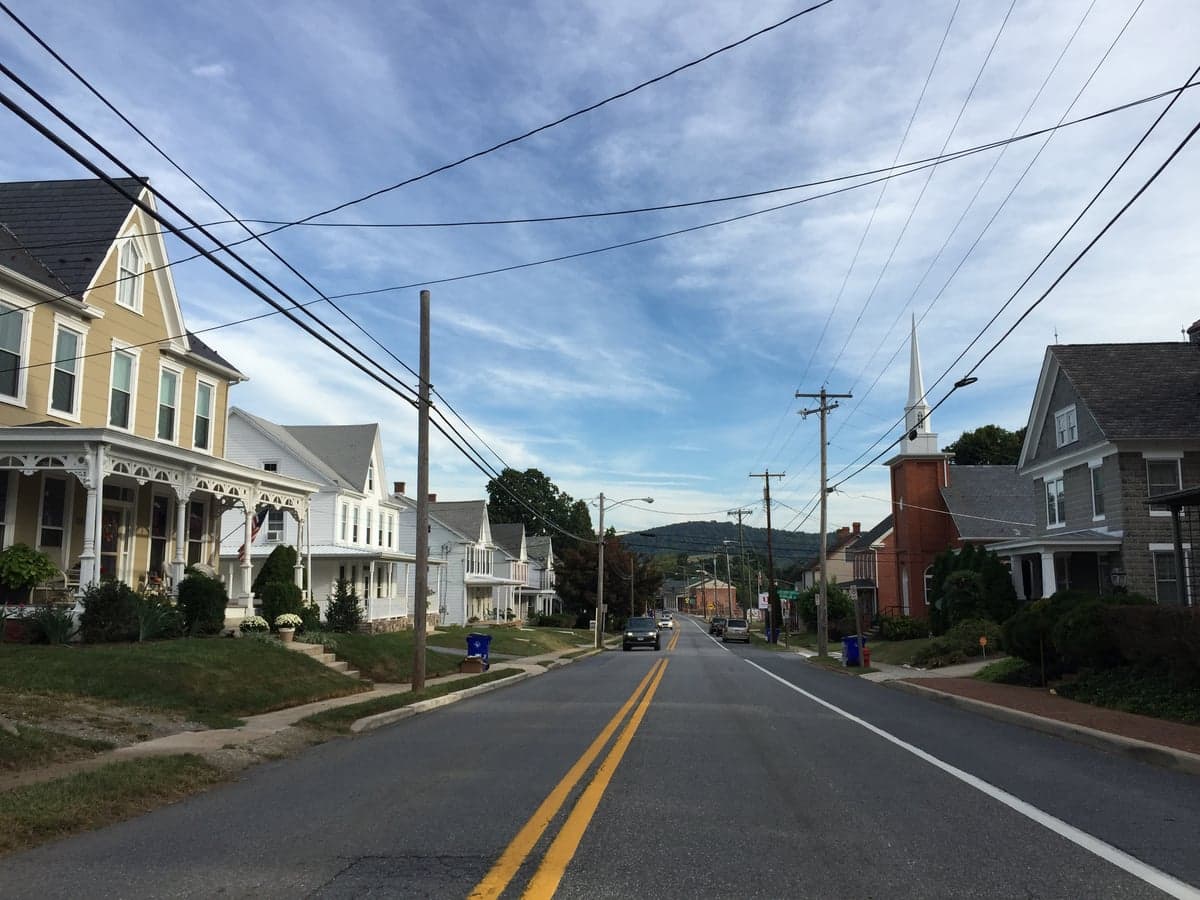
Myersville’s population history begins with German and English settlers who arrived in the mid-18th century, drawn by fertile farmland along the eastern slope of South Mountain. The town was officially laid out in 1804 by Daniel Myers, and its early economy revolved around agriculture, milling, and small-scale trade along the National Road (now U.S. Route 40). The original settlers built their homes and farms in what is now the Historic District, centered around Main Street and Church Street, where many 19th-century stone and brick structures still stand. A second wave of German Catholic families arrived in the mid-1800s, establishing St. Joseph’s Church and settling in the St. Joseph’s area along the western edge of town. These early groups formed the core of Myersville’s population for over a century, with the town remaining a small, homogeneous farming community through the 1950s. The 1960 census recorded just 456 residents, reflecting little change from the 19th-century population.
Modern era (post-1965)
The post-1965 period brought modest but notable demographic shifts. The 1970s and 1980s saw the first wave of domestic in-migration as families from the Washington, D.C., and Baltimore suburbs sought more space and lower housing costs, settling in newer subdivisions like Hillside Estates and Myersville Heights on the town’s eastern and northern edges. These newcomers were overwhelmingly White and middle-class, drawn by the town’s rural character and good schools. The Hispanic population, now 8.6%, began growing in the 1990s and 2000s, primarily through families moving from Frederick and Montgomery counties for work in construction, landscaping, and agriculture. Most Hispanic residents live in the South Myersville area near Route 17 and in rental properties along Main Street. The East/Southeast Asian population (2.5%) and Indian subcontinent population (0.9%) are very recent arrivals, largely professionals and their families who moved in after 2010, attracted by the town’s proximity to Fort Detrick and the I-270 technology corridor. These groups are dispersed, with no single ethnic enclave, though a small cluster of Asian families has formed in the Foxfield subdivision off Hessong Bridge Road. The Black population remains very small at 1.5%, with no distinct neighborhood concentration. Overall, Myersville’s racial and ethnic diversity has increased only modestly since 2000, and the town remains far less diverse than Frederick City or the D.C. suburbs.
The future
Myersville’s population is projected to grow slowly, likely reaching 2,800–3,000 by 2040, driven by continued domestic in-migration from the D.C. metro area. The town’s demographic trajectory points toward a gradual increase in Hispanic and East/Southeast Asian shares, but the foreign-born population will likely remain below 5% for the foreseeable future. New residential development is concentrated in the Myersville Crossing area near the I-70 interchange, where townhomes and single-family houses are attracting younger families, many of whom commute to Frederick or Montgomery County. The town’s cultural identity is evolving from a purely rural, German-American farming community to a more suburban, commuter-oriented town, but the pace of change is slow. The high college-education rate and the influx of professionals suggest Myersville will continue to lean politically moderate to conservative, with a strong emphasis on local schools, low taxes, and property rights. For a new resident, this means joining a community where long-time families still dominate local leadership and newcomers are welcomed but expected to respect the town’s historic character.
Myersville is becoming a quiet, well-educated bedroom community with a slowly diversifying population, but its core identity remains rooted in its German-American heritage and rural traditions. For those moving in now, the town offers a stable, safe environment with strong schools and a clear sense of place, but little of the rapid change or ethnic diversity found in larger Frederick County towns.

* Values derived from national, state, county, city and local statistics and may differ in a specific area. Last updated: 2026-08-26T18:54:43.000Z
Narrative content on this page is AI-generated and may contain mistakes. Verify any details that matter before acting on them.
ReloMaps may earn a commission from affiliate links at no extra cost to you.

