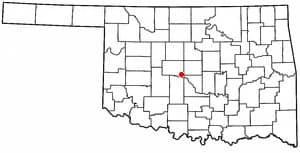
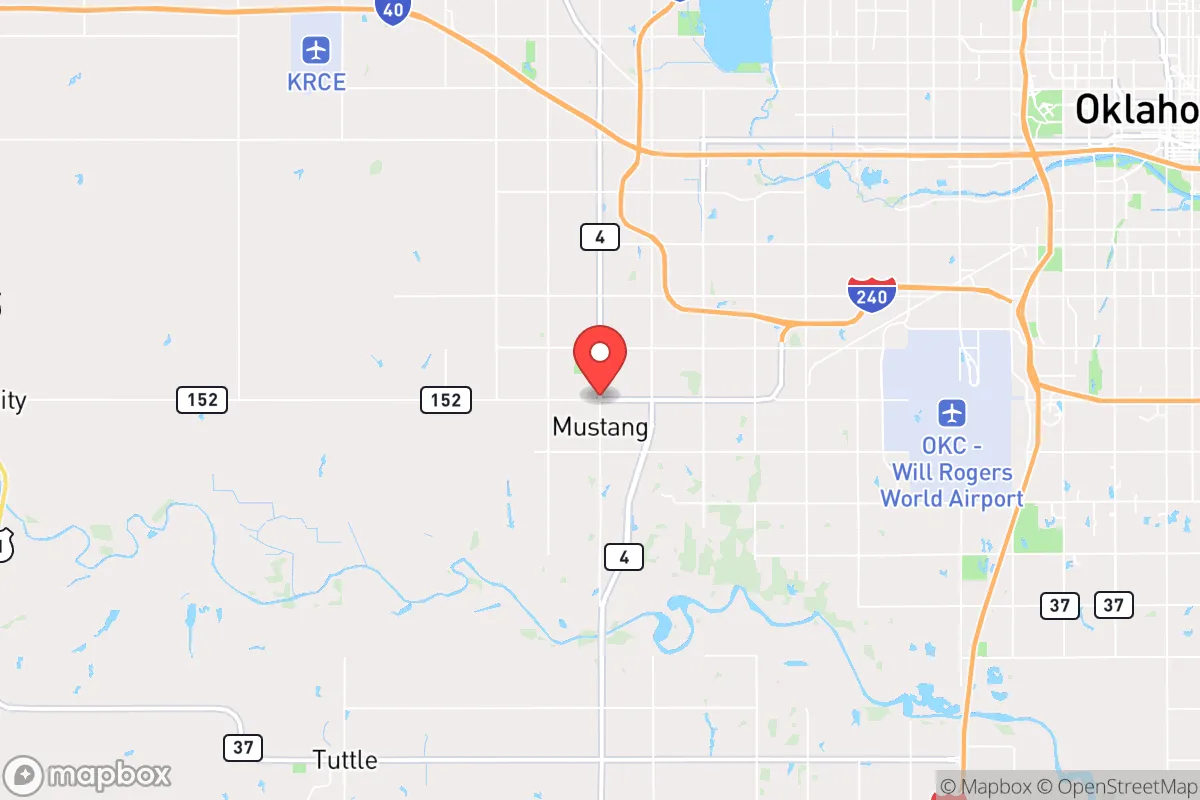
Photo: Wikipedia
Demographics of Mustang, OK
Affluence Level in Mustang, OK
A middle-class area roughly in line with national averages across income, home values, education, and employment.
People of Mustang, OK
The people of Mustang, Oklahoma, today form a predominantly white, family-oriented community of 21,290 residents, characterized by a strong sense of local identity and a notably low foreign-born population of just 1.9%. With 72.4% of residents identifying as white and 11.3% as Hispanic, the city presents a demographic profile that is less diverse than the national average, yet it is gradually absorbing new populations through domestic migration from the Oklahoma City metro area. The city’s identity is rooted in its agricultural past and its evolution into a commuter suburb, where single-family homes and a focus on schools and safety define daily life.
How the city was settled and grew
Mustang’s settlement began in the late 19th century, following the Land Run of 1889, which opened the Unassigned Lands of central Oklahoma to non-Native settlers. The area was originally a stop on the Chicago, Rock Island and Pacific Railroad, and the first permanent residents were farmers and ranchers drawn by the promise of cheap, fertile land. The town was officially platted in 1895, and its early population was almost entirely white, of Anglo-American and German descent, who built homesteads along the railroad corridor. The historic Old Town Mustang district, centered around what is now State Highway 152, became the commercial and social hub, with wooden storefronts and grain elevators serving the surrounding agricultural community. The original residential blocks—such as those near Mustang Road and SW 59th Street—were laid out in a simple grid, housing the families of farmers, blacksmiths, and railroad workers. Through the first half of the 20th century, the population grew slowly, remaining under 500 as late as 1950, with the community’s character defined by its rural, Protestant, and self-reliant ethos.
Modern era (post-1965)
The post-1965 period brought dramatic change as Mustang transformed from a sleepy farm town into a fast-growing suburb of Oklahoma City. The Immigration and Nationality Act of 1965 had little direct effect here—foreign-born residents remain scarce—but the completion of Interstate 44 and the expansion of the Kilpatrick Turnpike in the 1980s and 1990s made Mustang accessible to commuters. The city’s population exploded from 1,578 in 1970 to over 21,000 by 2025, driven almost entirely by domestic in-migration of white families seeking affordable housing, larger lots, and the highly rated Mustang Public Schools system. New subdivisions such as Wilderness Ranch (developed in the 1990s) and Lakewood Estates (2000s) attracted middle-class families, many moving from the inner-ring suburbs of Oklahoma City and Del City. The Hispanic population, now at 11.3%, began to grow in the 2000s, concentrated in the Mustang Crossing area and along the SW 44th Street corridor, where newer, more affordable rental housing and mobile home parks are located. The East/Southeast Asian community (1.8%) and Indian subcontinent community (0.7%) are small but present, with families typically settling in the newer subdivisions near Mustang High School and Wildhorse Park, drawn by the school system and professional jobs in the Oklahoma City metro. The Black population (3.2%) is dispersed but slightly more concentrated in the Stone Creek neighborhood, a mid-2000s development. The city remains overwhelmingly white, but the Hispanic share has doubled since 2010, marking the most significant demographic shift.
The future
Mustang’s population is projected to continue growing, likely reaching 25,000–28,000 by 2040, driven by ongoing residential development on the city’s western and southern fringes. The city is not homogenizing; rather, it is slowly tribalizing into distinct enclaves. The older, established white population remains dominant in historic neighborhoods like Old Town and Wilderness Ranch, while newer Hispanic and Asian families are clustering in the more affordable, newer subdivisions on the periphery. The foreign-born share is expected to rise modestly, possibly to 3–4%, as the Hispanic community grows through both domestic migration and natural increase. The Indian and East/Southeast Asian communities are likely to remain small but stable, as Mustang lacks the ethnic infrastructure—temples, ethnic grocery stores, cultural organizations—that draws larger immigrant populations to cities like Edmond or Norman. The biggest driver of future change will be the continued expansion of the Oklahoma City metro, which will bring more diverse, younger families seeking affordable housing, potentially accelerating the Hispanic share toward 15–18% by 2040.
For someone moving in now, Mustang is becoming a more diverse but still predominantly white, family-focused suburb where the public schools and low crime rates are the primary draws. The city’s identity is shifting from a rural farming community to a commuter suburb, and the new arrivals—whether white, Hispanic, or Asian—are largely assimilating into a shared culture centered on schools, sports, and church life. The bottom line: Mustang offers a stable, safe, and growing environment for families who value community cohesion and are comfortable with gradual, manageable demographic change.

* Values derived from national, state, county, city and local statistics and may differ in a specific area. Last updated: 2026-04-25T13:51:55.000Z
Narrative content on this page is AI-generated and may contain mistakes. Verify any details that matter before acting on them.
ReloMaps may earn a commission from affiliate links at no extra cost to you.

