
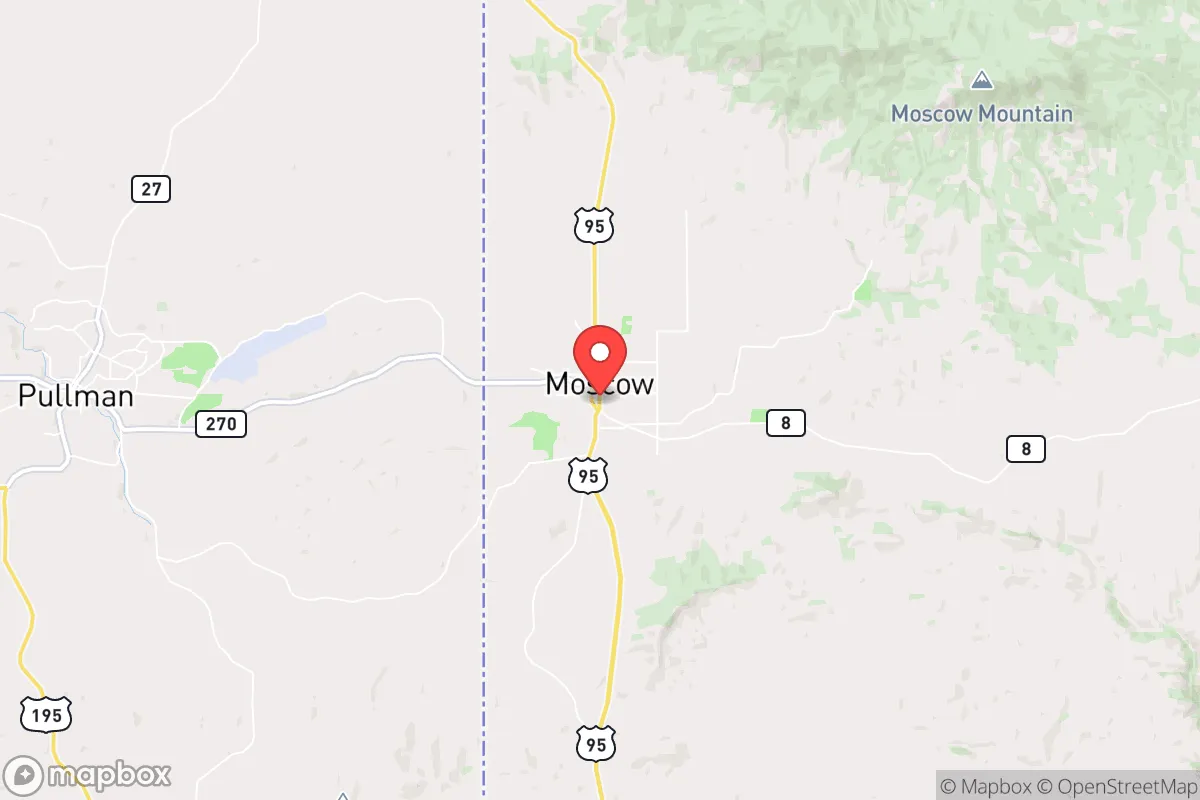
Photo: Wikipedia
Personal Sovereignty in Moscow, ID
Viable for self-reliance. Generally workable, though some barriers may limit total independence.
What does Personal Sovereignty tell us?
Personal Sovereignty measures your capacity for self-reliance and independence with minimal government friction. Higher scores mean fewer barriers between you and the way you want to live... but it assumes you have the space you need and good neighbors.
What does this tell us?
Personal Sovereignty measures your capacity for self-reliance and independence with minimal government friction. Higher scores mean fewer barriers between you and the way you want to live... but it assumes you have the space you need and good neighbors.
State Policy
Energy independence: Importer (25% of energy produced in-state)
Personal Liberty
Homesteading

Personal Liberty Analysis
Moscow, Idaho offers a notably high degree of personal sovereignty relative to most of the Pacific Northwest, largely because it sits in a state that has aggressively pushed back against federal overreach and maintains a legal culture that favors individual autonomy. For the survivalist or prepper-minded individual, the key takeaway is that Idaho’s state-level legal framework — including strong preemption laws on firearms, low regulatory burdens, and a constitutional carry environment — creates a buffer against the kind of municipal-level encroachments seen in neighboring Washington and Oregon. While Moscow itself is a college town with a more progressive local government than the surrounding rural areas, the state’s preemption statutes and tax structure mean that a resident’s day-to-day freedom is far less constrained than in comparable towns west of the Cascades.
Tax burden and regulatory posture: how Idaho’s fiscal climate supports self-reliance
Idaho’s tax structure is one of the most favorable in the nation for those seeking to maximize personal financial sovereignty. The state levies a flat income tax of 5.8% as of 2026, with no progressive brackets, meaning your marginal rate is your effective rate — a straightforward system that avoids the complexity and hidden costs of more progressive states. Property taxes in Latah County, where Moscow sits, average around 0.72% of assessed value, which is below the national median and significantly lower than Washington’s effective rate of roughly 0.93% or Oregon’s 0.85% (though Oregon’s system is complicated by its unique compression limits). There is no state sales tax on groceries or prescription drugs, and the general sales tax is 6%. Critically, Idaho has no estate tax, no inheritance tax, and no state-level capital gains tax — a major advantage for anyone building long-term wealth or passing assets to the next generation. Regulatory posture at the state level is explicitly pro-business and pro-property rights, with right-to-work laws in place and a regulatory review process that requires agencies to justify new rules against a cost-benefit analysis. For the prepper, this means fewer bureaucratic hurdles when establishing a home-based business, storing supplies, or modifying property for self-sufficiency. The state’s strong preemption laws also prevent Moscow from enacting its own stricter business or housing regulations, though the city does have a modest zoning code that can affect outbuildings and accessory structures — something to verify before buying.
Self-defense and gun law specifics: constitutional carry and statutory protections
Idaho is one of the strongest Second Amendment states in the country, and Moscow residents benefit directly from that legal environment. The state has permitted constitutional carry since 2016, meaning any law-abiding adult 18 or older can carry a concealed firearm without a permit, both inside and outside city limits. There is no state-level requirement to register firearms, no magazine capacity restrictions, and no "assault weapon" bans — all of which are common in neighboring Washington and Oregon. Idaho also has a "stand your ground" statute (Idaho Code § 19-202A), which removes any duty to retreat before using deadly force in self-defense, provided you are lawfully present. For the survivalist, the legal framework is unambiguous: the state explicitly recognizes the right to keep and bear arms as a fundamental, pre-existing right, and local governments are prohibited from enacting their own gun control ordinances under Idaho’s strong preemption law (Idaho Code § 18-3302). This means Moscow cannot impose its own waiting periods, background check expansions, or storage requirements — a critical protection against the kind of municipal-level gun control seen in cities like Seattle or Portland. The only practical consideration is that Moscow is a college town, and the University of Idaho campus has its own policies restricting firearms in certain buildings, but off-campus, the legal landscape is as permissive as any in the nation.
Self-reliance and homesteading viability: lot sizes, zoning, and off-grid feasibility
For those looking to establish a degree of self-sufficiency, Moscow offers a mixed but workable environment. Within city limits, standard residential lots range from 6,000 to 10,000 square feet, which is enough for a substantial garden, small livestock like chickens, and rainwater catchment — but not for larger animals or significant agricultural operations. Moscow’s zoning code does allow for accessory dwelling units (ADUs) and detached workshops, but permits are required, and the city has some restrictions on the number of structures per lot. The real opportunity lies just outside city limits, in unincorporated Latah County, where zoning is far more permissive and lot sizes can be as small as one acre for rural residential use, with no county-level restrictions on outbuildings, greenhouses, or alternative energy systems. Off-grid feasibility is high in the surrounding area: Idaho has no state-level prohibition on solar panel installation, rainwater collection is legal (though the state has a permitting system for large-scale capture), and composting toilets are permitted under the state’s alternative wastewater rules. The biggest practical hurdle is water rights — Idaho follows the prior appropriation doctrine, meaning you need a water right permit for any well that draws more than 13,000 gallons per day, but a standard domestic well for a single household is generally exempt. For the prepper, the ideal strategy is to buy a property just outside Moscow’s urban growth boundary, where you can legally store fuel, maintain a generator, and keep livestock without city interference.
Personal liberties: parental rights, medical autonomy, speech, and property
Idaho has become a national leader in protecting parental rights, with the Idaho Parental Rights Act (Idaho Code § 33-138) explicitly affirming that parents have the fundamental right to direct the upbringing, education, and healthcare of their children. This means Moscow public schools cannot provide medical or mental health services to minors without parental consent, and the state has banned the use of "critical race theory" and "social-emotional learning" curricula that many conservative parents view as ideological overreach. On medical autonomy, Idaho has some of the strongest protections against vaccine mandates in the country, with a 2023 law prohibiting employers from requiring COVID-19 vaccines and a general exemption framework for religious and philosophical objections. The state also has a robust medical freedom statute that allows individuals to refuse any medical treatment, including vaccinations, without penalty. Free speech protections are reinforced by Idaho’s lack of a "hate speech" law and its adoption of the "marketplace of ideas" standard in public forums — though Moscow’s city council has occasionally passed symbolic resolutions that some residents view as political overreach, these have no legal force. Property rights are protected by Idaho’s "private property rights protection act," which requires government agencies to conduct a takings analysis before enacting any regulation that could diminish property value. For the survivalist, this legal framework means you can speak your mind, refuse medical mandates, and control your children’s education without fear of state intervention — a level of personal sovereignty that is increasingly rare in the United States.
Overall, Moscow, Idaho represents one of the strongest environments for personal sovereignty in the Pacific Northwest, particularly when compared to the regulatory and legal climates of Washington and Oregon. The state’s constitutional carry law, parental rights protections, low tax burden, and preemption statutes create a legal buffer that preserves individual autonomy even within a college town with a progressive local government. For the prepper or survivalist looking to relocate, the key trade-off is between the convenience of living in town (with its access to services and community) and the greater freedom of a rural property just outside city limits. Either way, Idaho’s state-level legal framework ensures that your rights are not subject to the whims of a city council — a critical consideration in an era of increasing government overreach. If you value the ability to defend yourself, raise your family according to your own values, and build a self-reliant lifestyle without bureaucratic interference, Moscow is one of the few places in the region where that vision is not just possible, but legally protected.

* Values derived from national, state, county, city and local statistics and may differ in a specific area. Last updated: 2026-04-21T12:29:23.000Z
Narrative content on this page is AI-generated and may contain mistakes. Verify any details that matter before acting on them.
ReloMaps may earn a commission from affiliate links at no extra cost to you.

