Photo: Wikipedia
Demographics of Glacier County
Affluence Level in Glacier County
A below-average socioeconomic profile. Incomes, home values, and educational attainment trail the U.S., with higher poverty and unemployment.
People of Glacier County
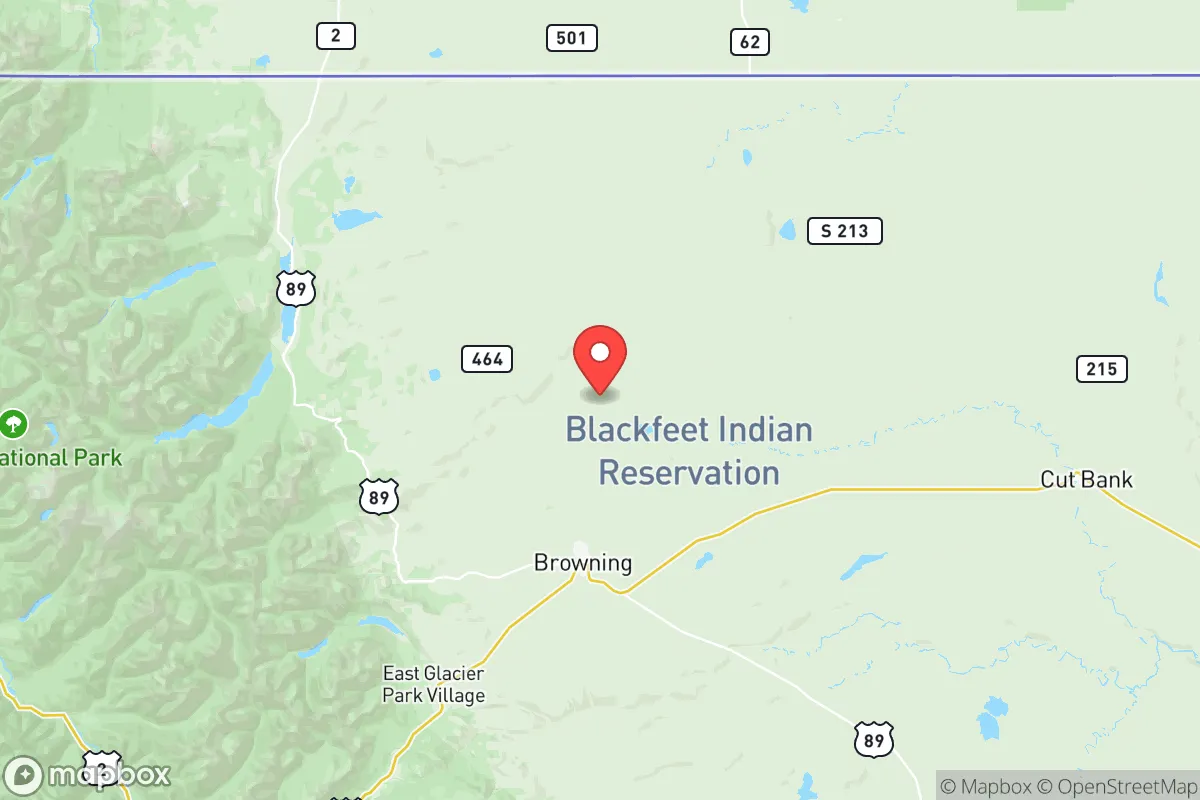
The people of Glacier County, Montana, today are overwhelmingly Native American, with the Blackfeet Nation comprising the majority of the county’s 13,713 residents and shaping its cultural, economic, and political identity. The county is one of the most sparsely populated in the state, with a population density of just over two people per square mile, and its demographic profile is distinctive: 29.3% of residents identify as White, 0.4% as foreign-born, and the remaining share is almost entirely Native American, with negligible Hispanic (2.8%), Black (0.2%), and East/Southeast Asian (0.6%) populations. The county seat of Cut Bank and the small town of Browning serve as the primary population centers, with Browning acting as the commercial and governmental hub of the Blackfeet Indian Reservation. This is a place where the human story is not one of successive immigrant waves but of enduring Indigenous presence, punctuated by brief periods of non-Native settlement that have since receded.
Settlement & growth (pre-1960)
The human history of Glacier County begins with the Blackfeet people, who have inhabited the region for centuries, long before any European contact. The Blackfeet Confederacy—comprising the Siksika, Kainai, and Piikani—controlled vast territories across what is now northern Montana and southern Alberta, with the area around present-day Browning serving as a central gathering point for bison hunting and seasonal camps. The first non-Native presence came with fur traders and explorers in the early 1800s, but sustained European-American settlement did not begin until the late 19th century, following the U.S. government’s forced confinement of the Blackfeet to a reservation established by the 1855 Lame Bull Treaty and later reduced by the 1887 Dawes Act. The arrival of the Great Northern Railway in the 1890s spurred the founding of towns like Cut Bank (incorporated in 1891) and the short-lived settlement of Midvale (later renamed East Glacier Park Village), which served as railroad stops and supply points for homesteaders and ranchers.
The Homestead Act of 1862 and its subsequent amendments drew a modest wave of White settlers—primarily of Northern European descent, including Germans, Scandinavians, and Irish—to the county’s open prairie lands in the early 1900s. These homesteaders established small farming communities such as Babb, St. Mary, and the now-vanished town of Meriwether, growing wheat and raising cattle on the arid plains. The 1910 Census recorded Glacier County’s population at just over 4,000, with roughly equal numbers of Native and non-Native residents. However, the Dust Bowl of the 1930s and the subsequent agricultural consolidation drove many homesteaders off the land, and the county’s non-Native population began a long decline. By 1960, the population had fallen to around 9,000, with the Blackfeet share growing as White families left for urban jobs in Great Falls and elsewhere. The Indian Reorganization Act of 1934 allowed the Blackfeet to re-establish tribal governance, and Browning became the seat of the Blackfeet Tribal Business Council, solidifying its role as the county’s cultural and political center.
Modern era (post-1965)
The 1965 Hart-Cellar Act, which reshaped U.S. immigration patterns nationwide, had virtually no impact on Glacier County. The foreign-born population today stands at just 0.4%, and the county has not experienced the waves of immigration from Latin America, Asia, or Africa seen in other parts of Montana. Instead, the dominant demographic trend since 1965 has been the continued outmigration of White residents and the consolidation of the Blackfeet population. The 1970s and 1980s saw the closure of many small family farms and ranches, accelerating the departure of non-Native families from towns like Cut Bank and East Glacier Park Village. Meanwhile, the Blackfeet population grew through natural increase—higher birth rates relative to the White population—and a modest return migration of tribal members from urban areas, drawn back by cultural ties and tribal housing programs.
Suburbanization, as understood in metropolitan America, has not occurred in Glacier County. The county remains rural and reservation-based, with Browning (population roughly 1,000) as the largest settlement. Cut Bank, once a thriving railroad and agricultural center, has seen its population decline from a peak of around 4,000 in the 1960s to roughly 3,000 today, as retail and services have shifted to Browning or to larger towns like Kalispell and Great Falls. The Blackfeet Nation has become the county’s largest employer, operating the Blackfeet Community College, the Indian Health Service hospital in Browning, and the Glacier Peaks Casino, which opened in 2012 and draws visitors from the nearby Going-to-the-Sun Road corridor. The county’s racial composition has shifted from roughly 50% Native in 1960 to over 70% Native today, reflecting both White outmigration and higher Native birth rates. The college-educated share of the population is just 18.1%, well below the national average, as many young people leave for educational and employment opportunities elsewhere.
The future
Glacier County’s population is projected to remain stable or decline slightly over the next decade, as outmigration of young adults—both Native and White—continues to offset natural increase. The county’s total population has hovered around 13,700 since 2010, and the U.S. Census Bureau projects a modest decline to roughly 13,000 by 2035. The Blackfeet share of the population is likely to grow further, potentially reaching 80% or more, as the White population continues to age and shrink. New residents are rare: the county attracts few domestic migrants, and international immigration is negligible. The small Hispanic and East/Southeast Asian populations (2.8% and 0.6%, respectively) are concentrated in Cut Bank, where a handful of families work in agriculture and the oil and gas industry, but these groups are not growing significantly.
The cultural identity of Glacier County is becoming more distinctly Blackfeet, with the tribe exerting increasing influence over local governance, education, and economic development. The Blackfeet Language Immersion School in Browning and the expansion of tribal enterprises like the Glacier Peaks Casino and the Blackfeet Nation’s buffalo herd restoration project are reinforcing this identity. However, the county faces significant challenges: poverty rates exceed 30%, housing is scarce and often substandard, and the lack of a diversified economy limits opportunities for younger residents. For someone moving in now, Glacier County offers a deeply rooted Indigenous community, unparalleled access to Glacier National Park, and a quiet, rural lifestyle—but also limited job prospects, harsh winters, and a population that is both shrinking and aging. It is a place where the human story is one of endurance and cultural preservation, not of growth or demographic transformation.

* Values derived from national, state, county, city and local statistics and may differ in a specific area. Last updated: 2026-07-29T02:09:42.000Z
Narrative content on this page is AI-generated and may contain mistakes. Verify any details that matter before acting on them.
ReloMaps may earn a commission from affiliate links at no extra cost to you.

