
Photo by Mike Gattorna on Unsplash
Demographics of St Charles County
Affluence Level in St Charles County
An upper-middle-class area. Household wealth, education levels, and homeownership run ahead of national benchmarks.
People of St Charles County
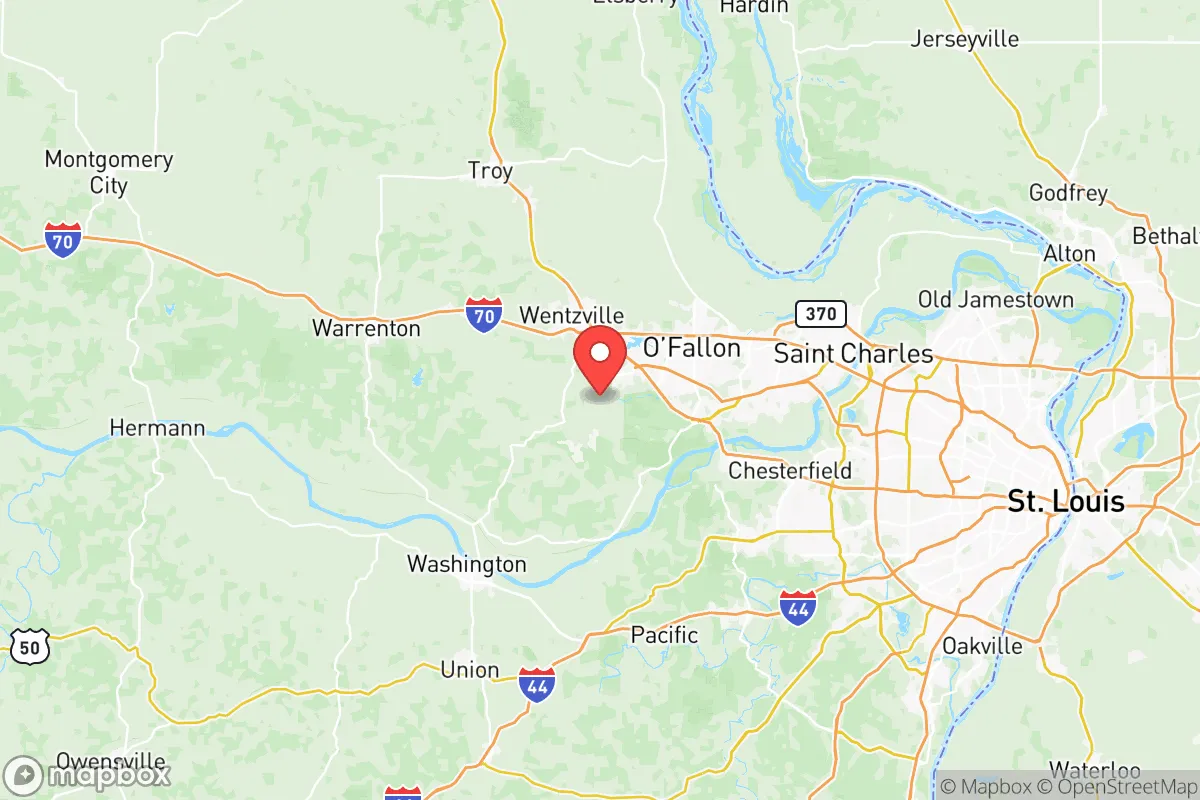
St. Charles County, Missouri, is a predominantly white, family-oriented suburban region of over 409,000 residents, characterized by its blend of historic river towns and master-planned subdivisions. The county’s population is notably less diverse than the national average, with a foreign-born population of just 1.9% and a white demographic share of 83.9%, reflecting its roots as a destination for German and other European settlers. Today, its identity is shaped by a strong conservative political leaning, high rates of homeownership, and a population that is both well-educated (42.4% college-educated) and deeply tied to the St. Louis metropolitan area’s westward expansion.
Settlement & growth (pre-1960)
Before European settlement, the area now known as St. Charles County was inhabited by the Osage and Missouria Native American nations, who used the Missouri River as a trade and travel corridor. French fur traders and missionaries were the first Europeans to arrive in the late 1600s and early 1700s, establishing small trading posts along the river. The region passed from French to Spanish control in 1763, and then to the United States with the Louisiana Purchase in 1803. The city of St. Charles, founded in 1769 as Les Petites Côtes (The Little Hills) by French Canadian fur trader Louis Blanchette, became the first permanent European settlement on the Missouri River and served as Missouri’s first state capital from 1821 to 1826.
The major wave of settlement came with German immigrants in the 1830s through the 1850s, drawn by cheap land, the promise of religious freedom, and the establishment of the Missouri Synod of the Lutheran Church. These German settlers were predominantly farmers and craftsmen, and they established tight-knit communities in towns like Augusta, Dutzow, and Washington along the Missouri River. The German influence remains visible today in the region’s wineries, architecture, and place names. A smaller wave of Irish immigrants arrived in the 1840s and 1850s, many working on the railroad and settling in St. Charles and O’Fallon. The county remained overwhelmingly rural and agricultural through the early 20th century, with a population of just 25,000 in 1900. The construction of U.S. Route 40 (later Interstate 70) in the 1950s began to open the county to suburban development, but the population remained under 100,000 until the 1970s.
Modern era (post-1965)
The 1965 Hart-Cellar Act had a minimal direct impact on St. Charles County, as the region did not become a primary destination for post-1965 immigrants. Instead, the county’s modern growth has been driven overwhelmingly by domestic migration—specifically, white families moving westward from St. Louis City and inner-ring suburbs. The completion of Interstate 70 and the expansion of Highway 40/61 in the 1970s and 1980s made towns like St. Peters, O’Fallon, and Wentzville accessible commuter suburbs. These communities experienced explosive growth: O’Fallon grew from 8,000 residents in 1980 to over 85,000 by 2020, while Wentzville expanded from 3,000 to over 45,000 in the same period.
The county’s racial and ethnic composition has remained relatively stable compared to national trends. The white population share has declined from approximately 95% in 1990 to 83.9% today, driven primarily by modest growth in Hispanic (4.0%) and Black (4.9%) populations. The Asian population (East and Southeast Asian) stands at 1.7%, with small concentrations in St. Charles and O’Fallon, while the Indian subcontinent population is 1.2%, with families often drawn to the technology and healthcare sectors. The foreign-born share of 1.9% is among the lowest for any county in the St. Louis metro area, reflecting the region’s limited appeal to new immigrant communities. The county has also seen a small but growing number of Arab and Middle Eastern families, though their numbers remain below 1% of the population.
Suburbanization has been the dominant force shaping the county’s character. Master-planned communities, large-lot subdivisions, and strip-mall commercial corridors define the landscape from Lake Saint Louis to Wentzville. The county’s population has more than doubled since 1990, from 198,000 to 409,830, making it one of the fastest-growing counties in Missouri. This growth has been almost entirely domestic, with families moving from St. Louis City and County seeking lower taxes, better schools, and larger homes.
The future
St. Charles County is projected to continue growing, with estimates reaching 500,000 residents by 2040. The population is likely to remain overwhelmingly white and native-born, though the Hispanic and Asian shares may increase modestly as second-generation families from St. Louis County seek suburban housing. The county is not tribalizing into distinct ethnic enclaves; instead, it is homogenizing into a broad, conservative-leaning suburban culture where new residents are absorbed into the existing social fabric. The Indian and East/Southeast Asian communities are small and dispersed, with no single concentrated ethnic neighborhood emerging.
The biggest demographic shift may come from generational change rather than immigration. As the large Baby Boomer cohort ages, the county is seeing an influx of younger families from St. Louis City and County, drawn by the same factors that attracted their parents: good schools, low crime, and affordable housing. This in-migration is reinforcing the county’s cultural identity rather than transforming it. The next 10-20 years will likely see continued outward expansion, with Wentzville and Foristell absorbing most new development, while the historic river towns of Augusta and Washington remain small and preservation-minded.
St. Charles County is becoming a denser, more suburban version of itself—a place where growth is steady but culturally conservative, and where the population is being replenished by domestic migration rather than transformed by immigration. For someone moving in now, the county offers stability, predictability, and a community that looks and votes much like it did a generation ago, with the trade-off being limited diversity and a slower pace of cultural change.

* Values derived from national, state, county, city and local statistics and may differ in a specific area. Last updated: 2026-05-12T10:43:13.000Z
Narrative content on this page is AI-generated and may contain mistakes. Verify any details that matter before acting on them.
ReloMaps may earn a commission from affiliate links at no extra cost to you.

