Photo: Wikipedia
Demographics of Jefferson County
Affluence Level in Jefferson County
A middle-class area roughly in line with national averages across income, home values, education, and employment.
People of Jefferson County
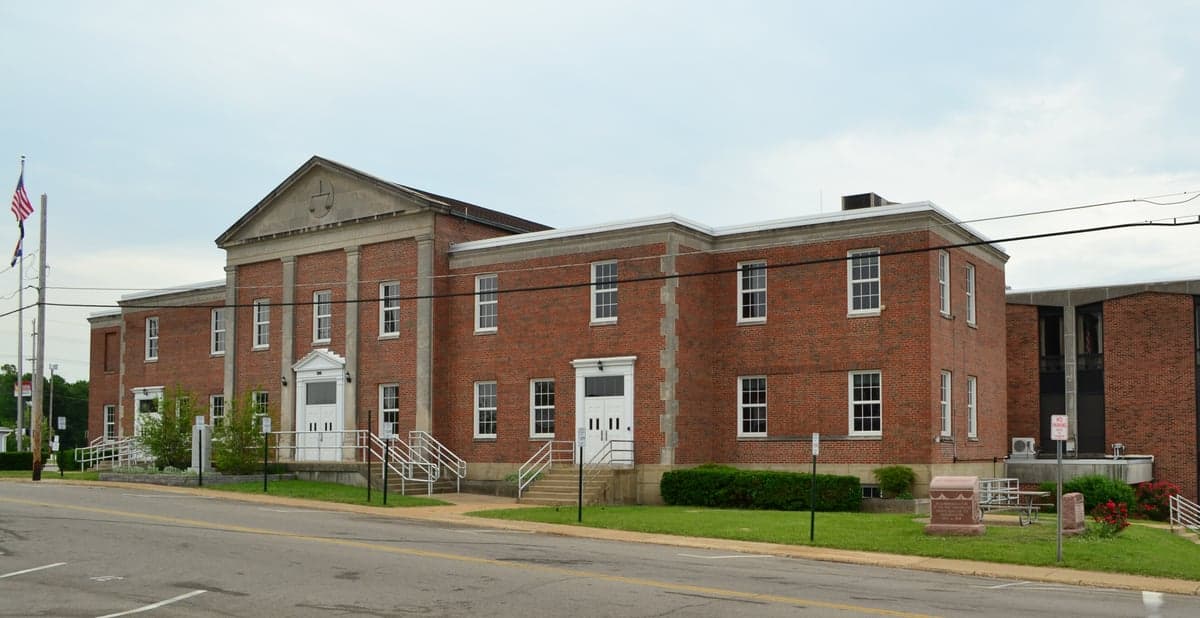
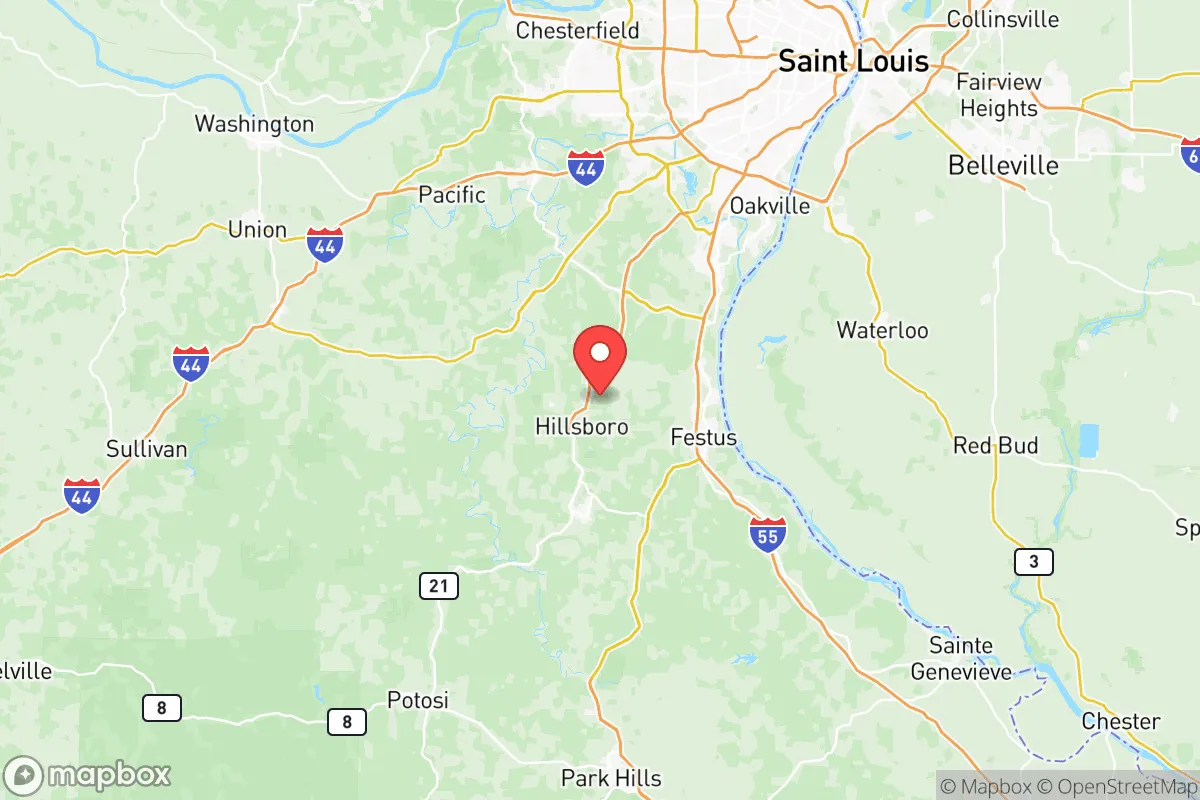
Jefferson County, Missouri, today is a predominantly white, family-oriented exurban county of roughly 228,000 residents, characterized by a strong sense of local identity and a population density that thins noticeably as you move south from the St. Louis metro area. With 89% of residents identifying as white, a foreign-born population of just 0.6%, and a college attainment rate of 23.6%, the county’s demographic profile reflects its deep roots in 19th-century European settlement and its limited exposure to the immigration waves that reshaped much of urban America after 1965. The people here are overwhelmingly native-born, with a cultural tone that leans conservative and self-reliant, shaped by generations of farming, mining, and commuting to industrial jobs in St. Louis.
Settlement & growth (pre-1960)
Before American settlement, the area that is now Jefferson County was inhabited by the Osage Nation, who controlled much of present-day Missouri and used the Meramec River valley for hunting and seasonal camps. French fur traders and missionaries passed through in the 1700s, but no permanent European settlements took hold until after the Louisiana Purchase in 1803. The first American settlers were largely of Scots-Irish and English stock, moving west from Kentucky, Tennessee, and Virginia in the 1810s and 1820s. They were drawn by cheap land under the 1820 Land Act and the promise of fertile bottomlands along the Big River and Meramec River. These early families established the first permanent communities, including Festus (originally called Tanglefoot) and Crystal City, which grew as river ports and agricultural hubs.
The single most transformative event for Jefferson County’s population was the discovery of rich lead deposits in the 1820s. The region became part of the Missouri Lead Belt, and mining towns sprang up almost overnight. De Soto, founded in 1857, became a major lead-mining center, attracting a wave of German and Irish immigrants who arrived in the 1840s and 1850s to work the mines and build the railroads. The Germans, in particular, left a lasting imprint: they founded Hillsboro, the county seat, and established Catholic parishes and farming communities in the rolling hills south of the Meramec. The Irish concentrated in Herculaneum, where the lead smelters operated along the Mississippi River. By 1860, Jefferson County’s population had reached roughly 10,000, with a mix of native-born Americans and a significant German-born minority.
After the Civil War, the lead industry boomed again, and the county saw a second wave of European immigration. Italian and Polish laborers arrived in the 1880s and 1890s, many recruited directly by mining companies. They settled in company towns like Bonne Terre (just across the county line in St. Francois County) and in the mining camps around Leadwood and Park Hills, though these were technically outside Jefferson County’s borders. Within the county, the Italian community concentrated in Pevely and Barnhart, where they worked in the limestone quarries and on the railroads. The Polish community was smaller, settling mostly in Imperial and along the Meramec River bottoms. By 1900, the county’s population had grown to 22,000, and it remained a predominantly rural, mining-and-farming economy through the Great Depression.
The post-World War II era brought the first major shift away from mining and agriculture. The construction of Interstate 55 in the 1950s and 1960s opened Jefferson County to commuters from St. Louis. Suburban subdivisions began to replace farmland in the northern part of the county, particularly around Arnold, which grew from a village of 1,500 in 1950 to a city of over 20,000 by 1980. This was the beginning of the county’s transformation from a rural mining district into an exurban bedroom community for St. Louis.
Modern era (post-1965)
The 1965 Hart-Cellar Act had almost no direct impact on Jefferson County. Unlike St. Louis city or St. Louis County, which saw modest growth in Hispanic and Asian populations after 1965, Jefferson County remained overwhelmingly white and native-born. The foreign-born population today is just 0.6%, one of the lowest rates in the St. Louis metro area. The county’s demographic change since 1965 has been driven almost entirely by domestic migration: white families leaving St. Louis city and the inner-ring suburbs of St. Louis County for larger lots, lower taxes, and newer schools in Jefferson County.
This domestic migration accelerated in the 1990s and 2000s. The population grew from 171,000 in 1990 to 228,000 by 2020, a 33% increase. Most of this growth concentrated in the northern half of the county, within commuting distance of St. Louis. Arnold continued to expand, and new subdivisions filled in the corridor along Highway 141 and Highway 30 between Fenton and High Ridge. The unincorporated areas around Imperial and Barnhart saw particularly rapid growth, as families sought newer, larger homes on acreage. The southern part of the county, including De Soto and Hillsboro, grew more slowly, retaining a small-town, rural character.
The county’s racial and ethnic composition has remained remarkably stable. The Hispanic share grew from 0.5% in 1990 to 2.5% in 2020, a small but noticeable increase driven largely by Mexican-origin families moving into construction and service jobs in the northern suburbs. The Black population, at 1.1%, is concentrated in Festus and Crystal City, where a small African American community has existed since the lead-mining era. East and Southeast Asian residents, at 0.8%, are mostly Vietnamese and Filipino families who moved to Arnold and Imperial for jobs in healthcare and manufacturing. The Indian-subcontinent population is negligible at 0.2%. The county remains one of the least diverse in the St. Louis region, with a white share that is 15 points higher than St. Louis County’s.
The future
Jefferson County’s population is projected to continue growing slowly, reaching roughly 250,000 by 2040, driven by continued exurban spillover from St. Louis County. The growth will likely concentrate in the northern tier — Arnold, Imperial, and the unincorporated areas along the Meramec River — where land is still available for large-lot subdivisions. The southern part of the county, including De Soto and Hillsboro, will grow more slowly, as it is farther from the St. Louis job market and lacks major highway access.
The county is unlikely to become significantly more diverse in the near term. The Hispanic share may rise to 4-5% by 2040, as second-generation families move outward from St. Louis city and St. Louis County, but the Black and Asian shares will likely remain below 3% each. The foreign-born population will probably stay under 2%, as the county lacks the ethnic enclaves, employer-sponsored visa pipelines, or refugee resettlement programs that drive immigration in other parts of the metro area. The college attainment rate, at 23.6%, is below the national average and is unlikely to rise sharply, as the county’s economy remains dominated by trades, manufacturing, and service jobs that do not require a four-year degree.
Culturally, Jefferson County is becoming more suburban and less rural, but its political and social identity remains deeply conservative. The county voted for Donald Trump by a 2-to-1 margin in 2020, and its residents tend to prioritize low taxes, gun rights, and local control over schools and land use. Newcomers are overwhelmingly white families from St. Louis County who are seeking a more affordable, less dense, and more politically aligned environment. This self-selection reinforces the county’s existing character rather than diversifying it.
For someone moving in now, Jefferson County offers a stable, predictable, and culturally homogeneous environment. It is a place where the population is growing slowly, the schools are adequate, and the pace of life is slower than in the inner suburbs. The county’s demographic future is not one of transformation but of gradual, incremental change — more houses, more commuters, and a slightly more diverse population, but still overwhelmingly white, native-born, and conservative. It is a good fit for families who value space, affordability, and cultural continuity over urban amenities and diversity.

* Values derived from national, state, county, city and local statistics and may differ in a specific area. Last updated: 2026-08-03T22:14:07.000Z
Narrative content on this page is AI-generated and may contain mistakes. Verify any details that matter before acting on them.
ReloMaps may earn a commission from affiliate links at no extra cost to you.

