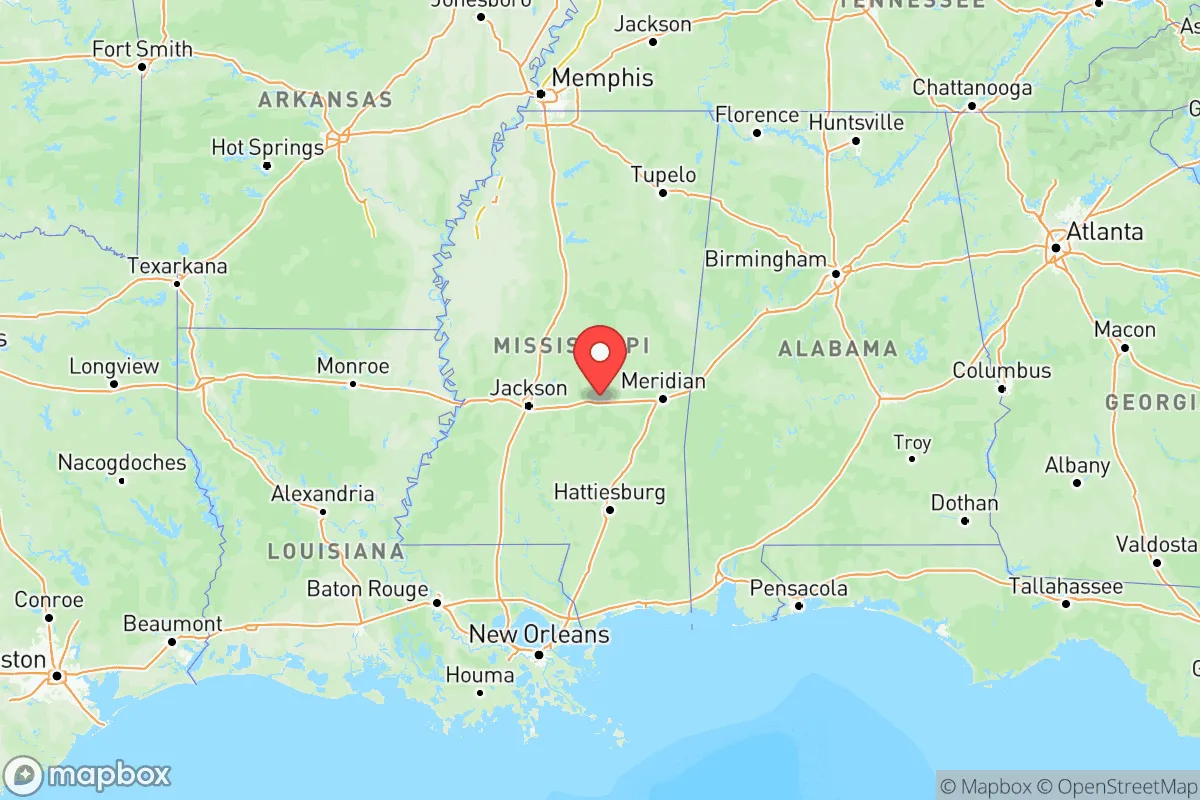
Photo: Wikipedia
Personal Sovereignty in Mississippi
Viable for self-reliance. Generally workable, though some barriers may limit total independence.
What does Personal Sovereignty tell us?
Personal Sovereignty measures your capacity for self-reliance and independence with minimal government friction. Higher scores mean fewer barriers between you and the way you want to live... but it assumes you have the space you need and good neighbors.
What does this tell us?
Personal Sovereignty measures your capacity for self-reliance and independence with minimal government friction. Higher scores mean fewer barriers between you and the way you want to live... but it assumes you have the space you need and good neighbors.
State Policy
Energy independence: Importer (50% of energy produced in-state)
Personal Liberty
Homesteading

Personal Liberty Analysis
Mississippi offers one of the most robust environments for personal sovereignty in the United States, particularly for those who view government overreach as a growing threat to individual liberty. The state’s legal and cultural DNA is built around a deep skepticism of centralized authority, making it a strategic relocation target for conservatives, preppers, and homesteaders who want to maximize autonomy. From the piney woods of Hattiesburg to the Delta flatlands near Greenville, the practical reality is that Mississippi’s government stays small, taxes stay low, and the law largely leaves you alone—provided you aren’t causing harm. This isn’t a place where the state micromanages your daily choices; it’s a place where you’re expected to handle your own business, and the legal framework backs that up.
Tax burden and regulatory posture: How Mississippi compares to high-control states
Mississippi’s tax structure is a deliberate feature of its sovereignty-friendly posture, not an accident. The state levies a flat personal income tax rate of 4.0% on income over $10,000, with a phase-down to 3.99% already legislated, and there is no state-level estate or inheritance tax. Property taxes are among the lowest in the nation, with an effective rate averaging just 0.52% of home value—roughly half the national average. For a prepper or homesteader, this means your land and improvements aren’t a recurring revenue stream for the county. Regulatory burden is equally light: Mississippi is a right-to-work state with minimal occupational licensing requirements compared to the Northeast or West Coast. The state’s Department of Environmental Quality is notably less aggressive than its counterparts in states like California or New York, meaning that building a pond, clearing timber, or installing a septic system on rural land near Oxford or Starkville typically involves fewer permits and less bureaucratic friction. If you’re coming from a state where every shed requires a permit and every fence line triggers a zoning review, Mississippi feels like a breath of fresh air—or, more accurately, like a place where the government trusts you to manage your own property.
Self-defense and gun law specifics: Stand your ground, permitless carry, and castle doctrine
Mississippi is a constitutional carry state, meaning that as of 2016, any law-abiding adult 18 or older can carry a concealed firearm without a permit. This isn’t a compromise—it’s a full-throated affirmation of the Second Amendment. The state also has a strong “Stand Your Ground” law, codified in Mississippi Code § 97-3-15, which removes any duty to retreat before using deadly force if you are lawfully present and reasonably believe force is necessary to prevent death, great bodily harm, or a forcible felony. The castle doctrine extends to your vehicle and your place of business, not just your home. For those who view personal security as a non-negotiable aspect of sovereignty, this legal framework is about as good as it gets. Local enforcement culture matters, too: in rural areas like Brookhaven or Columbus, sheriff’s deputies are generally supportive of armed citizens and rarely prosecute defensive gun uses aggressively. Compare this to states like New York or Illinois, where even owning a standard-capacity magazine can land you in legal trouble. Mississippi’s gun laws are not just permissive—they are actively protective of the individual’s right to self-defense, with no state-level red flag law or universal background check requirement as of 2026.
Self-reliance and homesteading viability: Lot sizes, zoning, and off-grid feasibility
For the survivalist or homesteader, Mississippi’s rural landscape is a blank canvas. Zoning is minimal outside of incorporated cities; most counties have no zoning ordinances at all, meaning you can buy a 5-acre parcel near Laurel or Vicksburg and build a cabin, plant a garden, raise chickens, and install solar panels without asking permission from a planning board. Minimum lot sizes in unincorporated areas are typically 1 to 2 acres for septic systems, but many counties allow smaller lots with alternative wastewater treatment. Off-grid living is entirely feasible: Mississippi has no state law prohibiting rainwater collection, and solar panel installation is not subject to the kind of HOA or municipal restrictions common in states like Colorado or Florida. The state’s building code is based on the International Residential Code, but enforcement is lax in rural areas—many counties don’t require permits for owner-built structures under a certain square footage. Water rights are also favorable: landowners have the right to drill a well for personal use without a permit, provided it’s not a commercial operation. For someone looking to establish a self-sufficient homestead with minimal government interference, the areas around Tupelo and Natchez offer cheap land—often under $3,000 per acre—with no zoning, no building permit hassle, and a climate that supports year-round growing seasons.
Personal liberties: Parental rights, medical autonomy, speech, and property
Mississippi is one of the strongest states in the nation for parental rights. The state has a Parental Bill of Rights (Miss. Code Ann. § 37-13-173) that explicitly affirms parents’ authority to direct the upbringing, education, and healthcare of their children. This means no school district can hide curriculum or medical decisions from parents—a significant concern for conservatives in the wake of federal overreach into education. Medical autonomy is also protected: Mississippi has no state-level vaccine mandate for adults, and while school vaccine requirements exist, religious and medical exemptions are available and not overly burdensome. On speech, the state has no hate speech laws that criminalize political or religious expression, and the courts have generally upheld strong protections for property rights, including the right to exclude others from your land. Eminent domain abuse is limited by state statute, which restricts its use primarily to public projects like roads and utilities—not private economic development. In practical terms, this means that if you buy 20 acres near Hernando or Petal, you can put up a fence, post “No Trespassing” signs, and expect the sheriff to enforce it. The legal culture respects the boundary between your property and the state’s authority, which is increasingly rare in the United States.
Overall, Mississippi ranks among the top five states for personal sovereignty when measured against the creeping regulatory state seen in blue states and even some purple ones. The combination of low taxes, minimal zoning, constitutional carry, strong parental rights, and a legal culture that defaults to individual liberty makes it a strategic relocation target for those who see the federal government and large-state bureaucracies as existential threats to freedom. It’s not perfect—the state has infrastructure challenges and a poverty rate that limits some economic opportunities—but for the person who values being left alone above all else, Mississippi delivers in ways that few other places can match. If you’re looking to escape the surveillance state, the vaccine mandates, the property tax creep, and the zoning boards that tell you what color your front door can be, Mississippi is a place where you can still live like a free person.

Top Cities for Personal Sovereignty in Mississippi





* Values derived from national, state, county, city and local statistics and may differ in a specific area. Last updated: 2026-04-18T23:31:22.000Z
Narrative content on this page is AI-generated and may contain mistakes. Verify any details that matter before acting on them.
ReloMaps may earn a commission from affiliate links at no extra cost to you.

